
LSA-349
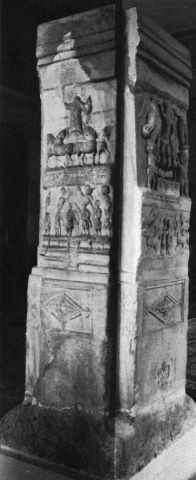
Base for bronze statue of Porphyrius, charioteer. Constantinople, Hippodrome. 500-510
Record details
Photographs
Inscription
FRONT FACE
Upper register, Base of Quadriga:
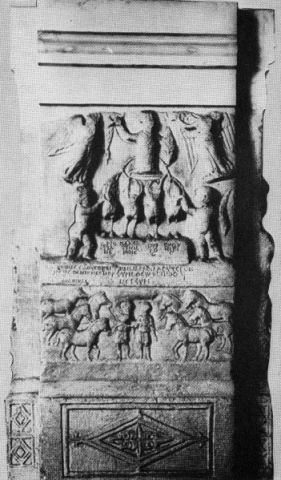
Ἀριστίδης, Παλαιστινιάρχης, Πυρρός, Εὐθύνικος
Band separating upper and middle register:
ὅλους ὧδε ὅλους ἐκεῖ καὶ διβέρσια δεύτερον μόνος ἐνίκησεν Πορφύρις ὁ εὐδόκιμος
LEFT SIDE
Surmounting epigram, according to Anthologia Planudea no. 340:
[Ἄλ]λοις παυσαμένοισιν, ἀ[εθλεύοντι δὲ μούνῳ]
[Π]ορφυρίῳ βασιλευς τοῦτο δ[έδωκε γέρας].
Πολλάκι νικήσας γὰρ ἑοὺς πό[ρεν ὠκέας ἵππους]
λάζετο δ’ἀντιπάλων καὶ πάλ[ιν ἐστέφετο.]
Ἔνθεν ἔην Πρασίνοις ἔρις ἄσπε[τος, ἔνθεν ἀϋτή.]
Ὡς Βενέτους, τέρψῃ, Κοίρανε κα[ὶ Πρασίνους]
Middle of upper register, above the heads of the horses:
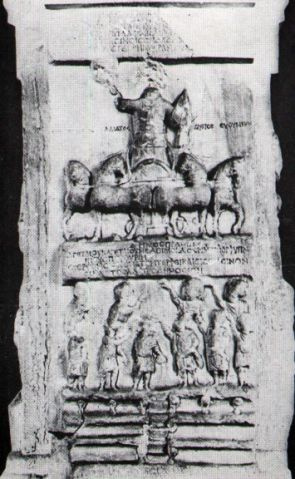
Νικοπόλεμος, Ῥαδιᾶτος, Πυρρός, Εὐθύνικος
Band separating upper and middle register:
δῆμος Πρασίνων·
ἄγεται οὐκ ἄγεται, οὐ μέλει μοι· δὸς ἡμῖν Πορφύριν,
ἵν’ οὓς Πορφύριν
ἔτερψεν εἰς Βένετον τέρψει καὶ εἰς Πράσινον
εἰ δ’ aὐτὸς λάβι τὸ δημόσιον
RIGHT SIDE
Surmounting epigram (Anth. Plan. 342):
[Αὐτὸν] Πορφύριον μὲν ἀπηκριβώσατο χ̣[αλκῷ]
[ὁ π]λ̣̣άστας ἔμπνουν οἷα τυπωσάμενος.
[Τί]ς δὲ χάριν, τίς ἄεθλα, τίς ἔνθεα δήνεα τέχνης
τεύξει, καὶ νίκην οὔποτ’ ἀμειβομένην;
Middle of upper register, above the heads of the horses:
Ἁλιεύς, Ἀνθύπατος, Κυναγός, Πελώριος
Inscription translation
FRONT FACE
Upper register, Base of Quadriga:
Aristides, Palestinarches, Pyrros, Euthynikos [= names of the horses]
Band separating upper and middle register:
All here and all there, and the diversium for a second time won only Porphyrius the highly esteemed.
LEFT SIDE
Surmounting epigram, according to Anthologia Planudea no. 340:
To others, when they came to an end, to Porphyrius alone when he was competing, the emperor gave this award. Because often after he won he conveyed his own fast horses, took over those of his rivals and was crowned again. Hence there was unspeakable jealousy at the Greens, hence battle shout: As you delighted the Blues, Master, do to the Greens as well!
Middle of upper register, above the heads of the horses:
Nikopolemos, Radiatos, Pyrros, Euthynikos [= names of the horses]
Band separating upper and middle register:
The faction of the Greens;
Whether it is in order or not, that does not matter much to me. Give us Porphyrius,
so that those Porphyrius
delighted by winning for the Blues he may delight by winning for the Greens.
If not, may he take the demosion himself.
RIGHT SIDE
Surmounting epigram (Anth. Plan. 342):
Him, Porphyrius, resembled the sculptor in bronze, so exactly he modeled him that he appears to breathe. Who will bring about the grace, the deeds, the divine inspiration of his art, and the victory that never was changed?
Middle of upper register, above the heads of the horses:
Halieus, Anthupatos, Kynagos, Pelorios [= names of the horses]
Bibliography
- Fıratlı, N., La sculpture byzantine figurée au Musée archéologique d'Istanbul, Paris 1990, 30-2 no. 63
Discussion
DESCRIPTION:
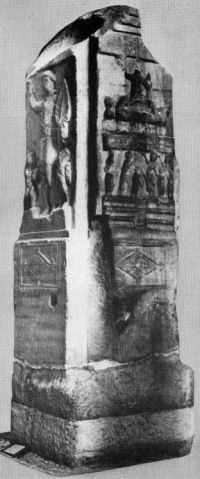
Tall marble base worked from one block, decorated on all sides. Top is irregularly broken, in the museum restored with plaster.
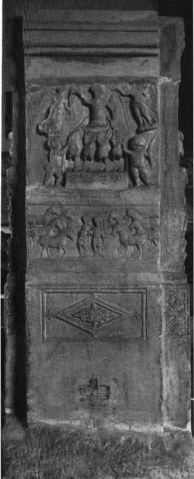
Front face: the victorious charioteer standing in his quadriga, in a triumphant pose, flanked by hovering victories; the quadriga is standing on a base flanked by putti (upper register). Two servants exchanging race horses (middle register).
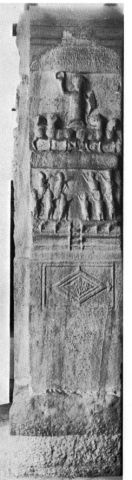
Both lateral faces: the charioteer in his quadriga, in triumphant pose, with horses shown in profile (upper register), applauding attendants (middle register).
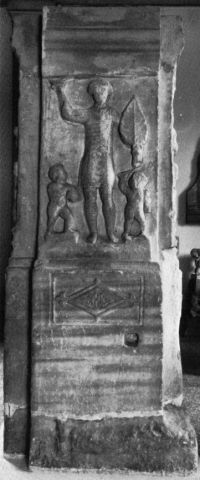
Back: Porphyrius in full figure in triumphant pose, but without quadriga; flanked by putti.
The lowest registers on all sides show a rosette set within a lozenge that is itself set within a rectangle. All sides once were surmounted by inscription panels (Cameron 1973, 14).
Besides the pictorial programme, all sides except the back preserve inscriptions, no less than 7 in all. Among these are the surmounting inscription panels on both lateral faces, both partly preserved (left: Anth. Plan. 340, right: Anth. Plan. 342) (for all the preserved inscriptions see the 'Record Detail' page). Additionally, the lost surmounting panels once bore the epigrams Anthologia Planudea 341 and 343 (Cameron 1973, 121).
Anthologia Planudea 341:
Αἱ πάντων ψῆφοί με καὶ εἰσέτι διφρεύοντα / ἔστησαν Νίκης ἐγγυθι Πορφύριον·/ δῆμος μὲν γὰρ ἐμὸς γέρας ᾔτεεν, οι δ’ ἕτεροί με δίζοντ’ αὖθις ἔχειν νεῖκος ἀπειπάμενοι·/ μήτι δ’ ἡνιόχων περιγίγνομαι, οἷσι καὶ ἵππους / κρείσσονας ἀντιπορῶν δεῖξα χερειοτέρους.
'The votes of all erected near to Victory the statue of me, Porphyrius, while still driving. For my own faction demanded the honour, and the opposite one desired to have me again, renouncing their hostility. I got the best of the other drivers by my cleverness, giving them in exchange for their own better horses and then showing them to be my inferiors.' (trans. W. R. Paton)
Anth. Plan. 343:
Εἰκόνι χαλκείῃ τὸν χάλκεον ἡνιοχῆα / ἄνθετο νικήτην κοιρανος Αὐσονίων / ὡς σοφόν, ὡς Βενέτοις περιλημένον· ἀλλ’ ἐπὶ νίκαις / Πορφυρίου πολλὰς εἰκόνας ὀψόμεθα.
'In a brazen image the Lord of the Latins set up the victorious driver, strong himself as brass, as being skilled and dear to the Blues; but we shall see many statues yet of Porphyrius erected because of his victories.' (trans. W. R. Paton)
PROVENANCE AND LOCATION:
Found c. 1845 in the second court of the Topkapı Saray (Firatlı), originally in the Hippodrome. Now in the Istanbul Archaeological Museum, inv. no. 2995.
HONORAND AND AWARDER:
Porphyrius was an extraordinarily successful charioteer who was awarded no less than seven statues, all set up in the Hippodrome at Constantinople and bearing a large number of recorded epigrams (Cameron 1973, 121 and 182 fig. 2). This statue was set up by the Blue faction.
DATE:
Porphyrius started his career c. 500 (Cameron 1973, 155); and was awarded four statues 'within about half-a-dozen years' of which this is the third (Cameron 1973, 121 no. B; 159, 166).
FURTHER DISCUSSION:
This is one of two extant bases for bronze statues of the charioteer Porphyrius from the Hippodrome (see, for the other, LSA-361). Further statues of the same athlete (LSA-499, LSA-500, LSA-501, LSA-502, LSA-503) are testified by recorded epigrams (in Anthologia Palatina and Anthologia Planudea). We have followed Alan Cameron's grouping of these epigrams, and hence his identification of the individual bases with their multiple inscriptions (Cameron 1973, cf. p. 121).
The Porphyrius monument belongs to a set of statues for charioteers, all set up within a period of no more than half a century in the latter half of the reign of Anastasius and the first half of the reign of Justinian. As Cameron argues (1973, esp. 222-258) this striking phenomenon was almost certainly the result of imperial politics, favouring the games in the Hippodrome over other forms of entertainment.
Discussion references
- Cameron, Al., Porphyrius the Charioteer, Oxford 1973
- Paton, W. R., The Greek Anthology in five volumes. V, London & New York 1926, 364-5
Cite: Last Statues of Antiquity, LSA-349 (Ulrich Gehn).