
LSA-357
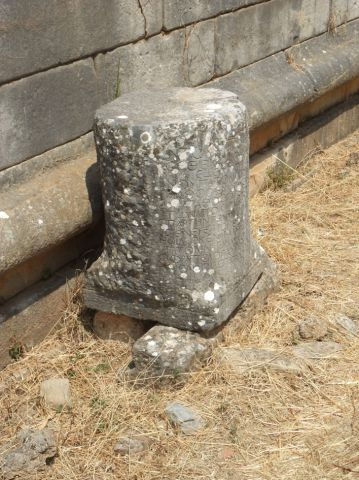
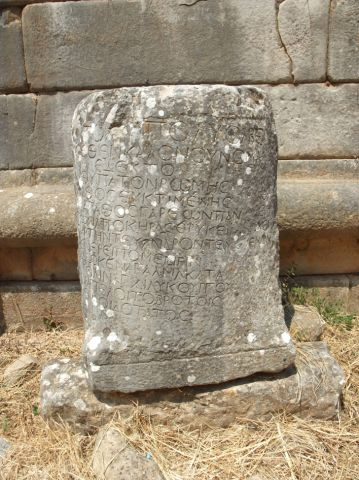
Base for statue of Anatolius, governor of Achaea. Sparta (Achaea). 375-388
Record details
Photographs
Inscription
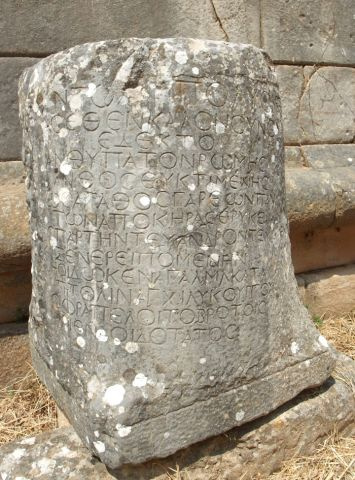
Ἀντολ̣[ί]η̣ πολύολβε, / σέθεν καλὸν οὔνομα / ἔδεκτο /
ἀνθύπατον Ῥώμης / (5) ἄνθος ἐϋκτιμένης. /
Ὡς ἀγαθὸς γὰρ ἐὼν πάν/των ἀπὸ κῆρας ἐρύκει /
Σπάρτην τ’ εὔανδρον τεῦ/ξεν ἐρειπομένην, /
(10) ἣ δῶκεν ἄγαλμ(α) κατὰ / πτόλιν ἄγχι Λυκούργου, /
ὄφρα πέλοιτο βροτοῖς / αἰὲν ἀοιδότατος.
Inscription translation
Wealthy Anatolia, from thee the proconsular flower of well-built Rome received his fair name. Being so good he saved Sparta, abounding in good men and true, from every grief, when it happened that she lay in ruins. She (Sparta) gave him a statue in the city, close to (that of) Lykourgos, so that he be always most famous to the people
Bibliography
- Feissel, D. & Philippidis-Braat, A., Inventaires en vue d’un recueil des inscriptions historiques de Byzance, 3. Inscriptions du Péloponnèse, (à l’exception de Mistra)., Travaux et mémoires, 9, Paris 1985, 267-395, p. 288 no. 26
Discussion
INSCRIPTION
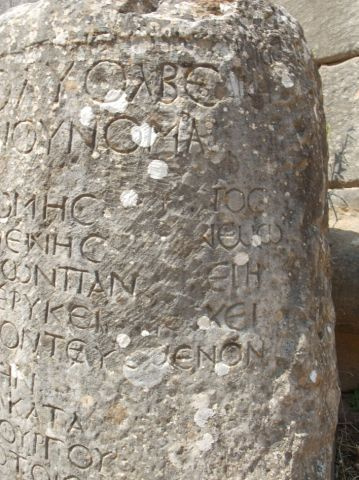
Verse inscription of three elegiac distichs laid out in 13 lines:
Ἀντολ̣[ί]η̣ πολύολβε, / σέθεν καλὸν οὔνομα / ἔδεκτο /
ἀνθύπατον Ῥώμης / (5) ἄνθος ἐϋκτιμένης. /
Ὡς ἀγαθὸς γὰρ ἐὼν πάν/των ἀπὸ κῆρας ἐρύκει /
Σπάρτην τ’ εὔανδρον τεῦ/ξεν ἐρειπομένην, /
(10) ἣ δῶκεν ἄγαλμ(α) κατὰ / πτόλιν ἄγχι Λυκούργου, /
ὄφρα πέλοιτο βροτοῖς / αἰὲν ἀοιδότατος.
'Wealthy Anatolia, from thee the proconsular flower of well-built Rome received his fair name. Being so good he saved Sparta, abounding in good men and true, from every grief, when it happened that she lay in ruins. She (Sparta) gave him a statue in the city, close to (that of) Lykourgos, so that he be always most famous to the people'.
The inscription celebrates the benefactions of the governor (proconsul) of Achaea Anatolius towards the city of Sparta.
Letters height: 5 cm (lines 1-2), 3 cm (lines 3-6).
DESCRIPTION:
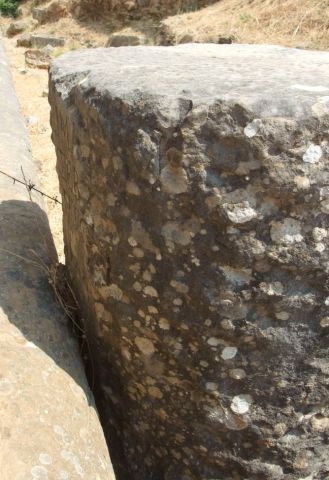
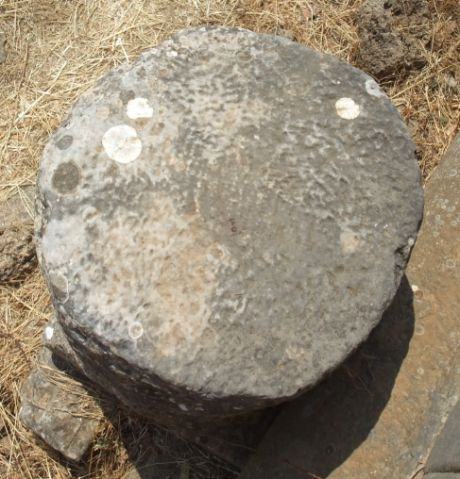
Columnar base of slightly irregular shape, cut from a rectangular base, as is visible from a trace of the original epigraphic field on the back. The bottom is formed by a rectangular rim (10 cm high), dressed with a claw and set off by an incised line. On both sides marble overlaps the rim.
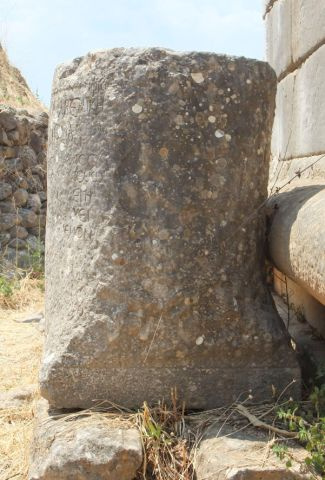
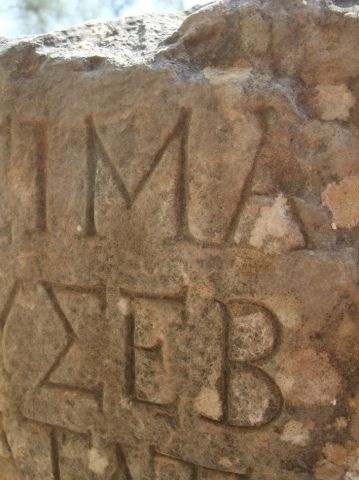
The base has been used twice in its current cylindrical form. Traces of the inscription of a first phase of reuse are still visible above the inscription that decorates the front surface; and to the right some syllables are preserved (see below). The epigraphic field of the latest inscription is dressed with a fine claw and partly polished, thereby erasing the older smoothly finished epigraphic field. The sides and back are very roughly finished with a point. At the back, a vertical strip (c. 13 cm high), with remains of the original inscription, is preserved.
The top is roughly finished with a claw, with no traces of support for statues. A break towards the upper edge of epigraphic field could be part of a clamphole. The surviving inscription (first published by Woodward) is off-centre and slopes downwards slightly towards the right.
Of the 2nd-use inscription, (on the same front side as the present inscription) we could still read:
ΦΙΣΙ / ΑΙΚΗ / - / - / --ΤΟΣ / ΝΕΜΩ / ---ΕΙΗ / ---ΧΕΙ / ΜΕΝΟΝ
Same inscription according to Woodward: l. 1--ε (ς?) καὶ φύσι ε—(φύσις?); l. 2: --λική l. 3: all erased, l. 4: all erased, l. 5: -- π̣ος; l. 6: -- νεμῳ l. 7: -- ειη l. 8: λ̣--ς̣ ἔχει l. 9: --ό̣μενον
Of the first-use inscription (on the original, rectangular base, now on the back), we were still able to read:
--ΕΙΜΑ-- /--Υ̣ΣΕΒ-- / --ΤΑΤΟ-- / --KΑΑ-- ? / --ΑΔΙ--?
LOCATION
The base is standing in the western parodos of the ancient theatre in Sparta.
HONORAND AND DATE
Anatolius was proconsul of Achaea (PLRE I 61 Anatolius 8). He was probably the same proconsul who awarded a statue for a pretorian prefect Probus in Athens (LSA-1). The latter is widely accepted to be the Sextus Claudius Petronius Probus (PLRE I 736-40, Sex. Claudius Petronius Probus 5) who held the praetorian prefecture of Illyricum three times, in 364, 368-375 and 383-. The duration of this last prefecture is not clear; but a secure terminus ante quem for the Athenian inscription (and therefore an approximate one for this Spartan base) is provided by Probus' death in 388. The ruins mentioned in the inscription probably allude to the earthquake of 375/6. Anatolius' governorship must therefore have occurred sometime in the period 375-388.
FURTHER DISCUSSION:
D. Feissel points out that πολύολβε in the epigram does not refer to Anatolius' wealthiness, as Groag had suggested.
Discussion references
- Feissel, D. & Philippidis-Braat, A., Inventaires en vue d’un recueil des inscriptions historiques de Byzance, 3. Inscriptions du Péloponnèse, (à l’exception de Mistra)., Travaux et mémoires, 9, Paris 1985, 267-395, p. 288 no. 26
- Groag, E., Die Reichsbeamten von Achaia in spätrömischer Zeit, Budapest 1946
- Jones, A. H. M. et al., The Prosopography of the Later Roman Empire. Vol. I 260-395, Cambridge et al. 1971 (1975)
- Robert, L., Epigrammes du Bas-Empire (Hellenica IV), Paris 1948, 63
- Woodward, A. M., Sparta. The Inscriptions., The Annual of the British School at Athens XXVII, 1925/6, 245-247
Cite: Last Statues of Antiquity, LSA-357 (Ulrich Gehn).