
LSA-358
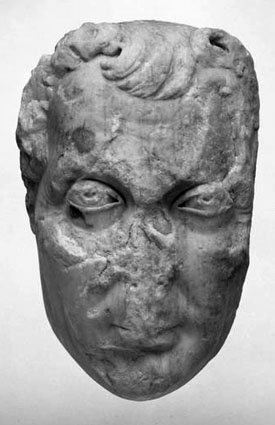
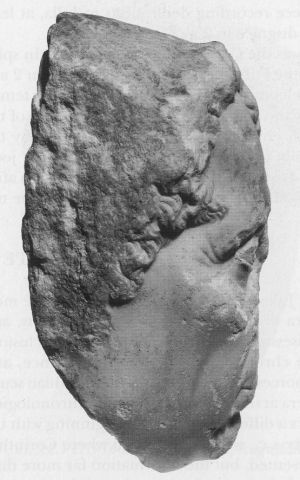
Male portrait head, probably of imperial office holder. Corinth. Late fourth to early fifth century
Record details
Photographs
Bibliography
- Vanderpool, C., Roman Portraiture, Williams, C. K. II & N. Bookidis, Corinth, the centenary, 1896-1996: Corinth XX, 369-384, Princeton 2003, pp. 379-80 fig. 22.13
Discussion
DESCRIPTION (Object)
Life-sized portrait head of a clean-shaven man in marble (Pentelic: Vanderpool 2003). Only the front half is preserved, nose and part of left forehead smashed, chipped around right eye and on chin.
PROVENANCE AND LOCATION
From the southwest corner of the Forum (Agora). Now in the Corinth Museum, inv. no. S-1977-13 (not on display).
DESCRIPTION (Subject)
Brushed-forward hairstyle, hair receding over the temples, a broad lock falling onto the forehead. Around the forehead the hair swells up to a modest 'wreath', partly drilled. Eyes protruding, iris incised, pupils drilled. Subtle modellings in the lower face, modest smile.
The Thessaloniki man wears a chlamys with tunic, the usual dress of high ranking imperial officials. Since few honorific monuments for military man are known, it seems more likely that the honorand was a member of the civil administration (see below, 'Honorand and Date' and 'Further Discussion').
HONORAND AND DATE
The head is very similar to another head from Kopanos, near Naoussa, between Veroea and Edessa in Macedonia, almost certainly to the same man, now in the Thessaloniki Archaeological Museum, which was brought to that Museum with a female 'pendant' head (Thessaloniki Museum inv. nos. 1060-1061; LSA-90 and LSA-91). Vanderpool dates them to the period 350-400 and argues that the man was a high ranking military man, possibly a general of Theodosius I (who, as Augustus of the East, had his headquarter in Thessaloniki in 379-380). L'Orange considered the Thessaloniki couple as examples of his 'subtle style', which he argued flourished around the year 400 (L'Orange 1961).
The late antique chlamys as representational dress of senatorial office holders is not testified to before the theodosian age, but appears massively in the archaeological record from that time onwards (obelisk base in Constantinople, city gate sarcophagi). This provides a terminus post quem of ca. 380; L'Orange's hypothesis that the vivid and subtle rendering of the facial features indicates a date in the early 5th century still holds. This opens a date range of ca 380-420 for our head.
FURTHER DISCUSSION
The twin portraits in Thessaloniki and Corinth could be explained either by subsequent offices in Macedonia and Achaea, or by an administrative rank covering both provinces (pretorian prefect, or vicar).
Discussion references
- L'Orange, H. P., 'Der subtile Stil. Eine Kunstströmung aus der Zeit um 400 n. Chr.', Antike Kunst , 4 (1961) 68-75
- Vanderpool, C., Roman Portraiture, Williams, C. K. II & N. Bookidis, Corinth, the centenary, 1896-1996: Corinth XX, 369-384, Princeton 2003, 379-80
Cite: Last Statues of Antiquity, LSA-358 (Amelia Brown/ Ulrich Gehn).