
LSA-361
Base for bronze statue of Porphyrius, charioteer. Constantinople, Hippodrome. 500-510
Record details
Photographs
Inscription
FRONT FACE
Upper register, above the band separating upper and middle register (remains of letters towards the right edge):
ΑΙ / Ν̣Ι̣Κ̣Η̣
Middle register, above the band separating middle and lower register:
...ΑΙ....Σ.... [Τ]ΩΝ ̣Π ̣̣Ρ ̣̣ΑΣ ̣̣Ι ̣̣ΝΩΝ[ΚΑΙ] ...
Lower register, upper angles.
Left:
+Σ ̣̣ΦΥ ̣̣ΡΙ / Χ ̣̣ΙΣΑ ̣̣ΜΜΑ / ..ΡΙΣ
Right:
Π .. Φ
BACK FACE
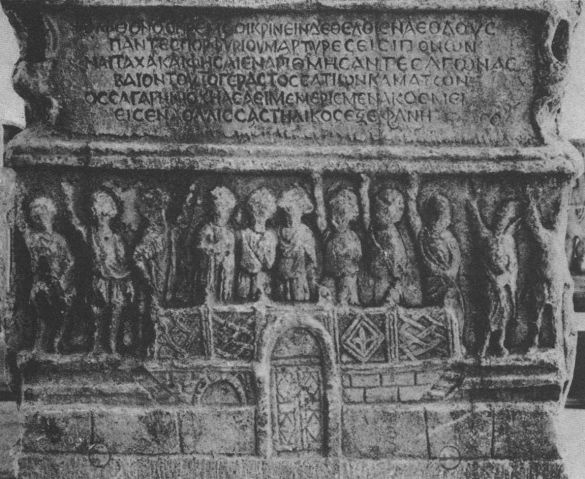
Surmounting panel (Anth. Plan. 352):
Πλάστης χαλκὸν ἔτευξεν ὁμοίϊον ἡνιοχῆϊ·
εἴθε δὲ καὶ τέχνης ὄγκον ἀπειργάσατο,
ὄγκον ὁμοῦ καὶ κάλλος ἅπερ φύσις ὀψὲ τεκοῦσα
ὤμοσεν „Ὠδίνειν δεύτερον οὐ δύναμαι.“
Ὤμοσεν εὐόρκοις ὑπὸ χείλεσιν· Πορφυρίῳ γὰρ
πρώτῳ καὶ μούνῳ πᾶσαν ἔδωκε χάριν
Upper register, above head of Tyche:
[Βη]ρ ̣̣̣υτ ̣̣̣ό ̣̣̣ς ̣̣̣
Band separating upper and middle register (Anth. Plan. 353):
+Εἰ φθόνος ἠρεμέοι, κρίνειν δ’ ἐθέλοιεν ἀέθλους,
πάντες Πορφυρίου μάρτυρές εἰσιν πόνων.
Ναὶ τάχα καὶ φήσαιεν ἀριθμήσαντες ἀγῶνας·
„Βαιὸν τοῦτο γέρας τοσσατίων καμάτων.“
Ὄσσα γὰρ ἡνιοχῆας ἀεὶ μεμερισμένα κοσμεῖ,
εἰς ἓν ἀολίσσας τηλίκος ἐξεφάνη.
LEFT SIDE
Surmounting panel (Anth. Plan. 356):
Ἄλλοις μὲν γεράων πρόφασις χρόνος· οἱ δ’ ἐπ[ὶ νίκαις]
κρινόμενοι πολιῆς οὐ χατέουσιν κόμης,
ἀλλ’ ἀρετῆς, ὅθεν εὖχος ἀνάπτεται, ἧς ἄπο [τοίων]
Πορφύριος δώρων δὶς λάχειν ἀγλαΐην,
οὐκ ἐτέων δεκάδας, νίκης δ’ ἑκατοντάδας [αὐχῶν]
πολλὰς καὶ πάσας συγγενέας Χαρίτων.
Upper register, above head of Tyche:
Νικομή[δεια]
Below upper register:
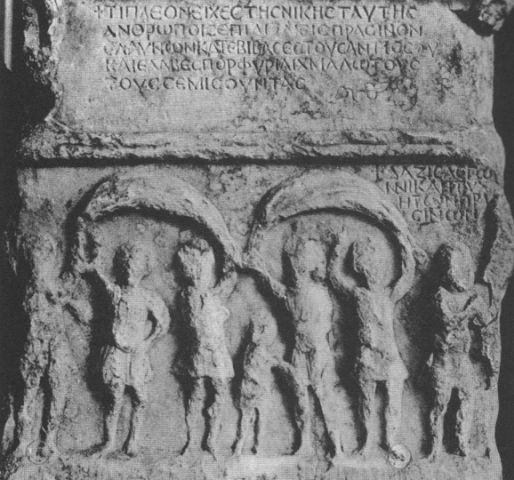
+Τὶ πλέον εἶχες τῆς νίκης ταύτης
ἀνθρώποις ἐπιδίξαι εἰς Πράσινον;
ἐλαύνων καταβίβασες τοὺς αντὶς σοῦ
καὶ ἔλαβες, Πορφύρι, αἰχμαλώτους
τούς σε μισοῦντας
Middle register, above the head of right dancer:
+Δάζις λέγω/ Νικᾷ ἡ τύχ-/ η τῶν Πρα-/ σίνων
RIGHT SIDE
Surmounting panel (Anth. Plan. 351):
Ὑ[μετέρων κήρυκες ἀμεμφέες εἰσὶν ἀγώνων]
[οἱ καὶ ἀπ’ ἀντιβίων] Πορφύριε, στέφανοι·
[πάντας γὰρ σταδιοί]σιν ἀμοιβαδὸν αἰὲν ἐλέγχει[ς]
[ἀντιτέχ]νους, τῆς σῆς παιγ[νι]ον ἱπποσύνης.
[Τοὔν]εκα καὶ ξεῖνον πρ[εσβ]ήϊον εὕρεο μοῦνος,
εἰκόνα χαλκείην δήμωι ἐν ἀμφοτέρωι.
Band below upper register:
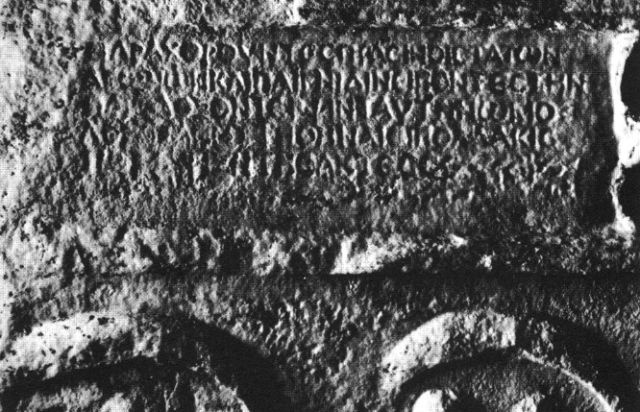
+Παραχοροῦντες Πρασίνοις τὰ τῶν
ἀγώνων, καὶ παιγνίδιν εἰπόντες τὴν
πα[ρά]δοξον τέρψιν ταύτην, ὡμο-
λόγ[ησα]ν ̣̣̣̣ ν ̣̣̣̣ι ̣̣̣̣κ ̣̣̣̣ηθῆναι, οἱ πολλάκις
Πο ̣̣̣̣ρ ̣̣̣̣φύ ̣̣̣̣ρ ̣̣̣̣ι ̣̣̣̣, ζ ̣̣̣̣ητήσαντές σε
Inscription translation
FRONT FACE
Upper register, above the band separating upper and middle register (remains of letters towards the right edge):
...victory...
Middle register, above the band separating middle and lower register:
... of the Greens [and] ...
Lower register, upper angles.
Left:
Right:
P[or]ph[yrius]
BACK FACE
Surmounting panel (Anth. Plan. 352):
The sculptor produced a bronze resembling the charioteer: But would that he had worked out also the vastness of his skill, the vastness together with the beauty, a thing which nature having it brought forth after a long while swore: "I cannot travail for a second time.“ She swore it with truthful lips, for to Porphyrius First and alone she gave all her gifts.
Upper register, above head of Tyche:
[Bei]rut
Band separating upper and middle register (Anth. Plan. 353):
If envy could be at rest and one would want to judge the contests [impartially], all men are witnesses of Porphyrius’ achievements.Yes, perhaps they would say, counting up his combats:
"A humble reward is this for so many toils.“
Because all that is distributed to the charioteers to adorn them forever, he gathered into one and appeared so great.
LEFT SIDE
Surmounting panel (Anth. Plan. 356):
For others, time is the motive of their rewards; those who because of their victories are judged [worthy], are not in need of grey hair, but of the virtue, to which vaunt is attached. Thanks to her [the virtue] Porphyrius twice gained the splendour of such gifts, not boasting of decades of years, but of many hundreds of victories and all of them akin to the Graces.
Upper register, abvoe head of Tyche:
Nikome(dia)
Below upper register:
What more would you want to show to the people but this victory for the Greens? On the course you have forced down those against you, and you took prisoners, Porphyrius, those who hate you.
Middle register, above the head of right dancer:
I, Dazis say: victory is the lot of the Greens
RIGHT SIDE
Surmounting panel (Anth. Plan. 351):
Blameless heralds of your achievements, Porphyrius, are the wreaths also from your adversaries. Because all the rival charioteers you put to a shame in the races, one after the other, always; they were a toy for your horsemanship.
And therefore you alone hast obtained a unusual honour, a brazen portrait statue in the area of both factions.
Band below upper register:
+Submitting the contests to the Greens, and saying that this outstanding entertainment was a child’s game for Porphyrius, they [the Blues] confess to be defeated, they who often sought you, Porphyrius.
Bibliography
- Fıratlı, N., La sculpture byzantine figurée au Musée archéologique d'Istanbul, Paris 1990, 32-4 no. 64
Discussion
DESCRIPTION
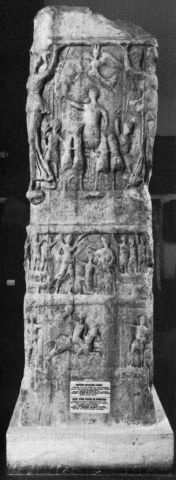
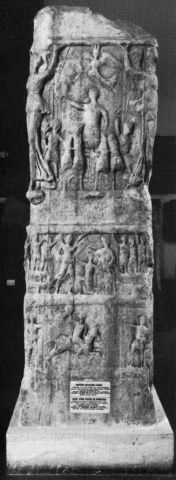
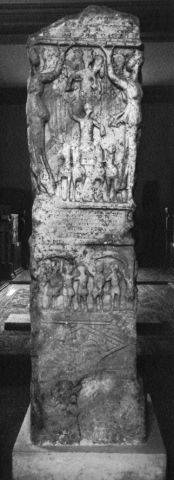
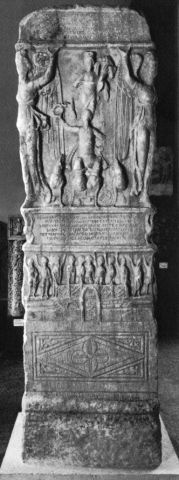
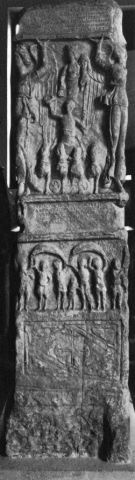
Tall marble base, decorated on all four sides with reliefs and inscriptions. Three registers on each side, in the upper four large victories decorate the corners.
Front, upper register: The victorious charioteer in his chariot flanked by Victories, with Fortune of the City hovering over his head. Middle register: Spectators hail the charioteer as he is crowned by a Victory. Lower register: Porphyrios riding a lap of honour.
Back, upper register: as front. Middle register: figures in and around the imperial box hail the charioteer above. Lower register: a rosette set in a lozenge set in a rectangle.
Both side faces, upper register: as front. Middle register: fans dance and celebrate with billowing capes over their heads. Lower register: as back.
Beyond the pictorial programme, all sides preserve several inscriptions (though some badly damaged), no less than 13 in all, some in verse, some in prose (for preserved inscriptions see the 'Record' page). Three of the surmounting inscription panels still bear the epigrams Anthologia Planudea nos. 351 (right), 352 (back), 356 (left); on the back face, a further epigram preserved in the Planudean Anthology (no. 353) is on the panel separating the upper and the middle register. Besides these, Planudean Anthology nos. 354, 355 almost certainly once decorated this monument (Cameron 1973, 121).
PROVENANCE AND CURRENT LOCATION
Found 1963 in Topkapı Saray (Istanbul), originally in the Hippodrome. Now in the Istanbul Archaeological Museum, inv. no. 5560.
HONORAND AND AWARDER
Porphyrius was an extraordinarily successful charioteer who was awarded no less than seven statues, all set up in the Hippodrome at Constantinople (Cameron 1973, 121 and 182 fig. 2). This statue was set up by the Green faction.
DATE
Porphyrius started his career c. 500 (Cameron 1973, 155) and was awarded four statues 'within about half-a-dozen years', of which this one is the second (Cameron 1973, 121 no. F; 159, 166).
FURTHER DISCUSSION:
This is one of two extant bases for bronze statues of the charioteer Porphyrius from the Hippodrome (see, for the other, LSA-349). Further statues of the same athlete (LSA-499, LSA-500, LSA-501, LSA-502, LSA-503) are testified by recorded epigrams (in Anthologia Palatina and Anthologia Planudea). We have followed Alan Cameron's grouping of these epigrams, and hence his identification of the individual bases with their multiple inscriptions (Cameron 1973, cf. p. 121).
The Porphyrius monument belongs to a set of statues for charioteers, all set up within a period of no more than half a century in the latter half of the reign of Anastasius and the first half of the reign of Justinian. As Cameron argues (1973, esp. 222-258) this striking phenomenon was almost certainly the result of imperial politics, favouring the games in the Hippodrome over other forms of entertainment.
Discussion references
- Cameron, Al., Porphyrius the Charioteer, Oxford 1973
Cite: Last Statues of Antiquity, LSA-361 (Ulrich Gehn).