
LSA-362
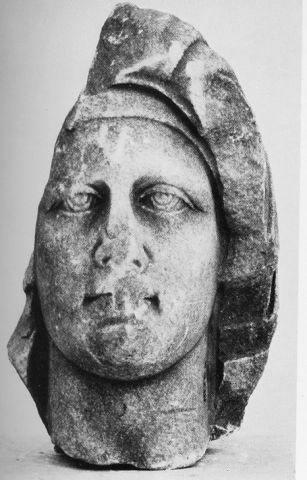
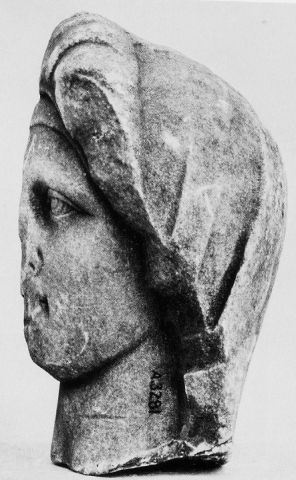
Veiled portrait head of woman, probably priestess. Perge (Pamphylia). Fourth or fifth century.
Record details
Photographs
Bibliography
- Fittschen, K., “Rez zu: Römische und frühbyzantinische Porträtplastik aus der Türkei: Neue Funde”, GGA 236 (1984), 207, no. 234 (re-used portrait of early second century)
- Inan, J. & E. Alföldi-Rosenbaum, Römische und frühbyzantinische Porträ̈tplastik aus der Türkei : neue Funde, Mainz 1979, 256, no. 234, pl. 167.1-2
Discussion
DESCRIPTION (Object)
Life-size portrait head, broken from statue. H: 23, W: 20 cm. Medium-grained white marble.
The head is broken at the base of the neck. The right side of the veiled head is mainly missing, and the edge of the veil is missing on the left side. The nose and lips are also missing. The eyebrows and chin are chipped.
The eyes are forcibly marked by two concentric engraved semi-circles. Within the inner arc are two contiguous drill holes.
PROVENANCE
Found at Nymphaeum (F2) in 1968. The Nymphaeum, located to the southwest of the Hellenistic city gate, was dedicated to Artemis Pergaia, the city, and the family of Septimius Severus.
DESCRIPTION (Subject)
The head represents an adult woman wearing a distinctive hair cap and veil. The face is a full oval with large, downward sloping, eyes and a broad mouth. It is impassive, unmoving, and without wrinkles or creases.
The head is completely covered. Directly above the tall brow is a tight-fitting band of material. Above this and carefully drilled away from it is the veil, the portion of the himation which is pulled over the head. It curves up and around a tall roll over the brow and then drapes more tightly over the rest of the head.
COSTUME
The tympanum relief from the Nymphaeum (A.Mansel, ‘Bericht über Ausgrabungen und Untersuchungen in Pamphylien in den Jahren 1957-1972’ Archäologischer Anzeiger 1975, 69, figs. 26-7) and a portrait statue found just north of the Nymphaeum (between Propylon H and niche wall H 1: J. Inan and E. Rosenbaum, Römische und frühbyzantinische Porträ̈tplastik aus der Türkei : neue Funde [Mainz 1979], 249-50, no. 228, pl. 161.2-3) show a woman wearing a similar combination of head scarf and veil. In both of these other cases the complete image and setting indicate clearly that this is the costume of the priestess of Artemis Pergaia.
DATE
The marking of the eyes with concentric circles and drill points is a technique not recorded on any securely dated portrait before the Tetrarchic period; see LSA-841. For this reason, Inan places the head in that period. Fittschen believes that the shape of the hair under the veil, with a tall frontal aspect, belongs to an early second century portrait with a hairstyle like that of Plotina. Thus, he believes that the eye-markings indicate a re-use of an older portrait. If this interpretation is correct, one cannot be sure that the costume still carried the original meaning. It may simply have been considered equivalent to the hair scarves worn by LSA-446 or LSA-8.
COMMENT ON CONTEXT
At the Nymphaeum, two over life-size portrait statues were found; a cuirassed portrait of Septimius Severus and statue of Julia Domna wearing a diadem. These stood in the aediculae to the south of Nymphaeum proper (over which went the above cited tympanum). An under life-size female portrait statue and a statue of a youth, both potentially imperial family members were also found at the Nymphaeum and presumably adorned the niches (five above and five below). This portrait head seems finer than the others and would have belonged to a statue as large as the imperial couple. Because heads can be moved readily from their original findspots, one wonders if this head did not come from the area north of the Nymphaeum F2.
Immediately north of the Nymphaeum was a propylon (H) leading to the southern baths and a wall with three niches for statues. One of the three bases is without inscription and the other two bear identical inscriptions for Plancia Magna, a local benefactor of the early second century who donated the gate and plaza. Three statues were found in front of the bases (A.Mansel, ‘Bericht über Ausgrabungen und Untersuchungen in Pamphylien in den Jahren 1957-1972’ Archäologischer Anzeiger 1975, 69, figs. 35-6). A statue of Plancia Magna, a statue of a male with a cithara, and a headless female statue, which may not have been originally made to go on the base. It is of suitable size and manufacture for this head, 1.61 m. Moreover, the base names Plancia as a priestess of Artemis Pergaia, and this solution would accommodate Fittschen’s suspicion that the head is a re-worked figure of the early second century.
Cite: Last Statues of Antiquity, LSA-362 (J. Lenaghan).