
LSA-363
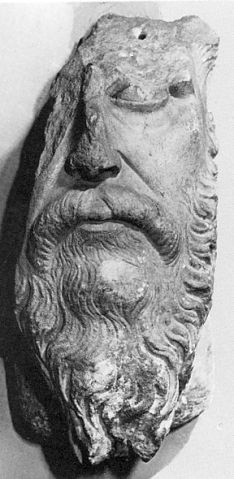
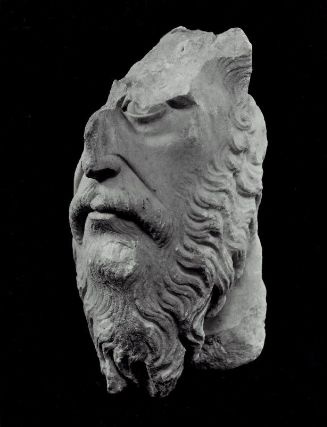
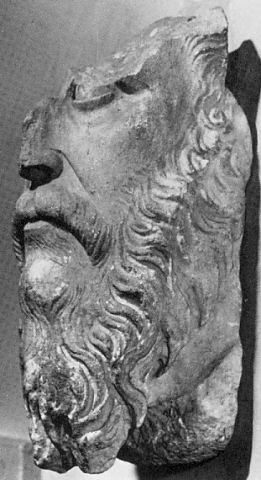
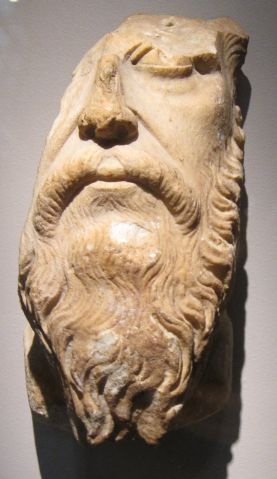
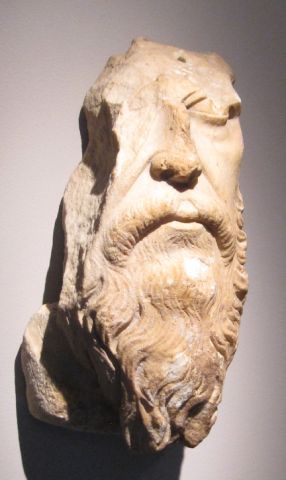
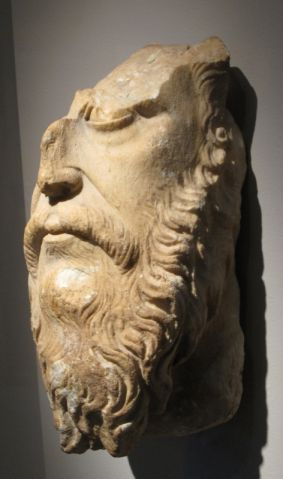
Fragmentary portrait head with long beard. From Assos. Fifth century.
Record details
Photographs
Bibliography
- Comstock, M.B. and C.C.C. Vermeule, Sculpture in Stone. The Greek, Roman, and Etruscan Collections of the Museum of Fine Arts Boston, Boston 1976, 238, no. 373
- Inan, J. & E. Alföldi-Rosenbaum, Römische und frühbyzantinische Porträ̈tplastik aus der Türkei : neue Funde, Mainz 1979, 156-7, no. 108, pl. 91.4-5
Discussion
DESCRIPTION (Object)
Over life-size portrait head, worked separately. H: 28.7 cm. W (at throat): 13.3 cm. Medium-grained white marble.
The head is broken from the right cheek to the brow and then across the brow. The back of the head has been deliberately taken off. The left eye and eye brow are chipped. The lower edge of the neck is rounded. The underside and side of the throat have been worked over with a claw-chisel. There is a pin hole on the left side of the brow.
The hair and beard are rendered with a combination of flat chisel and drill work. The iris is a broad ring which is about three-quarters of a circle. The pupil seems to be centrally placed and drilled.
PROVENANCE
The Agora in Assos.
DESCRIPTION (Subject)
The fragmentary head depicts a man with a long face and exceptionally long beard which has not been styled. The cheekbones project, the skin beneath the eyes hangs loosely, and the naso-labial folds are deep. The extant eye has a long narrow form, and the mouth is mainly concealed. The upper lip is covered by a thick moustache, and the beard begins directly under the lower lip.
DATE
The current statue of preservation makes it difficult to place the head chronologically. Neither the shape of the pupil nor the handling of the hair around the ears and nape, nor the fashion style are completely preserved. The long beard is well-rendered with a combination of flat-chisel and drill work, and the ring of the iris is incised. Thus, Fittschen concludes that the head belonged either to a Severan period portrait statue or a fifth-century one, such as LSA-318.
Inan and Rosenbaum compare the portrait to the Iamblichus type (LSA-110, LSA-111, LSA-112, LSA-113, LSA-114, LSA-115, LSA-116, LSA-894) and thus date it in the late third century. This is misleading since the head does not belong to the type but merely follows the same, diachronic tendency to show men with intellectual aspirations as long-bearded.
Vermeule dates it to 230-240 but notes that this sort of representation, ever more intensified, continues into the fifth century.
To this author, the head seems best placed in the fifth century. The width of the neck is disproportionately wide for the head; it is furthermore unusually flat. This suggests that the head has been worked over. Moreover, the curl at the left temple is markedly stylized, and the ring of the iris is exceptionally broad.
Discussion references
- Fittschen, K., “Rez zu: Römische und frühbyzantinische Porträtplastik aus der Türkei: Neue Funde”, GGA 236 (1984), 206, no. 108 (late Severan or fifth century)
Cite: Last Statues of Antiquity, LSA-363 (J. Lenaghan).