
LSA-364
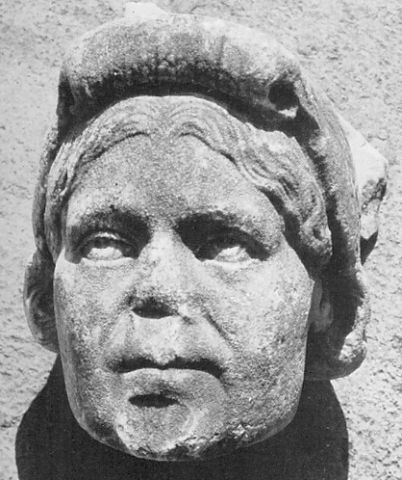
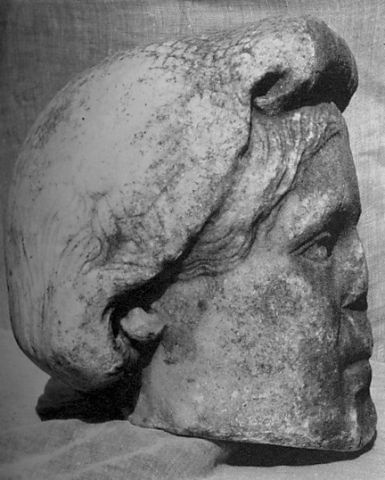
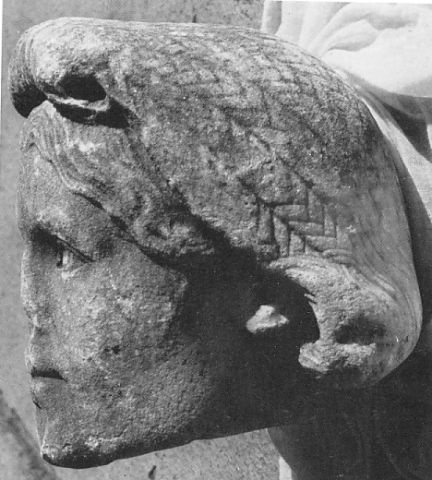
Portrait head of woman with broad central braid. From Asia Minor. Late third century.
Record details
Photographs
Bibliography
- Inan, J. & E. Alföldi-Rosenbaum, Römische und frühbyzantinische Porträ̈tplastik aus der Türkei : neue Funde, Mainz 1979, 167-8, no. 120, pl. 99 (Bergmann: Gallienic or late Gallienic)
Discussion
DESCRIPTION (Object)
Life-size portrait head. H: 22 cm. Large-grained white marble.
The head is broken at the top of the neck, directly behind the chin. The nose is missing, and there is a significant chip in the chin. The surface is weathered.
The pattern of the hair is carefully engraved with a flat chisel. The irises are incised semi-circles, and the pupils are defined by two contiguous drill points.
PROVENANCE
Unknown
DESCRIPTION (Subject)
The head represents an older woman with an elaborate hairstyle. She has a tall brow and a strong, square jaw. The eyes are long and narrow. The naso-labial folds are deep, and the mouth is broad. The upper lip has a pronounced central dip.
The hair is parted at the centre and around the brow is thin, long, and mainly straight; at the left temple is an unusual thick curly lock. The hair is pulled back, collected behind the ears, and then looped upwards. Just before the brow, this section of hair is twisted under itself in a broad and tall roll. At the back the looped hair is rendered as individual strands. At the ears, these strands turn into plaits, which become ever tighter and smaller as they arrive at the roll.
DATE
The head has been dated on the basis of the hairstyle to the 270s by Bergmann. In the catalogue of Inan and Rosenbaum, she reasserts this date and makes a comparison to a local male portrait for the facial features (J. Inan and E. Rosenbaum, Roman and Early Byzantine Portrait Sculpture in Asia Minor [Oxford 1966], no. 238, pl. 131.3-4); that portrait is, however, badly damaged.
The fashion hairstyle is a variation of the central braid style worn by Ulpia Severina. The location and breadth of the roll of hair at the brow as well as the modelled appearance of an elderly face recall details of the female portrait on the Annona Sarcophagus in Rome, generally dated on the basis of the male portrait to the 270s. LSA-1242 provides another example of this type of portrait.
Here the central braid, which runs up the back of the head, is unusually broad, covers most of the ears, and is not, in fact, braided until it reaches the height of the ears. In these details this portrait diverges from the metropolitan examples and best resembles other portraits from Asia Minor, LSA-433, LSA-434, LSA-435. Thus, it seems best to place the head in a wider chronological range.
Discussion references
- Bergmann, M., Studien zum römischen Porträt des 3. Jahrhunderts n. Chr., Bonn 1977, 185, pls. 53.4 and 54.3 (270s)
Cite: Last Statues of Antiquity, LSA-364 (J. Lenaghan).