
LSA-367
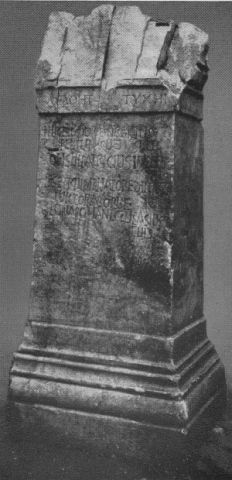
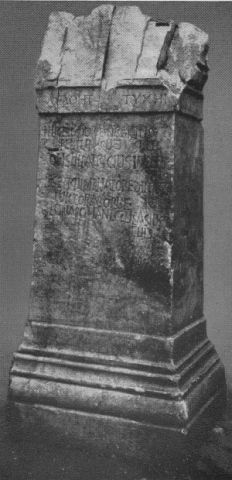
Base for statue of Basiliscus, consul and military commander. Philippopolis (Thracia). 465-474
Record details
Photographs
Inscription
Ἀγαθῇ τύχῃ.
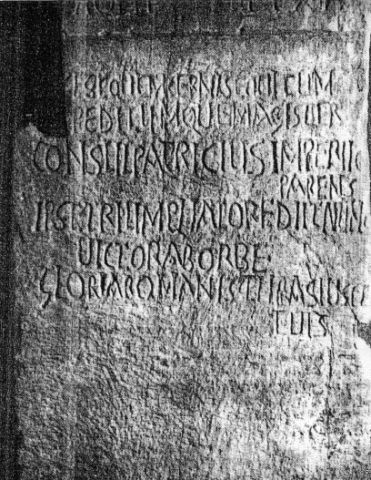
Hic est quem cernis equitum / peditumque magister, / consul, patricius, imperii(que)
parens. /
Ipse triumphator (r)ediit nunc / victor ab orbe. /
Gloria Romanis, tu Basilisce,
tuis.
Inscription translation
To Good Fortune.
He whom you see is the master of the cavalry and the infantry, consul, patricius, and father of the empire. This man now returns triumphant, victorious all over the world. You, Basiliscus, a glory to your Romans.
Bibliography
- Beševliev, V., Spätgriechische und spätlateinische Inschriften aus Bulgarien , Berlin 1964, no. 206 fig. 229
- L'Année épigraphique, , 1937, 98
Discussion
INSCRIPTION
In seven lines (one in Greek, followed by four lines of Latin verse, set over six lines of inscription):
Ἀγαθῇ τύχῃ.
Hic est quem cernis equitum / peditumque magister, /
consul, patricius, imperii(que) parens. /
Ipse triumphator (r)ediit nunc / victor ab orbe. /
Gloria Romanis, tu Basilisce, tuis.
'To Good Fortune.
He whom you see is the master of the cavalry and the infantry, consul, patricius, and father of the empire. This man now returns triumphant, victorious all over the world. You, Basiliscus, a glory to your Romans.'
Letter height: 2.5 - 5.5 cm.
DESCRIPTION (from Beshevliev and the published photographs)
Stone base with large mouldings on three sides at top and bottom, badly broken at the top: H 180, W 60, D 50 cm. A small piece with part of the inscription at the top left is missing. The Greek 'Agathe Tyche' on the upper framing band belongs to an older inscription, the rest of which has been erased to make way for the present one. The six lines of Latin inscription are irregular and, on two lines (3 and 6), the final words are added at the end below the line. On the right side of the base, at the bottom, the letters 'AU.../ HICES QUI' are legible (Danoff 1936, 81).
PROVENANCE AND LOCATION
Excavated in May 1935 in Tsar Ivan Sisman square in Plovdiv. Now in the Plovdiv Archaeological Museum, inv. no.1786.
HONORAND, AWARDER, AND DATE
Basiliscus was the brother of the empress Verina and brother-in-law of Leo I, and himself reigned as Augustus in 475-6 (PLRE II 212-14, Basiliscus 2). He was magister utriusque militiae in Thrace 464-67/8, defeating the Goths, and consul in 465. In 471 he aided Leo against Aspar and was awarded a triumph.
Our inscription does not record who awarded this statue. A similar statue to a general, at nearby Augusta Traiana, was awarded by the city (LSA-10), but this is not stated here.
Basiliscus' statue must be related to his military achievements in the region. The inscription records his consulship (in 465), but not his status of caput senatus, awarded in 474. It may well date to the principal period of Basiliscus' activity in Thrace, hence 465-8.
FURTHER DISCUSSION
This is one of a very few monuments for military men and markedly late for a statue in the Balkans. It can, however, be paralleled by a statue erected in nearby Augusta Traiana, to the general Aspar, which we believe was of roughly this same period (LSA-10). These two bases, if they are approximately contemporary, represent an interesting twist in the tail of the statue habit. In the troubled circumstances of the 5th-century Balkans, two generals (who traditionally had not been honoured with statues in the provinces) were awarded statues. Local communities in this part of the emprire may have realised that it was no longer governors whose favour they needed, but that of military men.
Discussion references
- Danoff, C. M., Neue Inschriften aus Bulgarien, Jahreshefte des Österreichischen Archäologischen Instituts in Wien 30, Beiblatt 78-86, Wien 1936, 81-4 no. III
- Martindale, J. R., The Prosopography of the Later Roman Empire. Vol. II A.D. 395-527, Cambridge 1980, Fl. Basiliscus 2
Cite: Last Statues of Antiquity, LSA-367 (Ulrich Gehn).