
LSA-368
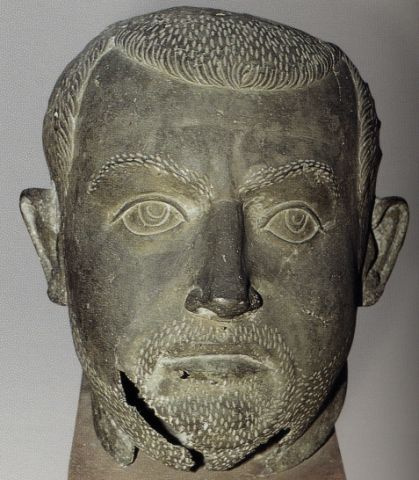
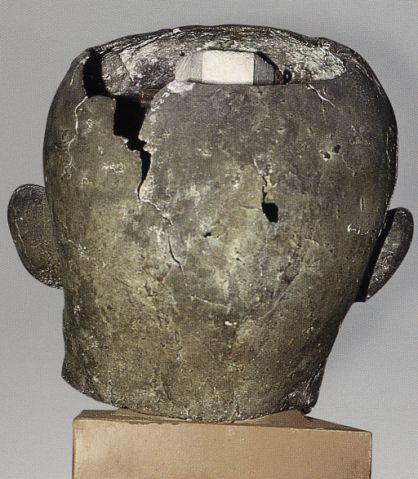
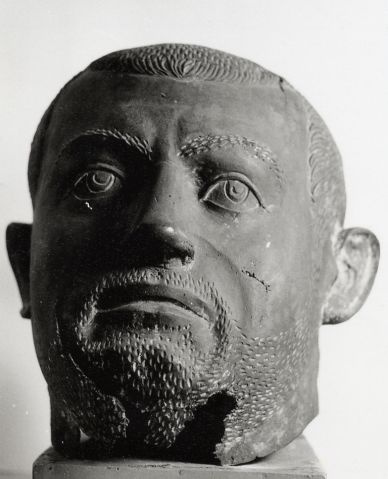
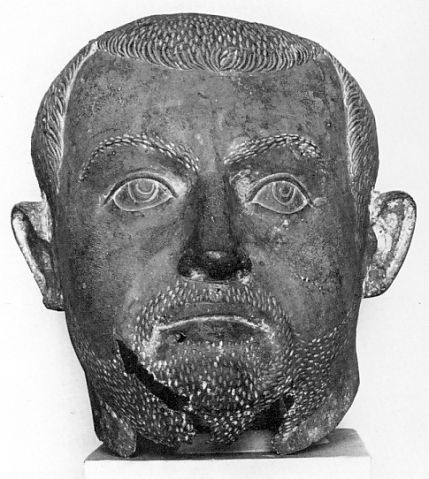
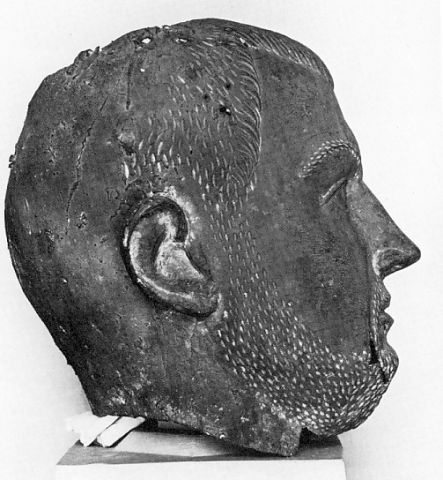
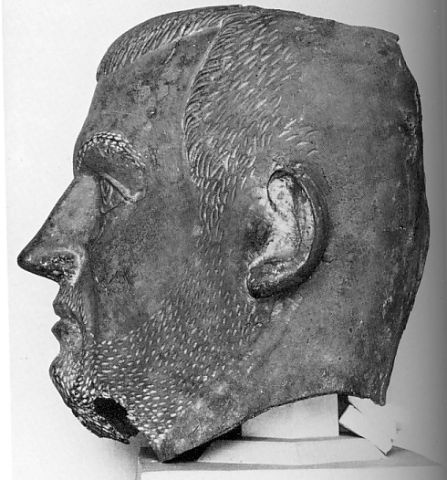
Bronze portrait head from nude statue of Tetrarch. From Adana. Late third to early fourth century.
Record details
Photographs
Bibliography
- Inan, J. & E. Alföldi-Rosenbaum, Römische und frühbyzantinische Porträ̈tplastik aus der Türkei : neue Funde, Mainz 1979, 269-270, no. 255, pl. 182
- Lahusen, G. and E. Formigli, Römische Bildnisse aus Bronze : Kunst und Technik, Munich 2001, 311-13, no. 193, figs. 1-9 and a-b
Discussion
DESCRIPTION (Object)
Over life-size portrait head, worked separately from statue. H: 37.8 , W: 37.6 cm. H (chin to crown): 35.5 cm. Bronze.
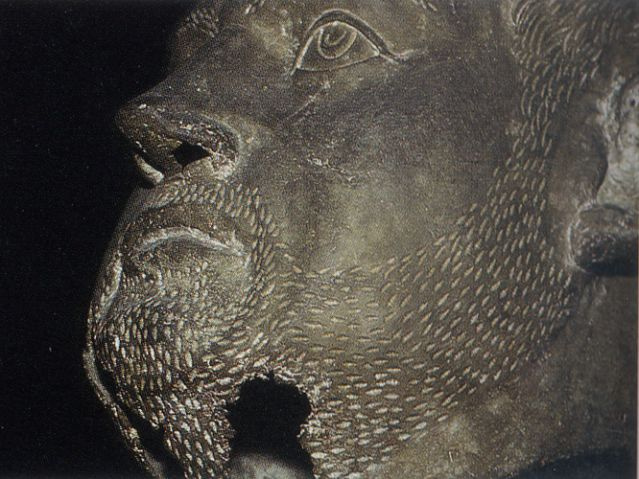
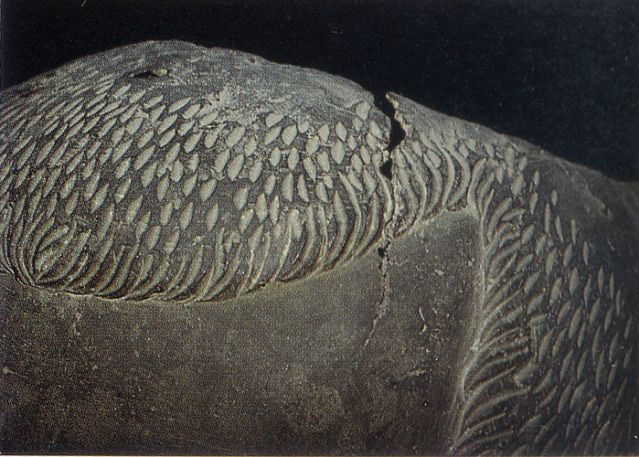
The head is preserved to an edge at the top of the neck which has some chips. There are holes under the chin made for the attachment to the body. Further holes and cracks are located at the back of the head. Fragments of the statue include a portion of naked body and a portion of the paludamentum fastened on the left shoulder. This was reported in passing by L. Budde, ‘Imago Clipeata des Kaisers Traian in Ankara’ Antike Plastik IV (1965), at page 113. Thereafter it appears in all authors without emendation or illustration.
The hair of the eyebrows, beard, moustache, and of parts of the head is rendered with schematic taps of the chisel. Only the hair touching the brow is more carefully worked with longer strokes of the chisel. Behind the ears the hair is not rendered at all. The iris is an engraved ring which is about three-quarters of a circle. The pupil is also an engraved ring of about three-quarters of a circle.
PROVENANCE
Recorded as from Adana.
DESCRIPTION (Subject)
The head is over life-size and was found with fragments of a naked statue wearing a paludamentum over the left shoulder. It shows a mature man with a short-cropped beard, moustache, and hairstyle. The hair is brushed forward on the brow and recedes at both temples.
The face is heavy-set with some modelling under the eyes and creases at the nabo-lasial folds. The brow is creased; the eyebrows arch over wide eyes; the nose is pointed; and the mouth is broad with down-turned corners.
DATE
The fashion style of hair and beard belong after the middle of the third century. The simple and schematic rendering and generally cubic structure of the head find closest parallels in Tetrarchic portraiture: See, for example, the portraits of Licinius LSA-325, LSA-373, and LSA-687 or a porphyry portrait from Antioch LSA-523. Meischner compares it to LSA-382. Rosenbaum, Smith, Meischner, and Lahusen all date it to the Tetrarchic period.
HONORAND
The large size of the statue indicates that it represented an Emperor. The nude costume is also appropriate for this identification. Meischner and Lahusen believe that it may represent Licinius. Lahusen adds that the head may have worn a crown or diadem. This might explain why the hair ceases to be rendered behind the ears.
Discussion references
- Meischner, J., Die Porträtkunst der ersten und zweiten Tetrarchie bis zur Alleinherrschaft Konstantins: 293 bis 324 n. Chr., Archäologischer Anzeiger 1986, 223-250, Berlin 1986, 233-4, 240-44, figs. 12 and 23 (possibly Licinius)
- Smith, R.R.R.,'The public image of Licinius I: Portrait sculpture and imperial ideology in the early fourth century', JRS 87, 1997, 182, pl. 9.2
Cite: Last Statues of Antiquity, LSA-368 (J. Lenaghan).