
LSA-369
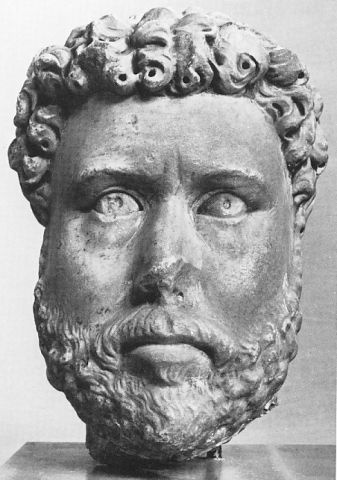
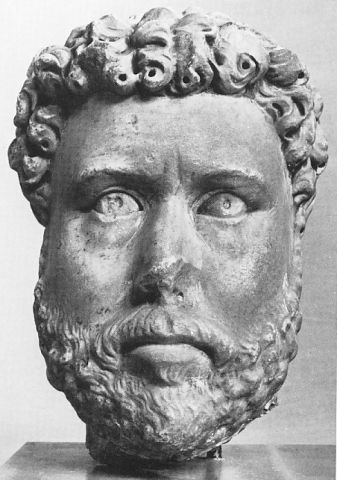
Portrait head of bearded man with thick curly hair. From Seleucia Pieria (Syria). Fourth century.
Record details
Photographs
Bibliography
- Inan, J. & E. Alföldi-Rosenbaum, Römische und frühbyzantinische Porträ̈tplastik aus der Türkei : neue Funde, Mainz 1979, 278-9, no. 268, pl. 192
Discussion
DESCRIPTION (Object)
Life-size portrait head. H: 21 , W: 17.5 cm. Fine-grained white marble.
The head is broken at the top of the neck. Both ears and the tip of the nose are chipped.
Most of the hair on the head and in the beard is rendered with a flat chisel. There is, however, significant drill work in the locks over the brow and in front of the ears. The face preserves rasp marks. The irises are unmarked but the right pupil is a large crescent-shaped depression and the left pupil is a drill hole.
The drilling of the hair around the brow, which creates deep shadows and corkscrew locks, and the marking of the pupils are not in keeping with the rendering of the rest of the head. They indicate a second use, to which also the rasp marks on the face and the awkward brow may be attributed.
PROVENANCE
Seleucia Pieria.
DESCRIPTION (Subject)
The head turned to its left and represents a bearded man with thick wavy hair. The hair builds in to a curly wreath over the brow. The beard and moustache are also full and are both more carefully rendered on the more visible right side of the face.
The brow is tall, and flat, with vertical creases over the root of the nose. The root of the nose is deeply indented and the lower face juts out beneath it. The eyes are close-set and hooded by the eyebrows. The face below the brow is broader and the cheeks swell beneath the hollows of the eye sockets. These details make the man seem plump.
DATE
The eye markings and drilling of the hair around the face, which creates almost creates a wreath hairstyle, belong to a second use. Rosenbaum generally dates this to the late antique period. It most probably belongs in the second half of the fourth century. The portraits of Oecumenius from Aphrodisias, LSA-150, and from Cyprus, LSA-869 are comparable and have a secure date in the later fourth century. On the basis of the back and top of the head, the first use was Hadrianic or early Antonine in date.
Cite: Last Statues of Antiquity, LSA-369 (J. Lenaghan).