
LSA-372
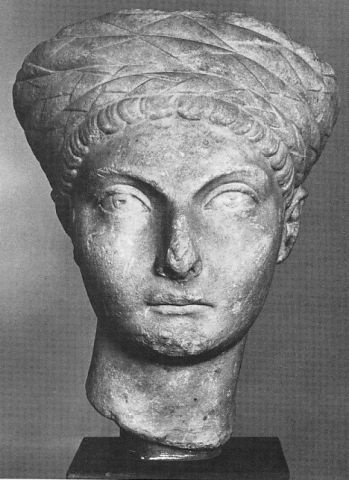
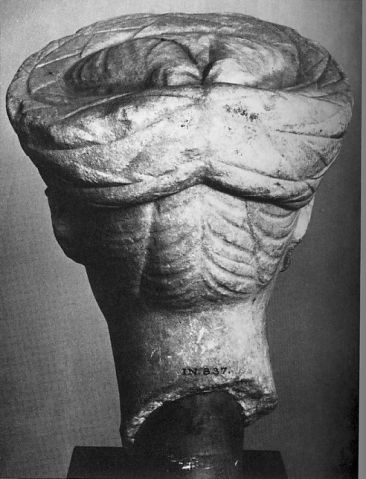
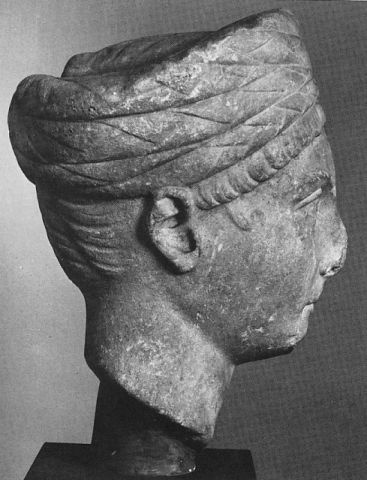
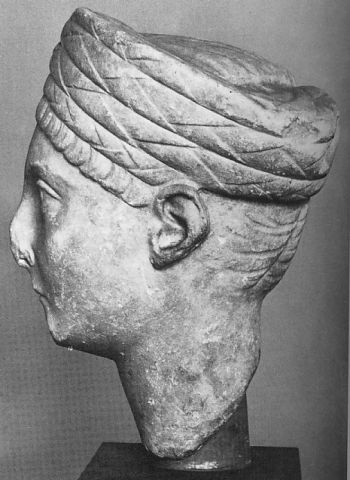
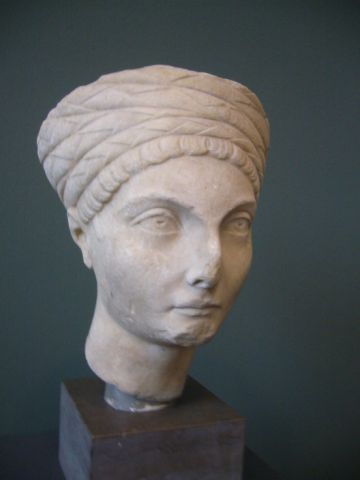
Portrait of woman with turban hairstyle, re-used? From Asia Minor. Fourth century?
Record details
Photographs
Bibliography
- Inan, J. & E. Alföldi-Rosenbaum, Römische und frühbyzantinische Porträ̈tplastik aus der Türkei : neue Funde, Mainz 1979, 309-310, no. 306, pl. 216
- Johansen, F. , Catalogue of the Roman Portraits III; Ny Carlsberg Glyptotek, (Copenhagen 1995), 176-7, no. 77 (mid-fourth c.)
Discussion
DESCRIPTION (Object)
Over life-size portrait head, separately worked. H: 28, W: 22 cm. H (chin to crown): 22.5 cm. Fine-grained white marble.
The head is preserved to the bottom of the neck. At the back this is higher than at the front. This is normal for separately worked heads that would be set into draped statues. The tip of the nose and edges of the ears are chipped.
The hair is rendered with a flat chisel. The eyebrows have been finely feathered with a small chisel. The irises are engraved and are three-quarters of circles. The pupils are located low within the iris and are a fine, flat crescent-shaped hollow.
PROVENANCE
Purchased in Istanbul in 1890 and thus securely from the Greek East, and probably from Asia Minor.
DESCRIPTION (Subject)
The separately-worked and over life-size head comes probably from a statue.
DATE
The turban hairstyle represented in this portrait was worn in the early second century; Fittschen in 1983, 63-5, under no. 85 covers this convincingly. He, von Sydow, and Bergmann have all argued that the head should not be dated to the fourth century as von Heintze, Inan, and Johansen assert.
That the head was originally created in the second century does not explain two details which have led to the fourth-century date: 1) the distinctive marking of the pupils, and 2) the fine, engraved, and high-arching ridge of the eyebrows. Fittschen responds to point 2 with a comparison to a head, now in Florence which has a similar hairstyle, unmarked eyes, and what he considers to be similar eyebrows. From photographs, this is difficult to assess, and this author suspects that the asymmetrical eyes of the head in Florence are not entirely antique. The lack of response to point 1 suggests that the eye drillings of the Copenhagen head are simply considered modern by these scholars.
The Copenhagen portrait shows two further details that have not been discussed: 3) the lower face is small and recessed; 4) the hair of the fringe is cut short in locks that are brushed forward. The angle made by the line of the chin and the neck is greater than 90 degrees which means that the head, almost assuredly from a statue, looked straight forward on a sloping neck; the re-worked portrait head LSA-409 of a forward-looking woman shows the expected angle and proportions between chin and neck. Thus the shortness from chin to neck means that the portrayed either had a distinctive lack of chin or that material has been cut away. The fringe hair is stiffly rendered in short thick locks which curve inwards over the brow; at the centre of the brow, the meeting is awkward. In second-century turban hairstyles, short fringes are unusual since the turban consists of long hair that is wound around the head in braids. This fringe recalls male fringes of the Constantinian periods (see, for example, LSA-596, Constantine or a son of Constantine).
Therefore, to this author it seems probable that the original portrait head of early second date, was re-used in the fourth century. Other clear examples of this phenomenon include LSA-976 from Rome and LSA-1224 without provenance.
Discussion references
- Bergmann, M. Review of W. v. Sydow, Zur Kunstgeschichte des spätantiken Porträts im 4. Jahrhundert n. Chr., Jahrbuch für Antike und Christentum 15, 1972, 214-25, Münster/ Westfalen 1973, 223 (second century)
- Fittschen, K., “Rez zu: Römische und frühbyzantinische Porträtplastik aus der Türkei: Neue Funde”, GGA 236 (1984), 208, no. 306
- Fittschen, Klaus and P. Zanker, Katalog der Porträts in den Capitolischen Museen und den anderen kommunalen Sammlungen der Stadt Rom, Band III , Mainz 1983, 64, no. d
- Sydow, W. von, Zur Kunstgeschichte des spätantike Porträts im 4. Jahrhundert. n. Chr, Bonn 1969, 151, fns. 25-29 (125-150)
- von Heintze, H. ‘Ein spätantikes Mädchenportät in Bonn. Zur stilitischen Entwicklung des Frauenbildnisses im 4. und 5. Jahrhundert’, Jahrbuch für Antike und Christentum 14, Münster 1971, 78, no. V 1, pl. 13b (360-390)
Cite: Last Statues of Antiquity, LSA-372 (J. Lenaghan).