
LSA-373
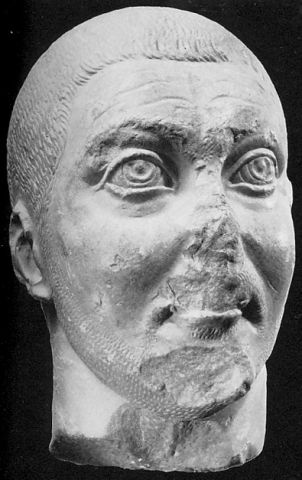
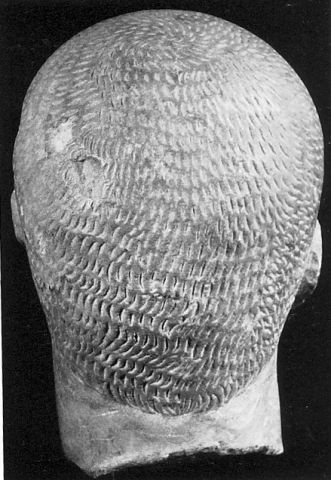
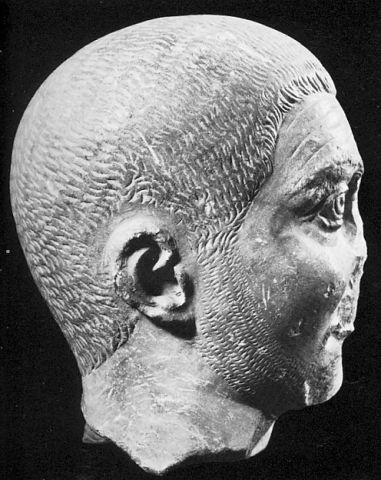
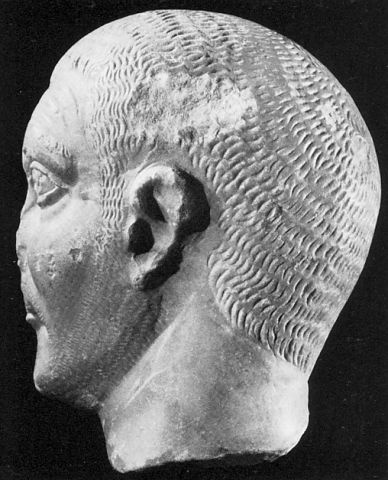
Portrait head in the Vienna-Izmir type, probably Licinius. From Asia Minor. Early fourth century.
Record details
Photographs
Bibliography
- Inan, J. & E. Alföldi-Rosenbaum, Römische und frühbyzantinische Porträ̈tplastik aus der Türkei : neue Funde, Mainz 1979, 312-13, no. 309, pl. 219
- Salomonson, J.W. 'Ein Porträtkopf der Tetrarchenzeit in Leiden', Bulletin antieke beschaving 39, Leiden 1964, 180-184, figs. 1-4
Discussion
DESCRIPTION (Object)
Over life-size head, separately worked. H: 28 cm. Fine-grained white marble.
The head and neck are preserved. The right lower edge of the neck appears to be chipped. The nose, upper lip, most of the chin, and the adam’s apple are missing. There are chips in the rims of the ears. The chip in the head above the left ear appears to be modern, possibly made by the plow or shovel which struck it.
The hair of the head and beard is rendered in repetitive and schematic strokes of a flat chisel. In front of the ears and over the brow, the strokes are longer and follow a more naturalistic pattern.
The irises are engraved and are three-quarters of circles. The inner canthi are also set off by engraved lines. The pupil is defined by a drilled U-shape which almost fills the area within the irises.
This portrait represents a second use of the head. An earlier, fuller hairstyle has been cut down. The beard is engraved into the cheeks; the eyebrows have been raised; and the eyes enlarged and marked.
PROVENANCE
Allegedly found by farmers in the vicinity of Istanbul. Acquired ‘shortly’ before 1964 when it was published by Salomonson.
DESCRIPTION (Subject)
The head turns to its right and portrays a bearded man with short-cropped hair and large eyes. It is a version of a type known in two colossal heads (LSA-325<k and LSA-687<k) and referred to by modern scholars as the Vienna-Izmir type.
The cap of hair has a uniform volume. It falls high on the brow, is cut short around the ears, and ends at the base of the skull. The hair is mainly combed forward. Around the brow it is longer, with ends that bend to the proper left. The moustache and beard are also carefully trimmed; the beard covers only the area around the jawline.
The brow is curved and has furrows that run parallel to the eyebrows and a vertical crease at the centre. The eyes are large, and the eyebrows, with carefully delineated hair, follow a high arch. The cheeks beneath the eyes are rounded and protrude between the hollows of the eye sockets and the deep naso-labial folds. The mouth has up-turned corners. The chin recedes beneath a projecting lower lip.
DATE
For stylistic reasons (the shape of the head and the rendering of the hair) Salomonson and Rosenbaum both dated this head to the Tetrarchic period: L’Orange in 1984 even proposed to identify it as Maximinus Daia. Fittschen protested that the head should be consistently dated with LSA-325<k and LSA-687<k, which he saw as related typologically and which he and all others had dated to the fifth century AD. Smith resolved the problem by demonstrating that LSA-325<k and LSA-687<k probably represented Licinius and that this head in Leiden was a version of the same type. The key indicators that it follows the same type are the vertical line through the forehead and the smiling mouth.
Discussion references
- Fittschen, K., “Rez zu: Römische und frühbyzantinische Porträtplastik aus der Türkei: Neue Funde”, GGA 236 (1984), 208-209, under no. 308
- L'Orange, H. P., Das spätantike Herrscherbild von Diokletian bis zu den Konstantin-Söhnen, 284-361 n. Chr. Das Römische Herrscherbild. III. Abteilung ; Bd. 4 , Berlin 1984, 113 (Maximinus Daia)
- Meischner, J., 'Das Porträt der valentianischen Epoche,', Jahrbuch des Deutschen Archäologischen Instituts, 107 (1992), 217-34, pl. 87-91, pl. 87.3
- Smith, R.R.R.,'The public image of Licinius I: Portrait sculpture and imperial ideology in the early fourth century', JRS 87, 1997, 189, pl. 6.1
Cite: Last Statues of Antiquity, LSA-373 (J. Lenaghan).