
LSA-375
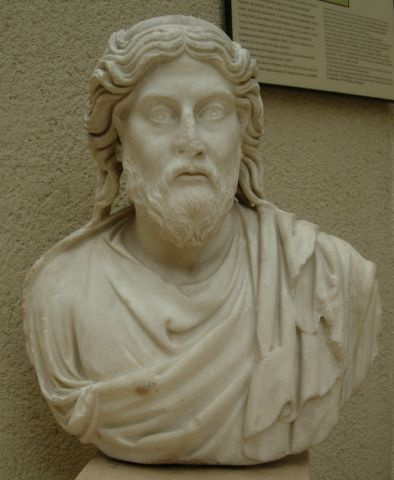
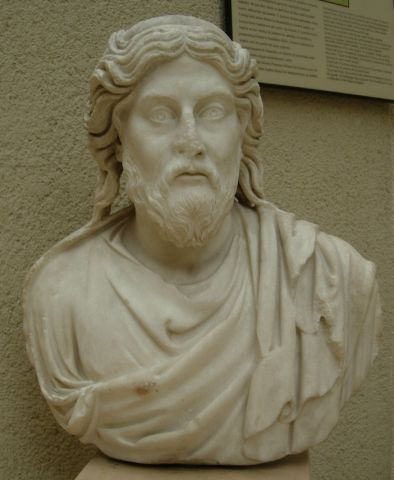
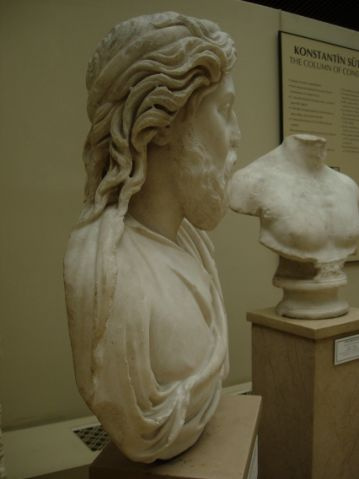
Portrait bust of a long-haired man wearing fillet, himation,and chiton. Constantinople. Fourth century.
Record details
Photographs
Bibliography
- Inan, J. & E. Alföldi-Rosenbaum, Römische und frühbyzantinische Porträ̈tplastik aus der Türkei : neue Funde, Mainz 1979, 282-6, no. 274, pl. 252
- Mendel, G., Musées Impériaux Ottomans. Catalogue des sculptures grecques, romaines, et byzantines I-III, Constantinople 1912-1914, III, 517-518, no. 1308
Discussion
DESCRIPTION (OBJECT)
Over life-size bust. H: 60 cm. H (beard to crown): 33, W (of head): 25.5 cm. Fine-grained white marble.
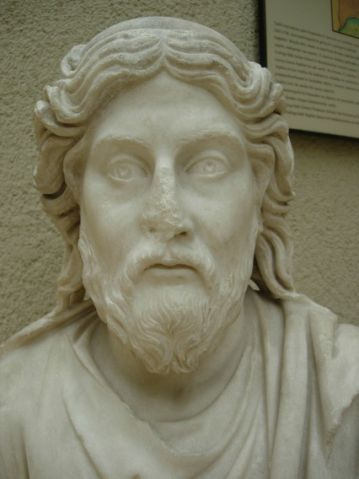
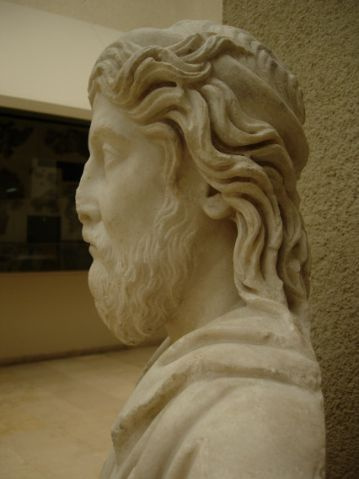
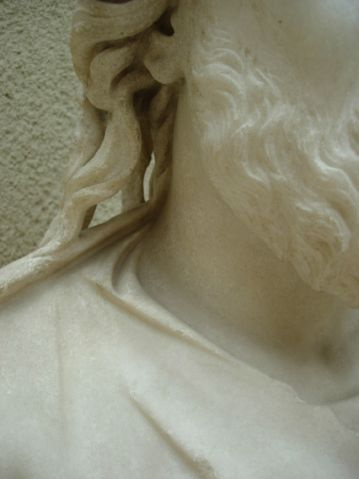
The bust and head are worked together from one piece of marble. The clothing is rendered with large, fully-finished, flat-bottomed folds. The hair shows masterful drillwork in the area around the ears and shoulders. Marble ‘bridges’ have been left between many of the channels. The beard, moustache, and eyebrows are rendered with fine flat chisel work. The pupils are large, crescent-shaped hollows. The engraved irises are three-quarters of a circle.
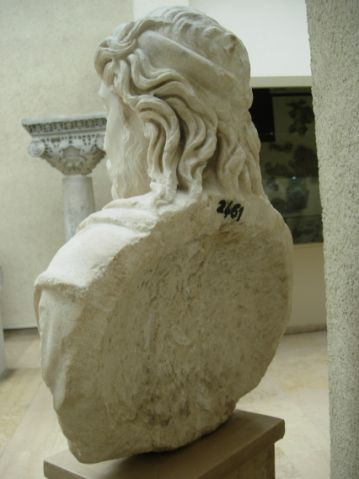
The back of the bust has been roughly hollowed with a large chisel and lacks a true spine, though there is a slightly raised vertical area at the centre of the back.
PROVENANCE
Gedikpasa
DESCRIPTION (Subject)
The portrait bust shows a man with long hair that is bound by a flat fillet. He wears a chiton under a himation which pulls diagonally across the body from the left shoulder to under the right arm. One end of the himation hangs vertically in front of the left shoulder.
The head turns slightly to its left. The long wavy hair is parted in the centre and brushed off the face, covering most of the ears. It reaches the shoulders. Around the upper part of the head runs a broad fillet. On both sides of the central part, individual locks are brushed over the fillet. The long beard divides, beneath the chin, into two sections which curl away from the centre. The full moustache leaves a small triangular space of skin exposed at the centre of the upper lip.
The face is large and flat with broad cheekbones and small features. The brow is tall, and the eyebrows are set high above the eyes. The eyes, which point downwards at the inner corners, have full circular irises and large low-set, crescent-shaped pupils. The lips are slightly parted.
DATE
The head has been dated from the Severan period (Mendel) to end of the third or early fourth century (von Sydow) to the Theodosian period (Rosenbaum) and to the end of the fourth or early fifth century (Fıratlı) .
The closest parallels are from the Atrium House at Aphrodisias. The tondi (for example, LSA-206, LSA-207, LSA-210) share the flat handling of the drapery and the deep drilling in the hair around the ears, and the bust (LSA-203) from the Atrium house shows the same handling of long hair on the shoulders, the same treatment of the eyes, and the same barely perceptible spine in the hollowed back of the bust. The find location and technique of the tondi and busts from the Atrium House suggest a late fourth or even early fifth century date. The Gedikpasa bust should belong to the same period.
HONORAND
The honorand has been identified as a priest, a philosopher, and an evangelist. The traditional form of the clothing (see the portrait of Menander from Ephesus, LSA-680 and Pythagoras from Aphrodisias, LSA-210) and the old-fashioned fillet (see again Pythagoras from Aphrodisias LSA-210 and an Aphrodisian portrait related to the ‘Apollonius of Tyana’ type, LSA-216) would seem to favour the identification with an intellectual or philosopher. The long unruly hair and beard contrast sharply with the securely identified and essentially contemporary image of an evangelist, LSA-2416, also from Istanbul. A portrait tondo, now in Stockholm (LSA-1195), and a portrait type known in versions in Izmir (LSA-236) and Heidelberg show similarly-conceived images of unidentified intellectuals.
Discussion references
- Fıratlı, N., La sculpture byzantine figurée au Musée archéologique d'Istanbul, Paris 1990, 18-19, no. 35, pl. 16 (end of fourth to early fifth century)
Cite: Last Statues of Antiquity, LSA-375 (J. Lenaghan).