
LSA-380
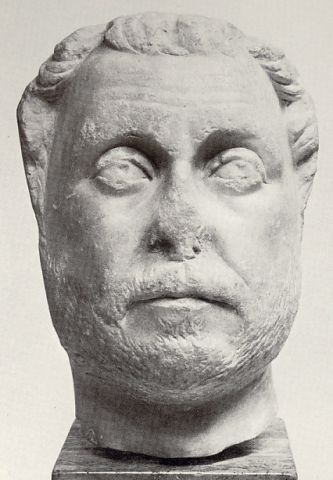
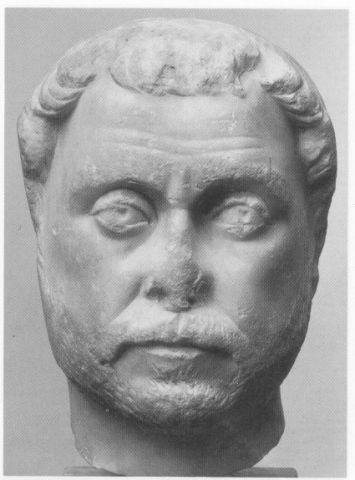
Portrait head of a man with short beard and brushed forward hair. Asia Minor. Late fourth to early fifth century.
Record details
Photographs
Bibliography
- Inan, J. & E. Alföldi-Rosenbaum, Römische und frühbyzantinische Porträ̈tplastik aus der Türkei : neue Funde, Mainz 1979, 305-308, no. 304, pl. 259 (Bergmann: first half of fifth c.)
Discussion
DESCRIPTION (Object)
Life-size head. H: 25.5 cm. Fine-grained white marble.
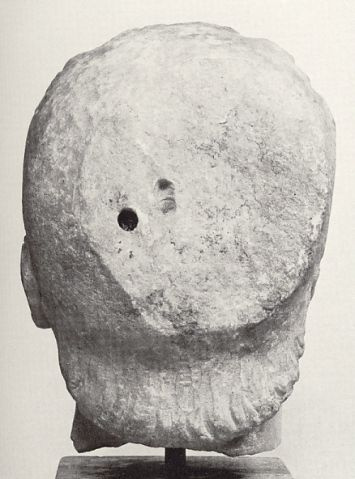
The head is broken through the middle of the neck. The back of the head has been removed and has two drill holes, one of which is deep and has iron in it. Bergmann considers these to be modern. The nose is mainly missing.
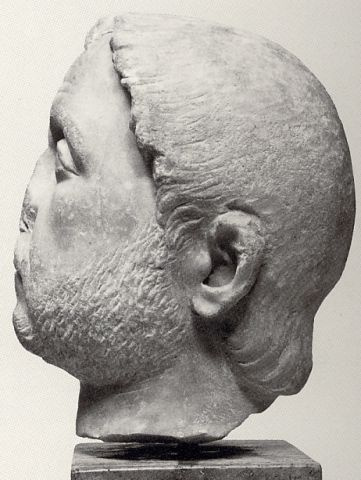
The hair at the top of the head and at the back above the base of the skull has a smooth surface. The hair in front of the ears and lying on the neck is defined with flat chisel work that is progressively more detailed as it reaches the face or nape. The facial hair is rendered with short strokes of a flat chisel. The pupils of the eyes appear to be crescent shapes. The irises are not indicated.
PROVENANCE
From Asia Minor. Before 1939 it was in an art gallery in Paris.
DESCRIPTION (Subject)
The head shows a mature bearded man with a combed forward hairstyle who turns to his left. The face is short and broad. The brow has several shallow creases and vertical lines of contraction over the root of the nose. The eyes are narrowly set with respect to the wide cheekbones. The nose would have projected forcefully from a deep root. The upper lip is thin.
The hair makes two marked recessions above the inner corners of the eyes. Between these two points it comes forward in a group of locks which all turn to the proper left. At the back the hair indents at the base of the skull. The beard and moustache are rendered as short.
DATE
The fashion style of beard and hair are similar to examples found on the Obelisk of Theodosius in Istanbul (c. 390) and can be seen on the consular diptych of Fl. Constantius Felix, AD 428 [see W.F. Volbach, Elefenbeinarbeiten der Spätantike und des frühen Mittelalters, (Mainz 1976), 30, no. 2, pl. 2]. The portrait of Oecumenius LSA-150 from Aphrodisias (and LSA-869 from Cyprus) also shows the same fashion style and has similarly rendered pupils. Oecumenius, identified by his base at Aphrodisias, should be dated to the late fourth or early fifth century.
Examples of similarly-styled portraits, all from Asia Minor, are LSA-158, LSA-178, LSA-380, LSA-445, and LSA-2282.
Discussion references
- Meischner, J., 'Das Porträt der theodosianischen Epoche II (400 bis 460 n. Chr.),' , Jahrbuch des Deutschen Archäologischen Instituts, 106 (1991), 385-407, pl.92.1
Cite: Last Statues of Antiquity, LSA-380 (J. Lenaghan).