
LSA-385
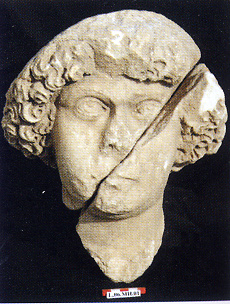
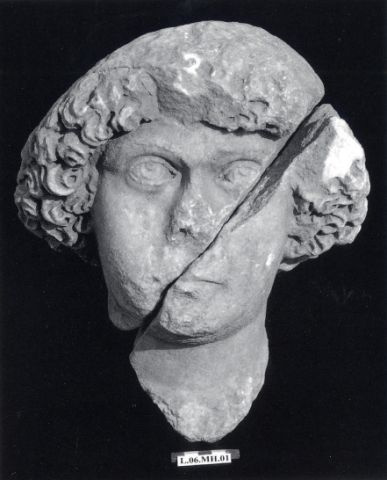
Portrait head with mop hairstyle. From Laodicea ad Lycum. Late fifth to early sixth century.
Record details
Photographs
Bibliography
- Şimşek, C., Laodikeia (Laodikeia ad Lycum), Istanbul 2007, fig. 158
- Şimşek, C. 'Sculpture from Laodikeia (Laodicea ad Lycum)', Roman Sculpture in Asia Minor. JRA Supplementary Series 80, Portsmouth RI, 2011, 344, fig. 22.17 (Fl. Palmatus)
Discussion
DESCRIPTION (Object)
Life-size head. White marble.
The head is broken in two. The break runs diagonally from the right jaw line to the left temple. The nose is missing. There are chips along the break line and in the hair in front of the left ear..
The head seems to have been worked separately from its statue. The neck seems to end in a rounded tenon. The pupils of the eyes are rendered as Us, and the inner canthi are drilled out and have a stylized form. The hair features some drilling in the locks around the brow.
PROVENANCE
Excavated in 2002 in an area of Byzantine houses at Laodiceia.
DESCRIPTION (Subject)
The head.depicts a broad-faced man without signs of age. He has a low brow; arching eyebrows; widely spaced large open eyes; and a broad, unsmiling mouth. He wears his full, loosely curling, hair in a “mop” style. It is combed forward, of relatively long length –covering all of the ear but a bit of the lobe-- , and gathers volume around the face. The hair over the brow is sharply undercut which serves to separate it emphatically from the brow and to provide a frame for the serious face below.
DATE
The head can be dated on the basis of its mop hairstyle. Flavius Palmatus (LSA-198) in nearby Aphrodisias wears this same hairstyle in the late fifth or early sixth century and Şimşek, even identifies this head as Palmatus
This portrait style is also close to LSA-173, also from Aphrodisias. Both hairstyle and physiognomy are similar; note, for example, the wide and long shape of the face as well as the fullness under the chin and the bulging skin below the lower eyelids. The technical details of the heads are also comparable; this is especially visible in details such as the canthi or the drillwork in the hair. Only the rendering of the pupils varies; disks in the Aphrodisian example and U shapes in the Laodiceia head.
HONORAND
The Laodiceian head, which has a tenon, seems to have been made for a statue. Two extant honorific inscriptions from the site commemorate men of the second half of the fifth century, Flavius Constantinus (LSA-525) and Docticius (LSA-526). These provide an idea of the sort of man represented.
Cite: Last Statues of Antiquity, LSA-385 (J. Lenaghan).