
LSA-386
Base for statue of Flavius Anysius, comes and vicarius. Laodicea ad Lycum (Phrygia Pacatiana). Early fourth century.
Record details
Photographs
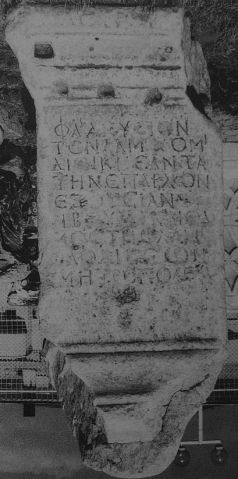
Inscription
[ἀ]γαθῇ τύχ[ῃ]/Φλ(άουιον) ᾿Ανύσιον/ τὸν λαμ(πρότατον) κόμ(ητα)/διοικήσαντα/ τὴν ἔπαρχον/ἐξουσίαν/ἡ βουλὴ καὶ ὁ δῆ-/μος τῆς λαμ(προτάτης)/ Λαοδικέων/ μητρόπολεω[ς].
Inscription translation
To Good Fortune. Flavius Anysius, of clarissimus rank, comes, exercising authority on behalf of the [praetorian] prefect; the council (boule) and people (demos) of the shining ? metropolis of the Laodiceans [honoured him].
Bibliography
- Corsten, T., Die Inschriften von Laodikeia am Lykos. Teil I (Inschriften griechischer Städte aus Kleinasien, Bd. 49) , Bonn 1997, 85-7, no. 41
- Ritti, T. (ed.), Museo Archeologico di Denizli-Hierapolis. Catalogo delle iscrizioni greche e latine - Denizli-Hierapolis Arkeoloji Müzesi. Yunanca ve Latince Yazılı Eserlerin Kataloğu, Napoli 2008, pp. 132-5 no. 50 (E. Miranda)
Discussion
INSCRIPTION
In ten lines:
(On the upper moulding): [ἀ]γαθῇ τύχ[ῃ].
Φλ(άουιον) ᾿Ανύσιον / τὸν λαμ(πρότατον) κόμ(ητα) / διοικήσαντα / (5) τὴν ἔπαρχον / ἐξουσίαν / ἡ βουλὴ καὶ ὁ δῆ/μος τῆς λαμ(προτάτης) / Λαοδικέων / μητρόπολεω[ς].
'To Good Fortune. Flavius Anysius, of clarissimus rank, comes, exercising authority on behalf of the [praetorian] prefect; the council (boule) and people (demos) of the shining ? metropolis of the Laodiceans [honoured him].'
DESCRIPTION (from Corsten 1997 and the published photo)
Base of white marble, with upper and lower mouldings on all surviving and visible sides: H 119, W 64, D 50 cm. Much of the bottom of the base is broken and lost, as is the top right corner. There are four holes towards the top of the base that probably date from a period of re-use, and the surface of the inscription is worn
PROVENANCE AND CURRENT LOCATION
The base was first recorded by Clerc (1887) near the Konak in Denizli and then by Buckler and Calder (MAMA VIII 1939) in the ruins of the Karaman mosque. It is today standing upside down in the garden of the Denizli museum at Pamukkale, inv. no. E. 552 K.940.
HONORAND, AWARDER AND DATE
The honorand, Flavius Anysius, was a high ranking imperial official (PLRE I, 80, Fl. Anysius 3). The formula used here to describe his rank, διοικήσαντα τὴν ἔπαρχον ἐξουσίαν (lines 4-6) can either denote a vicar, or, before the office of vicar was institutionalized (probably towards the middle of the 4th century), an official exercising the authority of a praetorian prefect (Corsten 1997, 86-7). His title comes, and his name 'Flavius', both suggest a Constantinian date for his period of office.
The awarders were the council and people of Laodicea, described a 'metropolis', a status the city had achieved by the early 4th century.
Discussion references
- Buckler, W.H. and W.M. Calder (eds.), Monuments and documents from Phrygia and Caria. Monumenta Asiae Minoris antiqua, v. 6, Manchester 1939, 8, no. 13, pl. 4
Cite: Last Statues of Antiquity, LSA-386 (J. Lenaghan).