
LSA-389
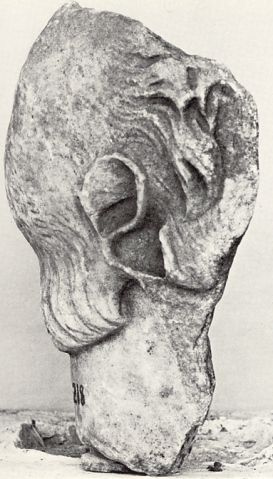
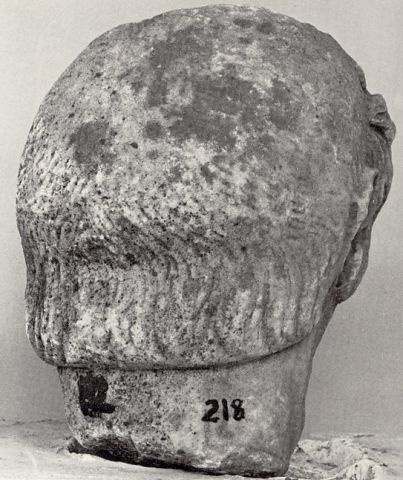
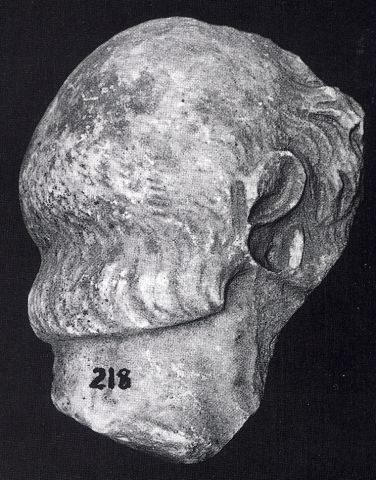
Fragment from back right of portrait head. From Stratonicea. Fifth century.
Record details
Photographs
Bibliography
- Özgan, R., Die Skulpturen von Stratonikeia. Asia Minor Studien, vol. 32, Bonn 1999, 137-8, no. K 52, pl. 45 c-d
Discussion
DESCRIPTION (Object)
Fragment of life-size head. H: 21, W: 14, D: 10 cm. Large-grained white marble.
The fragment preserves the back of the head, the right ear, the hair immediately in front of the right ear, and the back and right side of the neck. The shell of the right ear is broken, and the fragment appears to be broken on all sides. It is, however, unclear from the photographs whether the bottom right edge of the neck is a break or the worked end of a separately worked head for insertion.
The upper part and back of the head have been shaped but given only vague representational detail.
PROVENANCE
The exact find location within Stratonicea is not recorded.
DESCRIPTION (Subject)
The fragment comes from a portrait head of an adult man. The hair clings to the back of the head and the nape, outlining the shape of the cranium. At the nape it falls naturally downward in medium-length locks. It is combed forward towards the brow, falling again naturally at the temple. It builds in volume over the brow but remains nonetheless thin and straggly.
DATE
The hairstyle is preserved in numerous other late-antique portraits (for example, from Stratonicea LSA-447; from Asia Minor,LSA-181, LSA-182, LSA-688, LSA-690; and from Ostia, LSA-956). The technical detail of the hair rendered with detail, volume, and realism around the face and flatly at the top of the head with an indentation at the base of the skull recurs in several examples from Aphrodisias (see the already noted, LSA-181, LSA-182). This hairstyle and technique are generally dated to the mid-fifth century though there are no examples with fixed external chronological criteria.
HONORAND AND CONTEXT
It is interesting to note that at Stratonicea one individual of the fifth century, Maximus, was honoured with perhaps as many as four monuments (LSA-657, LSA-1200, LSA-1201, LSA-1202). This head belongs to the same period. Moreover, the only other extant male late-antique head from the site (now on a bust LSA-447) shows the same hairstyle.
Discussion references
- Inan, J. & E. Alföldi-Rosenbaum, Römische und frühbyzantinische Porträ̈tplastik aus der Türkei : neue Funde, Mainz 1979, 243, no. 219, pl. 262.1-2
Cite: Last Statues of Antiquity, LSA-389 (J. Lenaghan).