
LSA-390
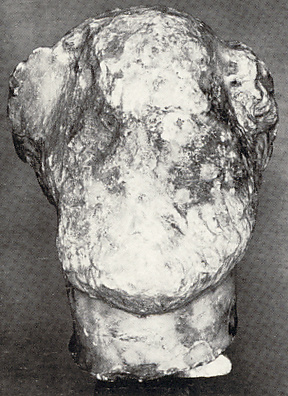
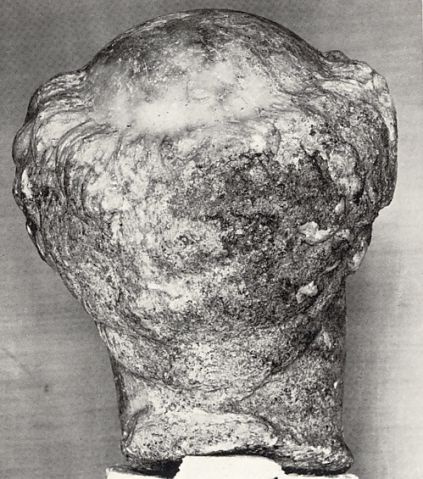
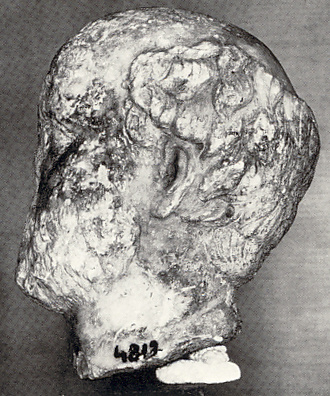
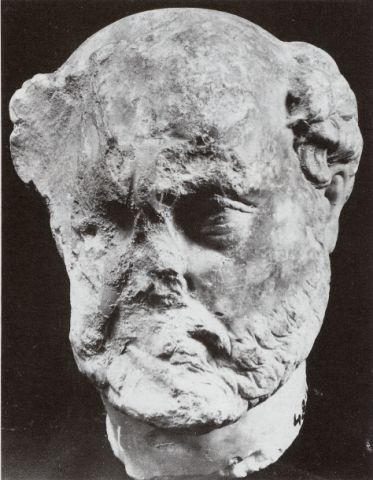
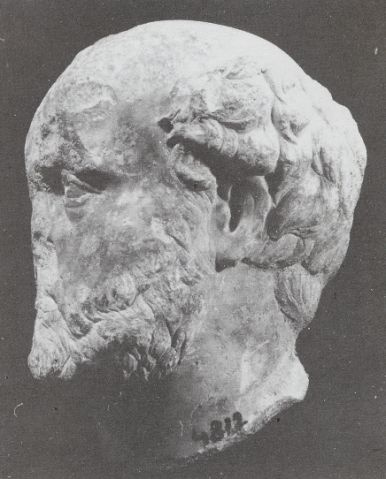
Battered portrait head of bearded man. Constantinople. Fifth to sixth century.
Record details
Photographs
Bibliography
- Fıratlı, N., La sculpture byzantine figurée au Musée archéologique d'Istanbul, Paris 1990, 15, no. 24, pl. 11
- Inan, J. & E. Alföldi-Rosenbaum, Römische und frühbyzantinische Porträ̈tplastik aus der Türkei : neue Funde, Mainz 1979, 286-7, no. 276, pl. 266.1, 3-4 (fifth-sixth c.)
Discussion
DESCRIPTION (Object)
Life-size head. H 25.5, H (chin to crown): 19.5, W: 17 cm. Fine-grained white marble.
The head is broken through the base of the neck. The face is badly battered and virtually illegible.
No drill work is visible in hair.
PROVENANCE
The head was found in the foundations of the 6th c. cistern in Istanbul.
DESCRIPTION (Subject)
The head shows a man full bearded man who is bald at the top and front of his head. Over the ears and at the back, the hair falls in irregular locks that curl over one another. The hair forms a protruding ring or ‘wreath’ around the head.
At the back of the neck is a trace of drapery that rises and falls in a steep curve.
DATE
The face is entirely missing. Inan and Rosenbaum, followed by Fıratlı, give a date in the fifth to sixth century on the basis of the hairstyle. They believe that wreath-like aspect on a bald head has much in common with LSA-694 or even more generally with LSA-198.
In my opinion this date should perhaps be narrowed to the fifth century. Although the length and rendering of the beard and hair might plausibly find parallels in the second century, bald pates framed by springing hair are more common in the fifth century. Then they occur both as parts of a deliberate tonsured hairstyle and as elements of a new ascetic realism: see LSA-170 and LSA-174. The full beard begins to go out of style in the later fifth century and is replaced by a stubble beard: see LSA-530 with a similar hairstyle but a stubble beard.
The drapery at nape would correspond well to the upper edge of a chlamys costume. The fine engraved line under the eye (showing a wrinkle) is also a common feature of the fifth-century heads: see LSA-169 and LSA-170. To be sure, this head does not show the virtuoso use of the drill that is apparent in all the fifth-century works from Aphrodisias. This may, however, be better explained as a workshop tendency than a chronological marker.
Cite: Last Statues of Antiquity, LSA-390 (J. Lenaghan).