
LSA-391
Plaque, probably from base for statue of Maximian, emperor. Panemoteichos (Pisidia). 293-305
Record details
Photographs
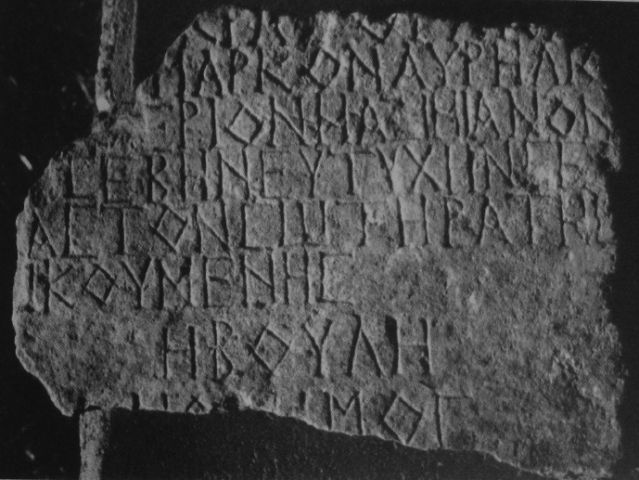
Inscription
[Αὐτο]κ̣ρατ̣ορ̣α̣ Κ̣α̣[ί]/[σαρα] Μᾶρκον Αὐρήλιο[ν] / [Οὐαλ]έριον Μαξιμιανὸν, / [ε]ὐ̣σεβῆν εὐτυχῆν, σ̣ε/[β]αστὸν, σωτῆρα τῆς / (6) [ο]ἰκουμένης. / ἡ βουλὴ / κ̣α̣ὶ̣ ὁ̣ [δ]ῆ̣μος.
Inscription translation
The emperor, Caesar Marcus Aurelius Valerius Maximianus, pious, fortunate Augustus, saviour of the civilised world. The council (boule) and people (demos) [honour him].
Bibliography
- Avdal Sabri, S. Mitchell, T. Robinson, and L. Vandeput, , ‘The Pisidian Survey 1995: Panemoteichos and Ören Tepe’ , Anatolian Studies 47, (1997), 141-3
- Horsley, G.H.R. and S. Mitchell (eds.) , The inscriptions of Central Pisidia : including texts from Kremna, Ariassos, Keraia, Hyia, Panemoteichos, the Sanctuary of Apollo of the Perminoundeis, Sia, Kocaaliler, and the Döseme Bogazı (Inschriften griechischer Städte aus Kleinasien, Bd. 57) , Bonn 2000, 113, no. 107
Discussion
INSCRIPTION
In eight lines:
[Αὐτο]κ̣ρατ̣ορ̣α̣ Κ̣α̣[ί]/[σαρα] Μᾶρκον Αὐρήλιο[ν] / [Οὐαλ]έριον Μαξιμιανὸν, / [ε]ὐ̣σεβῆν εὐτυχῆν, σ̣ε/[β]αστὸν, σωτῆρα τῆς / (6) [ο]ἰκουμένης. / ἡ βουλὴ / κ̣α̣ὶ̣ ὁ̣ [δ]ῆ̣μος.
The emperor, Caesar Marcus Aurelius Valerius Maximianus, pious, fortunate Augustus, saviour of the civilised world. The council (boule) and people (demos) [honour him].'
Letter height 4 cm.
DESCRIPTION (from Aydal, Mitchell, Robinson and Vandeput 1997, Horsley & Mitchell 2000, and the published image)
Fragment of limestone slab: H 35, W 50, D 11 cm. Parts of the original sides are preserved, if chipped, but the top and bottom are lost.
PROVENANCE
Found together with other pieces, now lost, in modern Boğazköy, site of ancient Panemoteichos, in about 1980. Our fragment survives in the Burdur museum (without published inv. no.).
DATE
The honorand, Maximian, was Augustus 293 -305.
DISCUSSION
The formulation of the inscription (honorand in the accusative and honouring bodies of the boule and demos at the end) is that of a statue base. This stele, which has a depth of 11 cm, was probably attached to a base made of a different material. S. Mitchell suggests that economic problems of the period compelled the honouring bodies to use stelai rather than bases.
Cite: Last Statues of Antiquity, LSA-391 (J. Lenaghan).