
LSA-393
Base for statue of Olympius, local notable. Termessus Maior (Pisidia). Fourth century
Record details
Photographs
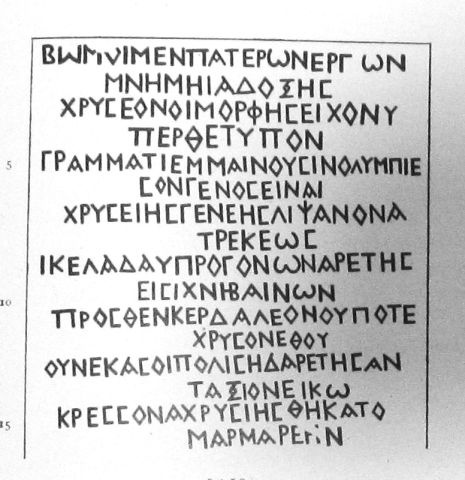
Inscription
Βωμοὶ μέν, πατέρων ἔργων / μημήϊα δόξης, χρύσεον οἳ μορφῆς εἶχον ὕ/περθε τύπον, γράμματι σημαίνουσιν, ᾿Ολύμπιε, / σὸν γένος εἶναι χρυσείης γενεῆς λίψανον ἀ/τρεκέως. ῎Ικελα δ´ αὖ προγόνων ἀρετῆς / εἰς ἴχνη βαίνων πρόσθεν κερδαλέον οὔποτε / χρυσὸν ἔθου. Οὕνεκά σοι πόλις ἡδ’ ἀρετῆς ἀν/τάξιον εἰκὼ κρέσσονα χρυσίης θήκατο / μαρμαρέην.
Inscription translation
The altars, memorials of paternal deeds of honour, which bear the gilded form of a statue above, indicate in writing, Olympius, that your race is truly the remains of golden stock. Resembling your forefathers, pursuing the trail of virtue, you never placed golden advantage first. Therefore the city for you has set up a marble rather than a gold likeness, just as worthy of your virtue.
Bibliography
- Heberdey, R., Tituli Asiae Minoris. Volumen III, Tituli Pisidiae : linguis Graeca et Latina conscripti , Vienna 1941, fasc. 1, no. 102
Discussion
INSCRIPTION
Verse inscription of four elegiac distichs, laid out in 16 lines:
Βωμοὶ μέν, πατέρων ἔργων/ μημήϊα δόξης, /
χρύσεον οἳ μορφῆς εἶχον ὕ/περθε τύπον, /
(5) γράμματι σημαίνουσιν, ᾿Ολύμπιε, / σὸν γένος εἶναι /
χρυσείης γενεῆς λίψανον ἀ/τρεκέως.
῎Ικελα δ´ αὖ προγόνων ἀρετῆς /(10) εἰς ἴχνη βαίνων /
πρόσθεν κερδαλέον οὔποτε / χρυσὸν ἔθου. /
Οὕνεκά σοι πόλις ἡδ’ ἀρετῆς ἀν/τάξιον εἰκὼ /
(15) κρέσσονα χρυσίης θήκατο / μαρμαρέην.
'The altars, memorials of paternal deeds of honour, which bear the gilded form of a statue above, indicate in writing, Olympius, that your race is truly the remains of golden stock. Resembling your forefathers, pursuing the trail of virtue, you never placed golden advantage first. Therefore the city for you has set up a marble rather than a gold likeness, just as worthy of your virtue.'
DESCRIPTION (from Heberdey)
Marble rectangular base, without mouldings: H 145, W 67, D 77 cm. The front panel bears 16 lines of inscription. The back is flat but roughly worked.
PROVENANCE AND CURRENT LOCATION
The inscription was first recorded at Termessus in portico L 5 in front of west column 17 (Lanckoronski 1892, 54-5 and map opposite p. 20). The base remains in situ.
HONORAND AND DATE
The base honours a man named Olympius. The poem commemorates the fine family and the scrupulousness of Olympius, but gives no indication of his position or any specific activity. PLRE includes many men of this name but this particular individual is uncited. He was probably a man of only local importance.
Verse inscriptions become common for high imperial office holders only in the 4th century, but were in use for municipal and provincial notables already earlier, from the late 2nd century onwards. The verbal play between virtue, gold, and the justification for a stone image is similar to the base for the governor Dulcitius at Aphrodisias, LSA-225 (fifth century), and may reflect the predominant use of marble in response to economic and legal necessities.
FURTHER DISCUSSION
The contrast of the marble statue and the honorand's 'golden stock' is a well-turned conceit.
Discussion references
- Lanckoronski, K., Städte Pamphyliens und Pisidiens. II. Band. Pisidien. Unter Mitwirkung von G. Niemann und E. Petersen, Wien 1892
Cite: Last Statues of Antiquity, LSA-393 (Ulrich Gehn).