
LSA-394
Base for statue Aquilinus, military commander. Olympus (Lycia). Fourth to fifth century (probably later fifth century)
Record details
Photographs
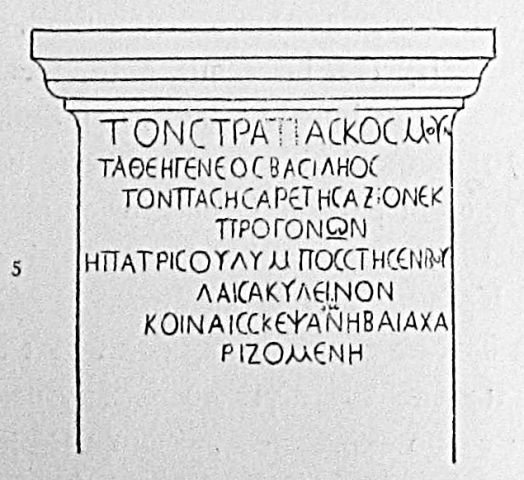
Inscription
Τὸν στρατιὰς κοσμοῦν/τα θεηγενέος βασιλῆος, / τὸν πάσης ἀρετῆς ἄξιον ἐκ / προγόνων, / ἡ πατρὶς Οὕλυμπος στῆσεν βου/λαῖς Ἀκυλεῖνον / κοιναῖς σκεψα<μέ>νη, βαιὰ χα/ριζομένη.
Inscription translation
Him who ordered the armies of the god-born emperor, him who is worthy of all virtue through his forefathers, the fatherland, the city of Olympus, having decided by common counsel, set up Aquilinus, as a humble present.
Bibliography
- Kalinka, E., Tituli Asiae Minoris. Volumen II, 1-2. Tituli Lyciae : linguis Graeca et Latina conscripti , Vienna 1920, fasc. 3, no. 1173
- Merkelbach, R. and J. Stauber (eds.), Steinepigramme aus dem griechischen Osten. Bd. 4. Die Südküste Kleinasiens, Syrien und Palaestina, Munich 2002, 75, no. 17/20/1
Discussion
INSCRIPTION
Verse inscription of two elegiac distichs laid out in eight lines:
Τὸν στρατιὰς κοσμοῦν/τα θεηγενέος βασιλῆος, /
τὸν πάσης ἀρετῆς ἄξιον ἐκ/προγόνων, /
(5) ἡ πατρὶς Οὕλυμπος στῆσεν βου/λαῖς Ἀκυλεῖνον /
κοιναῖς σκεψα<μέ>νη, βαιὰ χα/ριζομένη.
'Him who ordered the armies of the god-born emperor, him who is worthy of all virtue through his forefathers, the fatherland, the city of Olympus, having decided by common counsel, set up Aquilinus, as a humble present.'
Letter height: 3.5 cm (4.5 in line 1).
DESCRIPTION (from Kalinka 1920 and the published image)
Rectangular limestone base with upper moulding: W (without moulding) 72 cm.
PROVENANCE AND MOST RECENTLY RECORDED LOCATION
Found in the Hephaesteum at Olympus, set into the lower part of the outer wall of the southern aedicula of the sacellum (http://www.trismegistos.org/place/16426).
HONORAND, AWARDER AND DATE
The Aquilinus honoured was a native of Olympus (the statue is set up by his fatherland), and a military commander in the imperial service. He is not known from any other source (PLRE I, 91, Aquilinus 4).
Dedications to military commanders are rare. Here he is honoured by his homeland, as a local boy made good.
The vagueness about Aquilinus' precise military position, as well as the lettering and even the choice of words of the inscription ('theogenes basileus, god-born emperor' and the verb stēsen) suggest a date in the fourth century or later. Whereas Kalinka assigned our base a third- to fourth-century date, PLRE suggests a generous chronological range of fourth- to sixth-century.
A possible indicator of date is the singular βασιλῆος (line 2). The verse would allow for the last syllable to be long; the singular (instead of the plural βασιλήων, which has a long ultimate syllable) should therefore be assessed as deliberate. This would point to a date in the later 5th century, when the western rulers were not recognized any more in the eastern empire.
We suggest a terminus ante quem of 500, since statues in a provincial setting are extremly rare in the 6th century.
FURTHER DISCUSSION
If, as suggested, this dedication is from the later 5th century, it would be a further example of honours to outstanding military office holders in a provincial city at this period (LSA-10, LSA-367, LSA-639).
Discussion references
- Robert, L., Epigrammes du Bas-Empire (Hellenica IV), Paris 1948, 36, fn. 1
Cite: Last Statues of Antiquity, LSA-394 (J. Lenaghan/ Ulrich Gehn).