
LSA-396
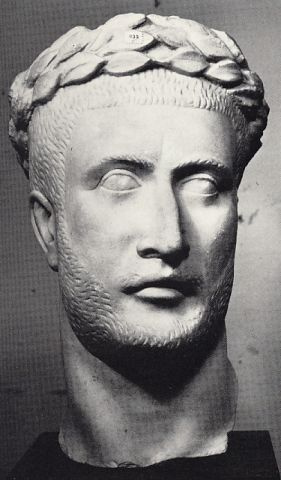
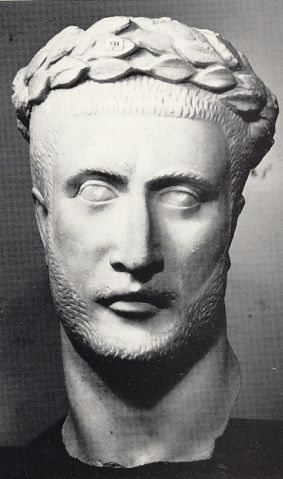
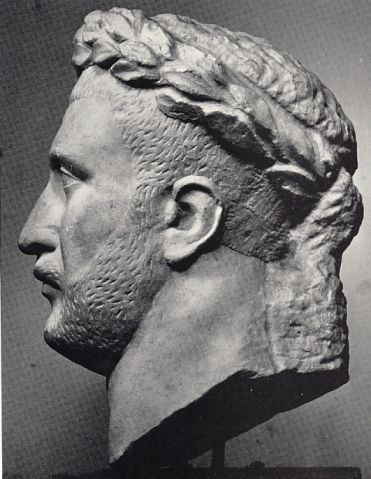
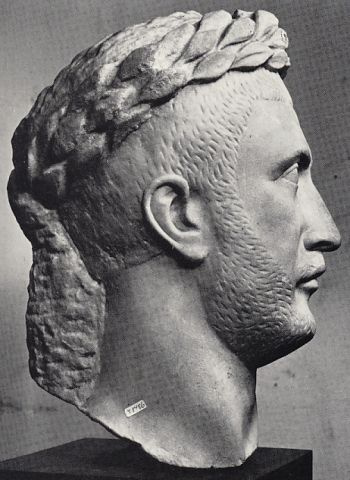
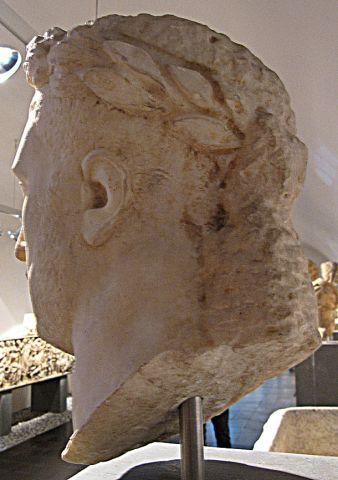
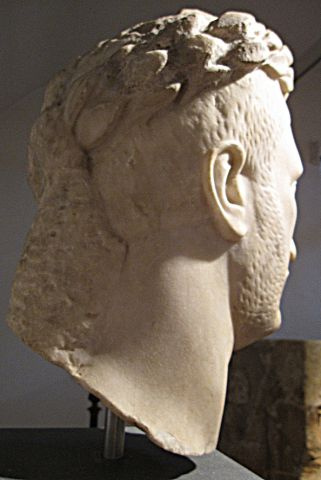
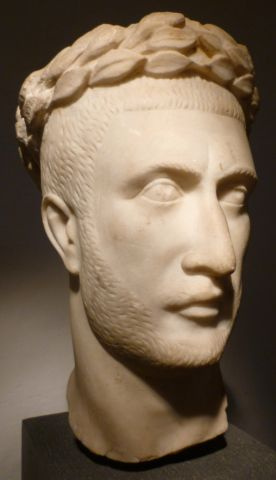
Re-cut head of Tetrach wearing laurel wreath. From Attalia (?). Late third to early fourth century.
Record details
Photographs
Bibliography
- Inan, J. & E. Alföldi-Rosenbaum, Römische und frühbyzantinische Porträ̈tplastik aus der Türkei : neue Funde, Mainz 1979, 343-44, no. 343, pl. 251
Discussion
DESCRIPTION (Object)
Over life-size head. H: 42, W: 22 cm. Fine-grained white marble.
The head is broken from a statue at the base of the neck. It is otherwise well-preserved.
The head was probably originally worked together with its statue. Attached to the back of the neck is a stretch of uncarved stone (neck pillar). This is separated from the more reduced surfaces of the hair and crown by a drill channel.
The top of the head, above the crown, is only roughly worked. It sits above and is separated from the crown below by a deep drill channel. The hair behind the ears has been taken down with flat and claw chisels. The areas of the neck adjacent to the face also have been taken down.
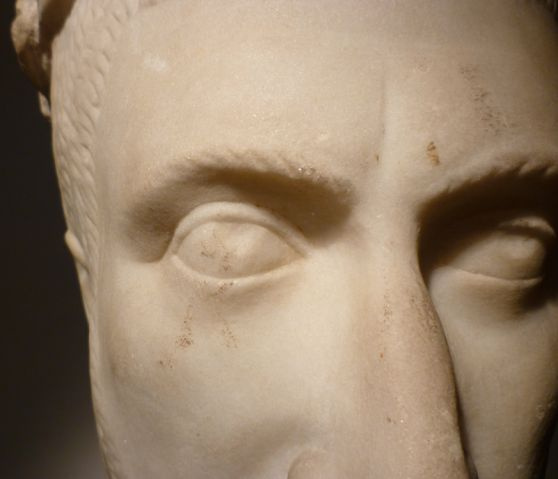
The face itself is fine and too small for the neck. The hair over the brow and the beard have been worked to an even raised surface which is scored by regular slashes of the flat chisel. The eyebrows have been treated in the same way. The eyeballs are marked by a shallow half circle that touches the upper eyelid but not the lower one.
The nostril holes, barely indicated, and the thin upper lip also attest re-working (Bergmann, 388 n. 10). The original lip was probably concealed by a fuller beard.
PROVENANCE
Probably from the general area of Antalya. Having passed through private collections, it is now in Basel, Sammlung Ludwig.
DESCRIPTION (SUBJECT)
The head depicts a mature man with short-cropped hair and a short beard who turns to his left. He wears a corona civica which indicates that the honorand was an emperor.
The short cropped hair and beard, a fashion style of the late third century, was widely disseminated by the Tetrarchs who often combined it with a non-specific physiognomy.
DATE
The corona civica indicates a date before Constantine, and the hair and beard style a date after the second quarter of the third century. The regular, expressionless physiognomy, however, suggests a date in the Tetrarchic period. Most mid third-century emperors did not last long enough for provincial cities to re-carve extant portraits.
Discussion references
- Berger, E. (ed), Antike Kunstwerke aus der Sammlung Ludwig. III Skulpturen, Mainz 1990, 388, Beil. 45 (M. Bergmann)
Cite: Last Statues of Antiquity, LSA-396 (J. Lenaghan).