
LSA-397
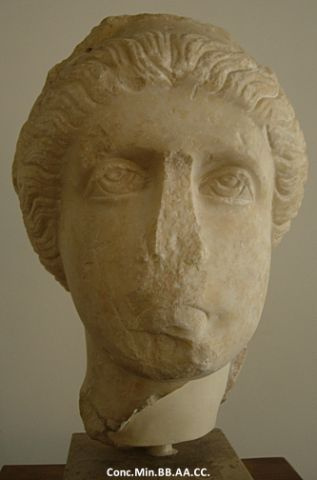
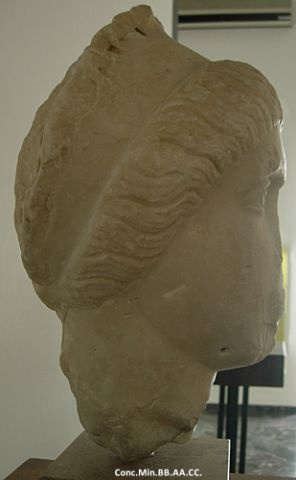
Portrait head of woman with stephane. From Rome. Fourth to fifth century.
Record details
Photographs
Bibliography
- Schade, K., Frauen in der Spätantike--Status und Repräsentation, Mainz 2003, 214, no. I 54, pl. 60.1 (first half of fifth c.)
Discussion
DESCRIPTION (Object)
Life-size head. H: 27.5 cm. Fine-grained white marble.
The head has broken unevenly at the neck. The proper right side of the neck is preserved but not the proper left. Moreover, on the extant right side the break slants downward both at the front and at the back which gives the impression of a tenon (as argued by Felletti Maj). The nose and chin have broken off, and the mouth is abraded. There is a chip in the brow over the right eye. The top of the head is only roughly worked.
The hair has been engraved with a flat chisel. The eyes are emphatically marked by two parallel, U-shaped, deeply engraved lines that indicate the iris and the edge of the pupil. Another drill hole denotes the pupil itself.
PROVENANCE
Found in Rome on the Via Portuense in 1908. It was found amid tombs with several funerary inscriptions and a headless female statue wearing a peplos, chiton, and mantle. The statue is 1.43 m and is said to be unrelated to the head (Vaglieri). A funerary context is unusual for late antique portraits.
DESCRIPTION (Subject)
The portrait depicts a young woman with a stephane (a tiara-like crown). The face is oval and smoothly finished. The large eyes slope downwards toward their outer corners and have relatively thick lids set under low eyebrows. The combination of large eye with an non-arching eyebrow makes the forehead seem low. The complicated and forceful delineation of the inner eye animates the portrait. The lips are full and have drooping downturned outer corners.
The hair, just as the inner eye, is emphatically and crudely chiseled. It springs upwards and back in waves that entirely cover the ears. The hair is then tucked under a broad stephane, the upper edge of which seems to have had a decorative band.
The smooth face and diadem contrast sharply with the rough texture of the hair and eyes.
DATE
The head can be generally dated by the eye markings to the fourth or fifth centruy. The shape of the face, the rendering of the eyes, and the shape and form of the eyes are close to those of a male portrait now in the Museo Tuscolano (LSA-381).
Discussion references
- Felletti Maj, B.M., I ritratti, Rome 1953, 164, no. 326
- Vaglieri, D, 'III. Roma. Nuove scoperte nella città e nel suburbio', Notizie degli Scavi di antichità 1908, 133 fig. 7
Cite: Last Statues of Antiquity, LSA-397 (J. Lenaghan).