
LSA-399
Four fragments of base for an imperial statue, probably of Constantine II. Athens (Achaea). 317-340
Record details
Photographs
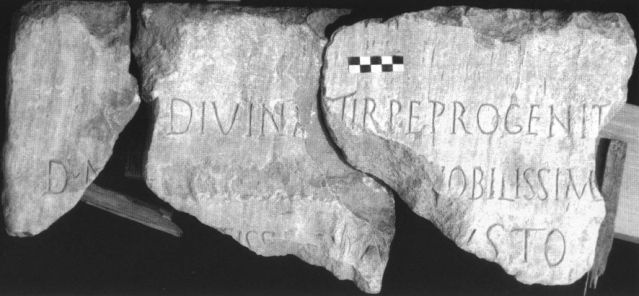
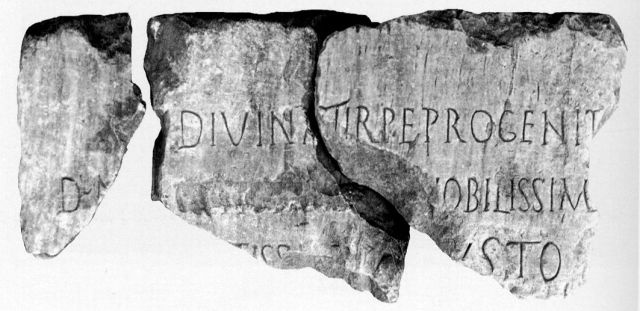
Inscription
IG II/III(2) 13270:
Divina stirpe progenito, / d(omino) n(ostro) [Fl](avio) [[Co]nstant[ino]], nobilissim[o] / [ et for]tissi[m]o Au[g]usto
IG II/III(2) 13272:
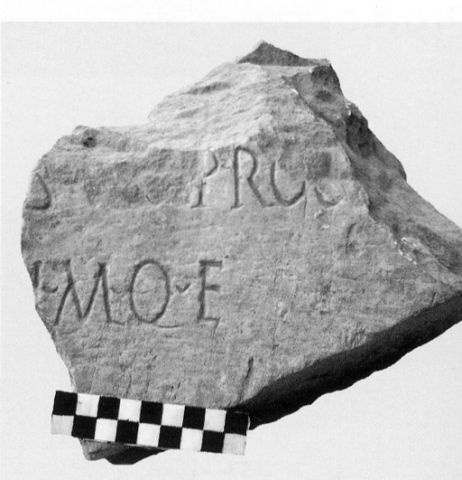
[-----iu]s v [.] c[.], proc[o(n)sul] / [prov(inciae) Achaiae, d.] ṇ. m. q. e. ----
Inscription translation
IG II/III(2) 13270:
To our lord Flavius Constantinus, of divine parentage, the most noble and most powerful Augustus ...
IG II/III(2) 13272:
[---iu]s, of clarissimus rank and governor(proconsul) of the province of Achaea, devoted to his divine spirit and majesty, [set this up].
Bibliography
- Inscriptiones Graecae, II/III(2) 13270
Discussion
INSCRIPTION:
Divina stirpe progenito, / d(omino) n(ostro) [Fl](avio) [[Co]nstant[ino]], nobilissimo] / [ et for]tissi[m]o Au[g]usto
'To our lord [Flavius Constantinus], of divine parentage, the most noble and most powerful Augustus.'
[-----iu]s v [.] c[.] proc[o(n)sul] / [prov(inciae Achaiae d.] ṇ. m. q. e. ----
'[---iu]s, of clarissimus rank and governor (proconsul) of the province of Achaea, devoted to his divine spirit and majesty, [set this up].'
DESCRIPTION (from Sironen and the published photos):
Four fragments of this base in grey marble have been identified: three (published by Sironen) are from the first lines of the inscription, while one (published as IG II/III(2) 13272) preserves parts of the last two lines. As discussed below (in the 'Further Discussion') not all these fragments necessarily originate from the same inscription.
The three fragments from the top of the base:
Fragment a = inv. no. PA 1675. Upper edge preserved, broken on all other sides. Letter height 2.8 - 3.6 cm.
Fragment b = inv. no. PA 1677. Upper edge preserved, broken on all other sides and on back. Letter height 2.9 - 3.6 cm.
Fragment c = inv. no. PA 1678. Left and upper edge preserved, broken on both other sides and on back. Letter height 3.3 - 3.5.
Fragments a and b are adjoining.
The single fragment from the bottom of the base (IG II/III(2) 13272) is broken on all sides but preserves part of its lower edge. Letter height 3 - 3.4 cm.
PROVENANCE AND LOCATION:
From the Roman Agora in Athens. Now in the storerooms of A' Ephoria, inv. no. PA 1675, PA 1677, PA 1678.
HONORAND, AWARDER AND DATE:
For a detailed discussion of why this base was probably set up to Constantine II, see the 'Further Discussion' below.
Flavius Claudius Constantinus was a son of Constantine I, probably illegitimate. He was born in February 317, proclaimed Caesar on March 1, 317, elevated to the rank of Augustus in September 337, and killed in 340 after which his memory was erased by his successful brother Constantius (PLRE I 223, Fl. Claudius Constantinus 3).
If the fragment IF II/III(2) which preserves the proconsular title of the awarder is part of this inscription, the terminus post quem can be raised to the re-elevation of the province of Achaea to proconsular rank, probably in 324.
FURTHER DISCUSSION:
This base belongs to a set of four or five fragmentary honorific bases for emperors of the Constantinian dynasty set up in the Roman Agora of Athens, recognised and fully discussed by E. Sironen (Sironen 2001). In our catalogue we have included only the three most complete bases (LSA-399 here, LSA-400, and LSA-402), while fully accepting Sironen's argument that they probably form part of a larger contemporaneous set. The bases testify to a Constantinian dynastic group on the Roman Agora in Athens, perhaps set up in the context of Constantine I's succession plans in the 330s (Sironen 2001, 262-3).
The four fragments here (LSA-399) are Sironen 2001 no. 1. Fragments a and b are adjoining in their general shape and in the text sequence, and they have convincingly been brought together, although, as Sironen points out, there is 'no absolutely secured physical contact surface' (Sironen 2001, 258). Fragment c however could, as Sironen states, belong to another base (Sironen 2001, 258). The lower fragment, with the proconsular title of the awarder and the formula 'devotus numini maiestati que eius' (Sironen 2001, 261-2 no. 4 = IG II/III(2) 13272), could also belong to another base.
The imperial name is erased, but Sironen was still able to read '[Co]nstant...' . This could be completed as 'Constantino', 'Constantio', or 'Constanti' (i.e. for any of Constantine I's three sons: Constantius, Constantine, or Constans). However, as Sironen points out, only Constantine II's name was often erased (after his death in 340) (Sironen 2001, 258 with n. 3). The imperial title 'Augustus', not itself erased, is written over an erasure (Sironen 2001, 258). Sironen argues that this replaced an original 'Caesar', and must have been changed when Constantine II was elevated to the rank of Augustus in 337 (Sironen 2001, 263).
The awarder is not known, but was probably a governor (proconsul) of the province of Achaea (Sironen 2001, 263).
Similar lettering and a reoccurring formula ('...ius, vir clarissimus, proconsul, devotus numini maiestati que eius') justify the attribution of these fragmentary bases to a set of contemporaneous honorific monuments, whose Constantinian date is provided by Sironen 2001 no. 2 (LSA-400) (and additionally the present one), where the name is sufficiently legible.
The bases testify to a Constantinian dynastic group on the Roman Agora in Athens, perhaps set up in the context of Constantine I's succession plans in the 330s (Sironen 2001, 262-3).
Discussion references
- Deligiannakis, G., Late Antique Honorific Statuary from the province of Achaia, A.D. 300-600: A contribution to the topography and public culture of late antique Greece, Psaroudakes, K. & E. Sioumpara (eds.), Festschrift for Professor P.G. Themelis, Athens, 2010, 14, 27-8
- Jones, A. H. M. et al., The Prosopography of the Later Roman Empire. Vol. I 260-395, Cambridge et al. 1971 (1975), 223, Fl. Claudius Constantinus 3
- Sironen, E., 'Lateinische und griechische Inschriften der Spätzeit aus Attika', Zeitschrift für Papyrologie und Epigraphik 136, 257-266, Bonn 2001
Cite: Last Statues of Antiquity, LSA-399 (Ulrich Gehn).