
LSA-402
Fragment of base for imperial statue, possibly of Constantine I. Athens (Achaea). 324-337 (?)
Record details
Photographs
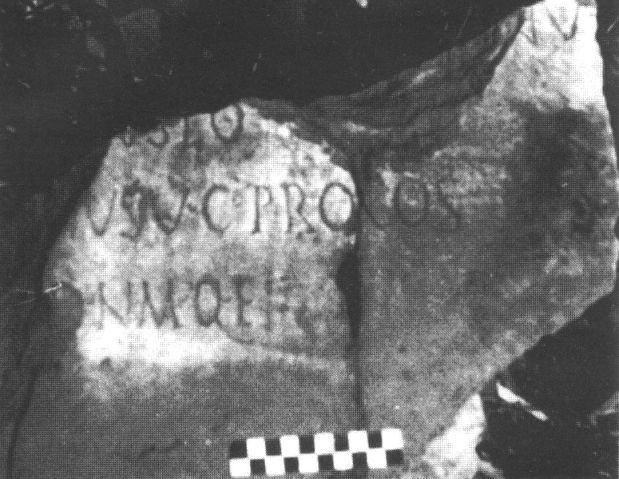
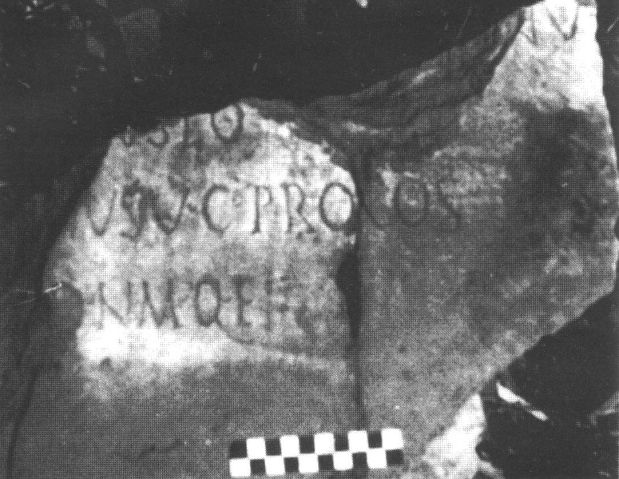
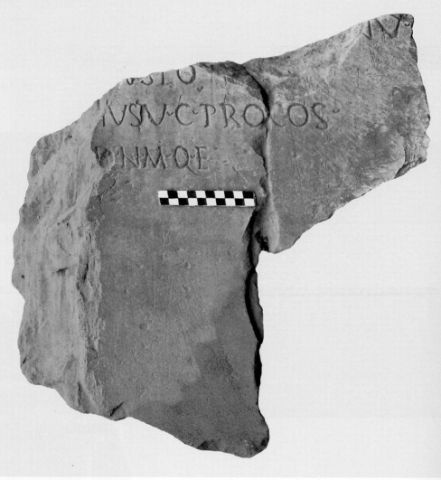
Inscription
[---divina stirpe progenito], / [d(omino) n(ostro) Fl(avio) Constantino, i]nv(icto) / [et semper Aug]usto --- / [-----------------]ius, v(ir) c(larissimus), proco(n)s(ul) --- / [prov(inciae Achaiae)], d(evotus) n(umini) m(aiestati) q(ue) e(ius)--- / ---
Inscription translation
To our lord Flavius Constantinus of divine parentage, the unconquered and eternal Augustus
... ius, of clarissimus rank, governor (proconsul) of the province of Achaea, devoted to his divine spirit and majesty, [set this up].
Bibliography
- Inscriptiones Graecae, II/III(2) 13269
Discussion
INSCRIPTION
Partly preserved in four lines:
[---divina stirpe progenito], / [d(omino) n(ostro) Fl(avio) Constantino, i]nv(icto) / [et semper Aug]usto --- / [-----------------]ius v(ir) c(larissimus), proco(n)s(ul) --- / [prov(inciae Achaiae)], d(evotus) n(umini) m(aiestati) q(ue) e(ius)--- / ---.
'To our lord Flavius Constantinus of divine parentage, the unconquered and eternal Augustus ...
... ius, of clarissimus rank, governor (proconsul) of the province of Achaea, devoted to his divine spirit and majesty, [set this up].'
The completion of this inscription, with the name of Constantine, is hypothetical, suggested by Sironen in IG II/III(2) (see below, 'Honorand, Awarder and Date').
DESCRIPTION (from Sironen and the published photo):
Fragment of a grey marble block, broken on all sides and on back. Vertical cleft on front. Letter height 3-4.3 cm.
PROVENANCE:
From the Roman Agora in Athens. Now in the storerooms of A' Ephoria, inv. no. PA 1672.
HONORAND, AWARDER AND DATE:
Of the imperial name nothing is preserved. Sironen 2001 had suggested Constantius II or Constans as honorands, but corrected this in IG II/III(2) to Constantine I on the basis of l. 3 '-nv-' (presumably from 'invicto'), the only trace of the imperial title.
Constantine was Augustus in the West from 306 onwards, but fully recognized in the East only from 310 (Kienast 1996). The inscription, though heavily damaged, gives the proconsular title of the awarder and provides therefore a terminus post quem of 324, the year when the governorship of Achaea was again elevated to a senatorial proconsulship (Groag 1946).
FURTHER DISCUSSION:
This base belongs to a set of four or five fragmentary honorific bases for emperors of the Constantinian dynasty set up in the Roman Agora of Athens, recognised and fully discussed by E. Sironen (Sironen 2001). In our catalogue we have included only the three most complete bases (LSA-399, LSA-400, and LSA-402 here), while fully accepting Sironen's argument that they probably form part of a larger contemporaneous set. This fragment is Sironen 2001, no. 3. Similar lettering and the reoccurring formula ('...ius vir clarissimus proconsul, devotus numini maiestati que eius') justify the attribution of these five bases to a set of contemporaneous honorific monuments, whose Constantinian date is provided by Sironen 2001 no. 2 (LSA-400), where the name partially survives. The bases testify to a Constantinian dynastic group in the Roman Agora of Athens, perhaps set up in the context of Constantine I's succession plans in the 330s (Sironen 2001, 262-3).
Discussion references
- Groag, E., Die Reichsbeamten von Achaia in spätrömischer Zeit, Budapest 1946, 22
- Kienast, D., Römische Kaisertabelle. Grundzüge einer römischen Kaiserchronologie, Darmstadt (2)1996, 299
- Sironen, E., 'Lateinische und griechische Inschriften der Spätzeit aus Attika', Zeitschrift für Papyrologie und Epigraphik 136, 257-266, Bonn 2001, 260-1 no. 3
Cite: Last Statues of Antiquity, LSA-402 (Ulrich Gehn).