
LSA-409
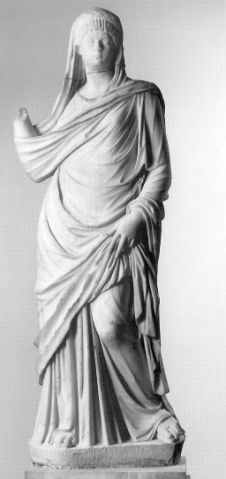
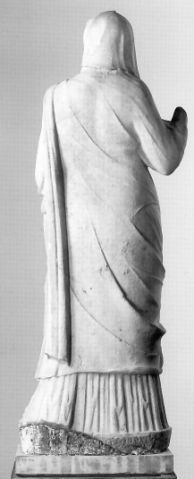
Portrait statue re-used for a mother-in-law. From Rome. Fourth century.
Record details
Photographs

Bibliography
- Johansen, F. , Catalogue of the Roman Portraits III; Ny Carlsberg Glyptotek, (Copenhagen 1995), 196-99, no. 87
- Schade, K., Frauen in der Spätantike--Status und Repräsentation, Mainz 2003, 181-82, no. 1 19, pl. 34 and 35.3
Discussion
DESCRIPTION (Object)
Over life-size statue. H: 189 cm. Marble.
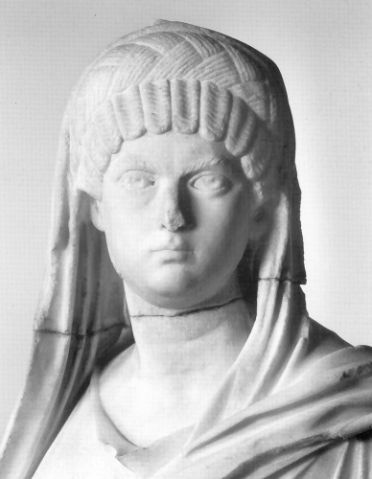
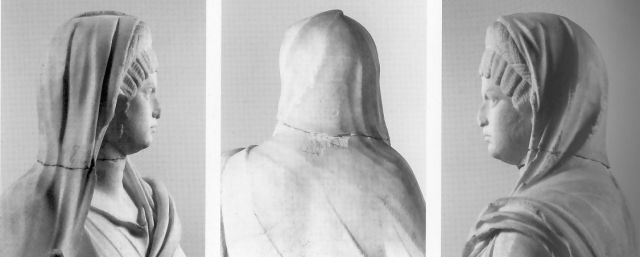
The statue is missing the right hand and tip of the nose. The head, which was worked in one piece with the body, has broken off and been reattached. The head has been reworked; and in front of the right ears are remnants of the original hairstyle (Johansen).
The eyebrows have been heavily scored with a flat chisel, and the line below them emphatically inscribed. The pupils of the eyes are marked by large U-shaped depressions.
PROVENANCE
From Rome. Found near the Lateran behind the Scala Santa in 1885.
DESCRIPTION (Subject)
The statue follows the well-known ‘Ceres’ type which dictates the dress and most of the stance. The statue wears a himation over a chiton. The himation covers the head but is lifted up at the left thigh, thus revealing the chiton below. The sandals on the feet have two bands which converge at a thong between the first and second toes.
The weight is on the right leg. The right arm is bent and the upper arm is raised . The left arm remains along the side of the body, and the left hand, resting near the left thigh, pulls the hem of the himation up. The head turns to its left. The right arm of this body type usually holds a torch or sheaves of grain.
The re-cut head has a small but full face with a distinctive physiognomy. The eyebrows arch forcefully; the nose is hooked; and a small round chin is followed by fleshy skin, a double chin.
The hair is divided into two sections. Crimped waves with vertical divisions frame the face. A thick braid sits above them like a crown. The braid is marked by overlapping diagonal locks.
INSCRIPTION
ΤΗΝ ΠΙΝΥΤΗΝ ΕΚΥΡΗΝ ΕΥΒΟΥΛΙΟΝ ΙΣΑΤΟ ΓΑΜΒΡΟΣ
'Eubulion, the son-in-law, set up his wise mother-in-law.'
DATE
The letter forms of the inscription are clearly late, and the re-worked portrait head (hairstyle and technique) suggests a mid-fourth century date.
Discussion references
- Meischner, J., Bildnisse der Spätantike : 193-500 : Problemfelder : die Privatporträts , Berlin 2001, 180 (under 324-337) and 181 (under 364-379)
- von Heintze, H. ‘Ein spätantikes Mädchenportät in Bonn. Zur stilitischen Entwicklung des Frauenbildnisses im 4. und 5. Jahrhundert’, Jahrbuch für Antike und Christentum 14, Münster 1971, 73, no. III 2 (first third of fourth century)
Cite: Last Statues of Antiquity, LSA-409.