
LSA-410
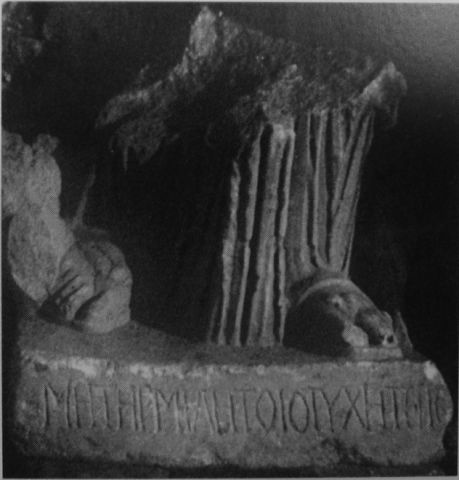
Fragmentary re-used female statue with epigram. From Miletus. Fourth century or later.
Record details
Photographs
Bibliography
- Rehm, A., and P. Herrmann, Inschriften von Milet, Teil I (Milet VI, 1), Berlin 1997, fasc. 3, 244-45, no. 1402, pl. 39
Discussion
DESCRIPTION (Object)
Fragment of legs and plinth of over life-size statue. H of plinth: 10; W: 47 cm. Marble.
The statue is broken through the shins, and the plinth is broken on the proper left. There is broken stone outside the left foot which may be drapery or an attribute. The folds of a chiton are schematically and sharply rendered. The slightly rounded plinth bears a cramped epigram.
PROVENANCE
Miletus.
DESCRIPTION (Subject)
The plinth supports the lower legs of a female statue of standard dress, size, and manufacture for the high imperial period. A fine, copious chiton falls around the lower legs. A trace of the heavier himation seems to appear on the outside of the left leg. The feet wear sandals with a thong between the big and second toes. The left leg bears the weight and the right foot is slightly raised. The position of the legs recalls the Small Herculaneum type. Hermann speculates about the presence of a rudder on the right (viewer's) side of the plinth but without better images this is difficult to assess.
INSCRIPTION
The slightly rounded plinth bears an incomplete epigram which has been variously restored.
Μήτηρ Μιλήτοιο Τύχη τε πό[ληος ...
Restorations (as presented by Hermann):
Μήτηρ Μιλήτοιο Τύχη τε πό[ληος ἀγαυῆς]
Μήτηρ Μιλήτοιο Τύχη τε πό[ληος ἔγωγε]
Μήτηρ Μιλήτοιο Τύχη τε πό[ληος Ἄρεια]
'Mother of Miletus and Tyche of the illustrious city.'
'I am mother of Miletus and Tyche of the city.'
'Areia, mother of Miletus, and Tyche of the city.'
None of the restorations is entirely satisfactory. The third interpretation takes the 'mother' of the inscription to refer to the mother of the legendary founder of Miletus (also named Miletus) and thus conjectures that the name Areia is missing. The conflation of Tyche with the mother of the founder or with the mother of the city are unusual.
DATE
The statue itself probably belongs to the late second century on the basis of the technical rendering. The lettering of the inscription, however, should date in or after the fourth century. The lack of clarity in the traditional sense of the text would suit such a date.
Cite: Last Statues of Antiquity, LSA-410 (J. Lenaghan).