
LSA-412
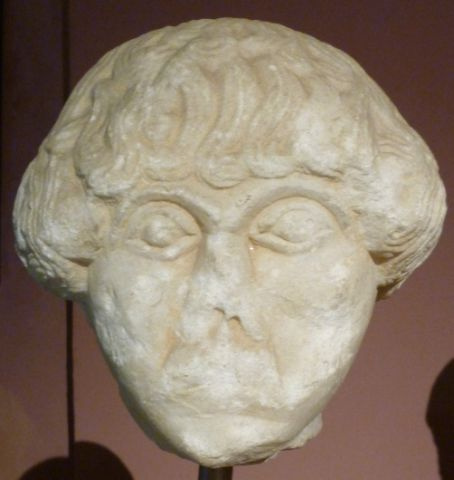
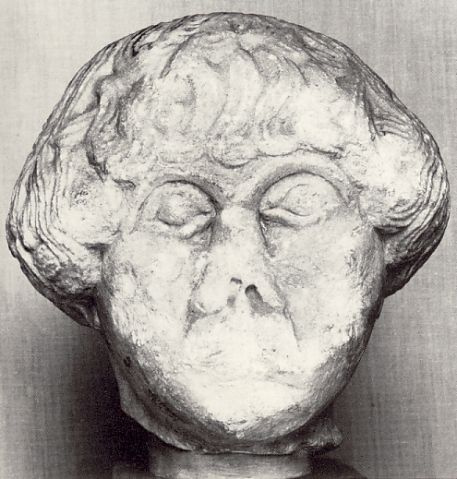
Portrait head of man with mop hairstyle. From province of Hellespontus. Sixth century.
Record details
Photographs
Bibliography
- Fıratlı, N., La sculpture byzantine figurée au Musée archéologique d'Istanbul, Paris 1990, 15-16, no. 25, pl. 12 (first half of 6th c.)
- Inan, J. & E. Alföldi-Rosenbaum, Römische und frühbyzantinische Porträ̈tplastik aus der Türkei : neue Funde, Mainz 1979, 159-60, no. 112, pl. 269 (Justinianic)
Discussion
DESCRIPTION (Object)
Life-size head. H: 21, W: 21.2, D: 19.5 cm..
The head is broken through the neck. The nose and mouth are missing.
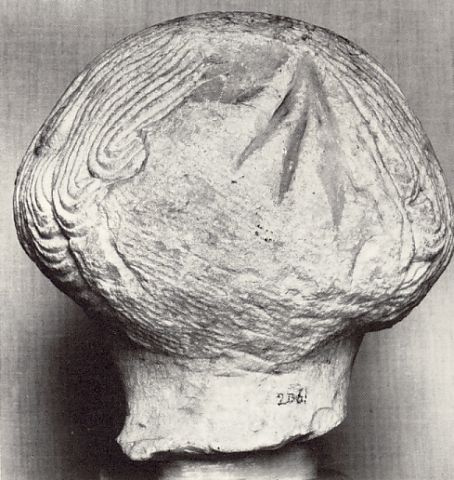
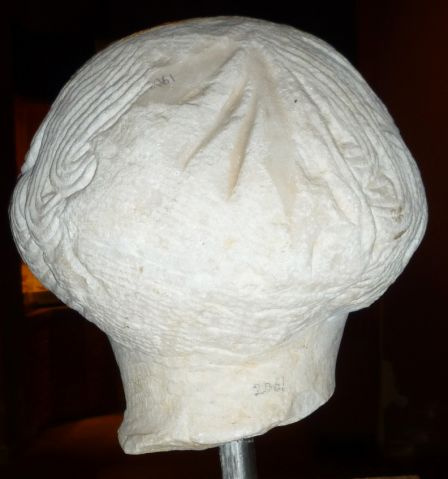
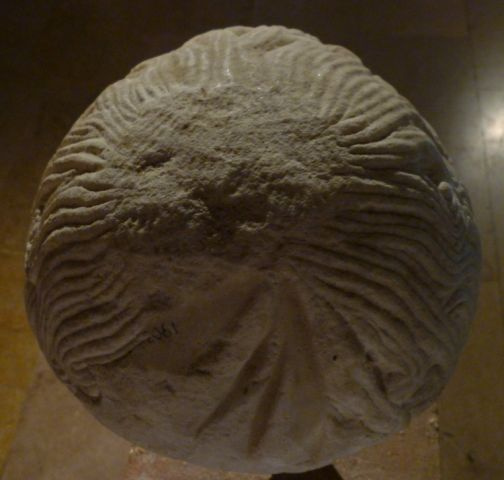
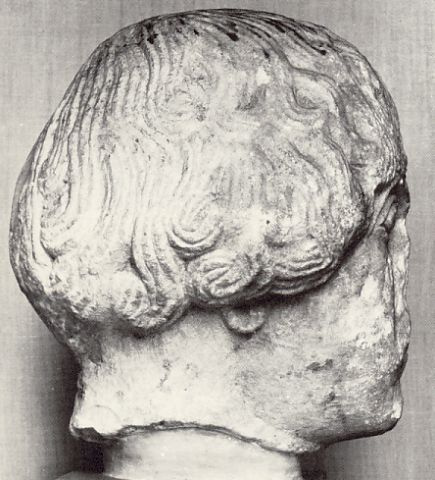
The head has been re-cut from a worked piece of marble. The hair at the very top and at the back of the head is not fully rendered. At the top of the head is a patch of surface with claw-chisel marks. At the back of the head a series of deep, fully worked grooves (perhaps once drapery folds) descend from the top and terminate in another area with a horizontally claw-chiselled surface.
The large eyes are separated from a protruding eyebrow by a deep chisel channel. Another such channel runs under the lower lid. The eyeball itself is convex but otherwise unmarked.
PROVENANCE
Found in the modern province of Çanakkale between the cities Biga, Balikesir, and Bayramiç. According to Inan and Rosenbaum, the findspot was Kayalıdağ, a mountain and according to Fıratlı, the findspot was the village of Kayadağ which is either too small to appear on any map or the name of which has since changed. Inan and Rosenbaum write that it was found in 1909, and Fıratlı, that it entered the Istanbul museum in 1909.
DESCRIPTION (Subject)
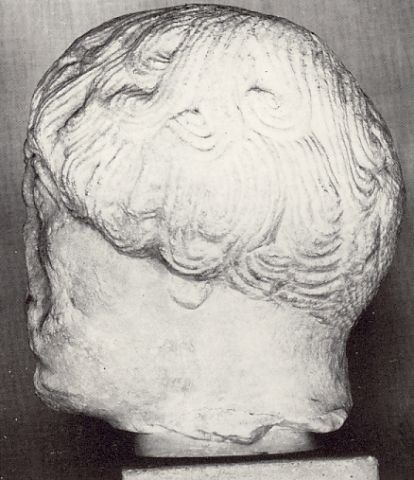
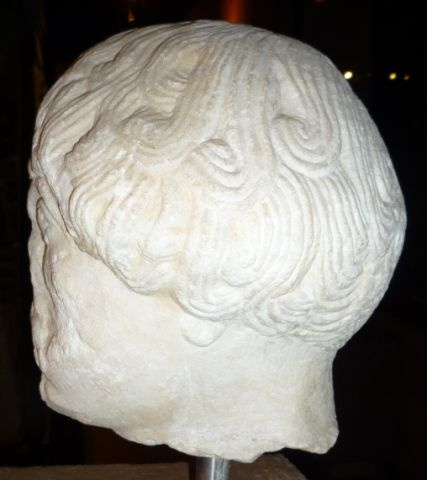
The portrait shows a fragment of a portrait of a man with long hair that ends in curls which give greater volume and create a ‘mop’ effect. The hair falls low on the brow (almost to the eyebrows) and covers the ears.
The face is round. The most striking detail are the thick, well-defined eyelids which encircle bulging eyes. A horizontal channel below the mouth turns down at both end points and suggests that the mouth was broad and glum.
There is perhaps a trace of drapery on the back left side of the neck. This is not, however, enough to justify Fıratlı’s proposal that this portrait was once attached to a chlamys body.
DATE
The head probably dates to the sixth century. Consular diptychs of the earlier sixth century provide dated examples of this hairstyle; for example, of Aerobindus (Constantinople, AD 506),Clementinus (Constantinople, AD 513), Orestes (Rome AD 530), and Apion (Constantinople AD 539)---see W.F. Volbach, Elefenbeinarbeiten der Spätantike und des frühen Mittelalters (Mainz 1976), pls. 6.13; 7.15; 16.31; and16.32. The lattermost, of Apion, perhaps provides the closest parallel in the length and broad final curl of the hair.
The best sculpted parallel for the expression and rendering of the eyes comes from Sardis LSA-1098. LSA-702 from Ephesus also has similarly worked eyes but is bearded. Moreover, both LSA-1098and LSA-702 have what is usually termed a 'wreath' rather than 'mop' hairstyle. LSA-697 and LSA-707, both from Ephesus are more similar in the mop style but are worked by a more competent sculptor. Thus, scholars are divided over the date of LSA-702 (either mid-fifth or mid-sixth century) and place LSA-697 and LSA-707 in the late fifth century.
Other related portraits include LSA-413 from Sardis and LSA-385 from Laodicea.
Cite: Last Statues of Antiquity, LSA-412 (J. Lenaghan).