
LSA-414
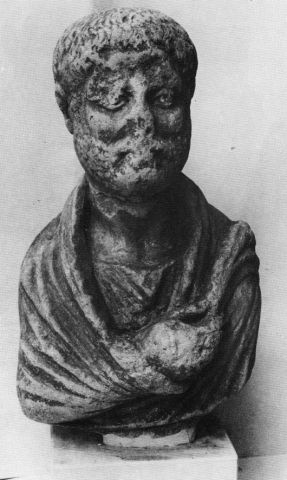
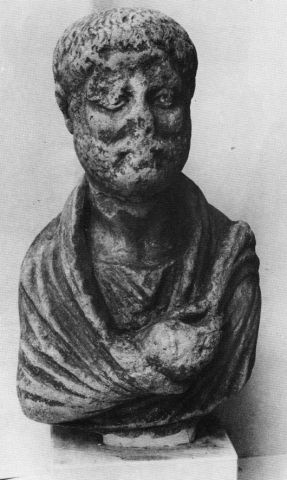
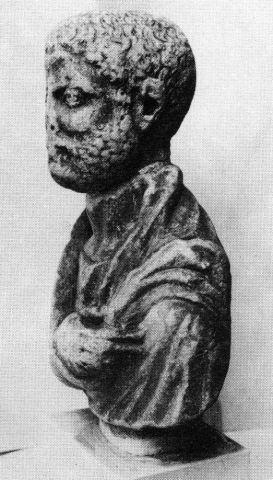
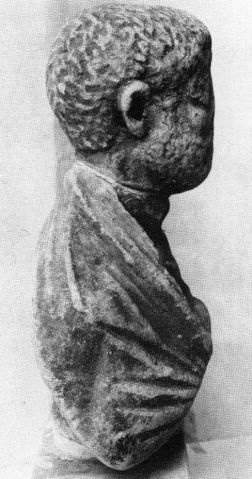
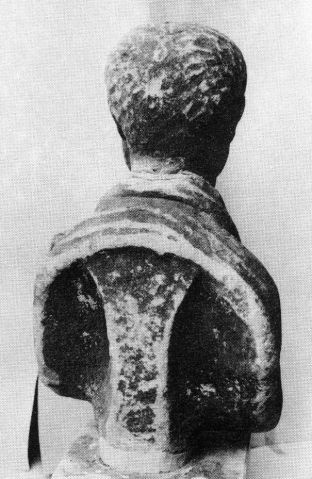
Under life-sized bust of bearded man wearing chiton and himation. Sparta. Late third to fourth century
Record details
Photographs
Bibliography
- Datsoule-Stavride, A., Romaika Portraita sto Mouseio tes Spartes, Athens 1987, pp. 26-7 without no. pls. 59-60 g
Discussion
DESCRIPTION (Object)
The neck is broken at the throat but reattached to the bust; the foot is lost. The nose is broken off, brow, eyes and mouth are chipped. Further chips on right hand and at the folds of the himation.
Above the forehead the hair is divided into wavy strands by thin, shallow chisel-lines. At the left side it is articulated by short irregular chisel strokes, at the right and back sides just roughly finished with a flat chisel.
As far as is recognizable from the published photos, the pupil is circumscribed by a circular line, the iris marked by a round drill hole (still visible on the left eye). The beard is set off the flesh by a continuous line, single locks are marked by irregular short chisel strokes.
The flesh is scarsely modelled, with few prominent points of the face (cheeks, chin) accentuated.
The bust appears undersized compared to the head.
PROVENANCE/ LOCATION
There is no published record on the provenance of the bust. It is today in Athens, National Archaeological Museum, without published inv. no.
DESCRIPTION (Subject)
The mature age of the portrayed is indicated by the full beard; his head is slightly turned to the left. He wears chiton and himation, the traditional Greek dress. His right arm looped into the himation in front of the breast.
DATE
The head was dated to the tetrarchic period by Datsoule-Stavride 1987.
The eyes are marked in a technique one would expect not earlier than in the late 3rd century; the coiffure displayed by the bust with its wavy strands is best understood as a Constantinian hairstyle; in our view, a Constantinian date is supported by the stylistic features of the face.
Cite: Last Statues of Antiquity, LSA-414 (Ulrich Gehn).