
LSA-415
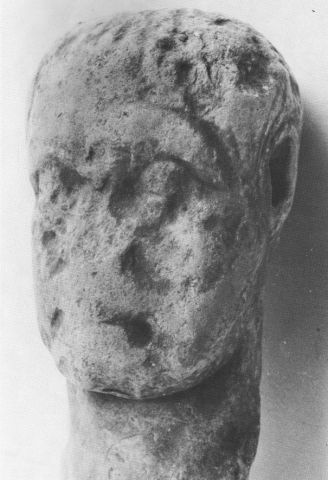
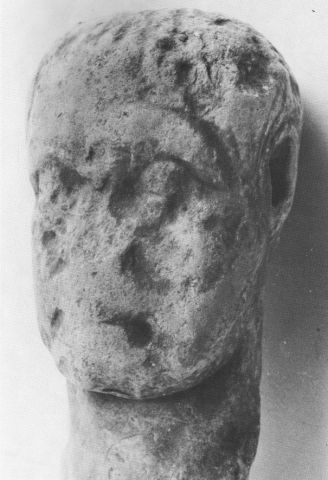
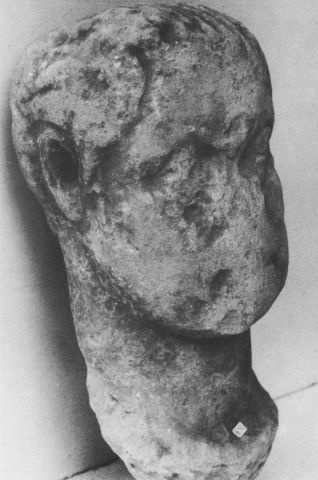
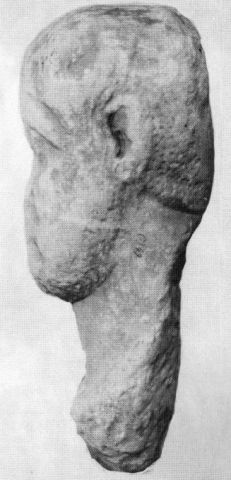
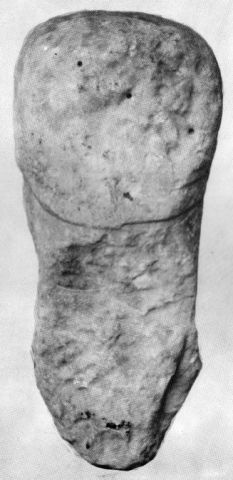
Portrait head of bearded man, re-worked from earlier portrait. Sparta. Late third to early fourth century
Record details
Photographs
Bibliography
- Datsoule-Stavride, A., Romaika Portraita sto Mouseio tes Spartes, Athens 1987, 27, figs. 61-63 b
Discussion
DESCRIPTION (Object)
Worked for insertion; the cone is roughly finished and broken at the back side. No published record on the material; H (overall) 38.6, (head) 25; W 16.8, D 15.6 cm. Eyebrows, nose, cheeks, lips, and chin are chipped off. At the back a large layer of stone is chipped off. There are three small round holes, possibly from an antique repair of that damage. The upper side of the skull is heavily washed.
The hair is a compact mass. It is set off the right ear by a deep drilled or chiselled line, and by a similar line off the flesh at the right temple. Above the right forehead some short drilled or chiselled lines separate the hairline into single compartments. Around the left ear a bit of the surface of the hair is preserved; it was picked in by a point behind the ear, whereas in front of the ear parallel chiselled lines indicate lank hair.
The ears are clumsily worked and are set to high; this and the way the hair is set off the right ear are indicators that the head in its present state is the result of a re-work.
PROVENANCE/ LOCATION
There is no published record on the provenance of the head. It is today in the Sparti Archaeological Museum, inv. no. 63.
DESCRIPTION (Subject)
The portrayed wears short hair and a trimmed beard.
DATE
The head was dated to the tetrarchic period by Datsoule-Stavride 1987.
The picked hair as visible behind the left ear is an indicator of a date in the tetrarchic period, in the late 3rd or earlier 4th century.
Cite: Last Statues of Antiquity, LSA-415 (Ulrich Gehn).