
LSA-416
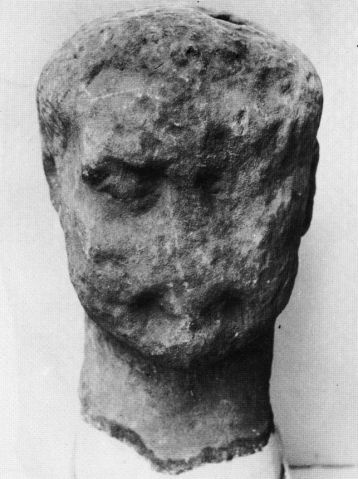
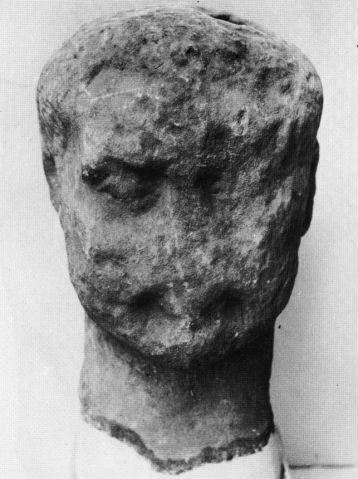
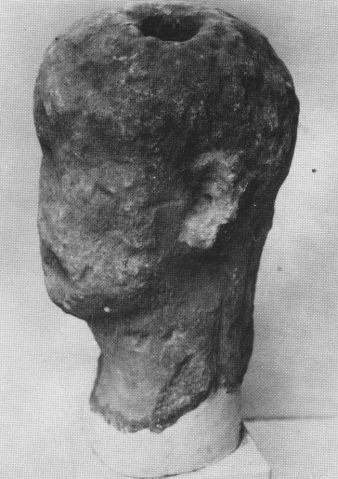
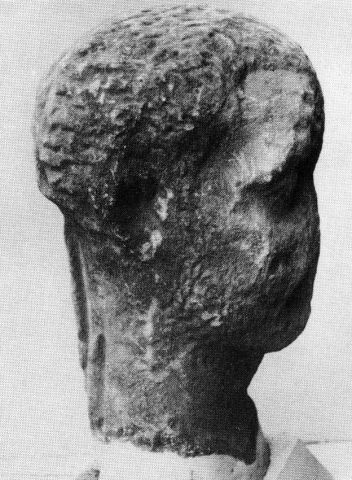
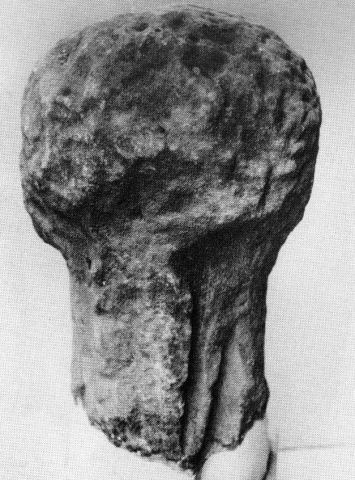
Reworked portrait head of bearded man. Sparta. Late third to fourth century
Record details
Photographs
Bibliography
- Datsoule-Stavride, A., Romaika Portraita sto Mouseio tes Spartes, Athens 1987, pp. 27-8 (without no.) pls. 64-65c
Discussion
DESCRIPTION (Object)
H (overall) 32.6, (head) 24.4, W. 19.2, D 19. 6 cm. Neck broken at collar bones, the whole surface is badly worn. Nose, left eye, right ear and a portion of the left, and mouth are broken off. On the left side of the skull there is a deep, round hole; the back of the head has been re-worked after the use as a portrait head, possibly to fit as building material.
The front of the face is chipped beyond the legibility of technical properties. At the right side a portion of the beard is preserved rendered with irregular crescent shaped short chisel strokes. The hair is rendered in small crescent shaped strands (from Datsoule-Stavride, not visible on the published photos); at the right behind the ears the surface is finished roughly with a point. This is an indicator that the head in its late-antique state was reworked from an earlier portrait.
PROVENANCE/ LOCATION
There is no published record on the provenance of the head. It is today in the Sparti museum, without published inv. no.
DESCRIPTION (Subject)
The portrayed is a man with short hair and a short beard.
DATE
Datsoule-Stavride 1987 dated the head to the tetrarchic period.
The way the beard is rendered, and the re-use with the rough finish of the back assign a late-antique date to the head.
Cite: Last Statues of Antiquity, LSA-416 (Ulrich Gehn).