
LSA-418
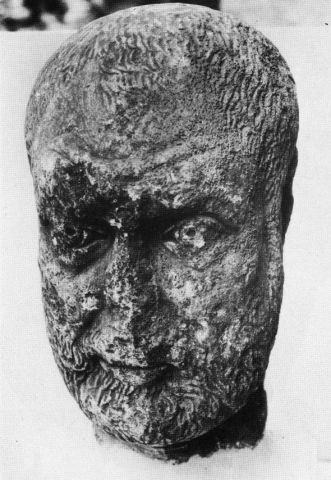
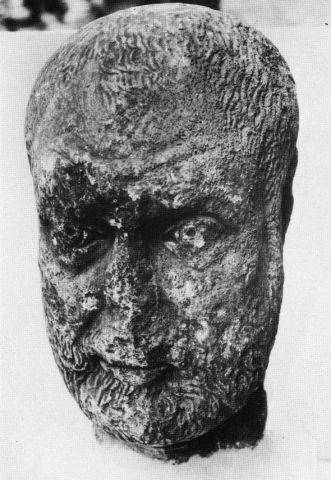
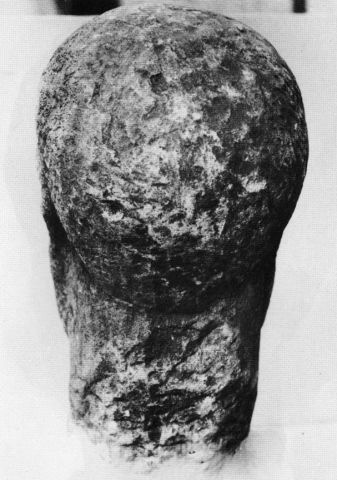
Portrait head of bearded man. Sparta. Late third to earlier fourth century
Record details
Photographs
Bibliography
- Datsoule-Stavride, A., Romaika Portraita sto Mouseio tes Spartes, Athens 1987, p. 29 no. 6010 figs. 70-73
Discussion
DESCRIPTION (Object)
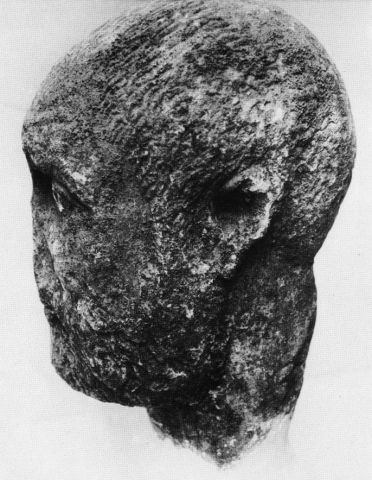
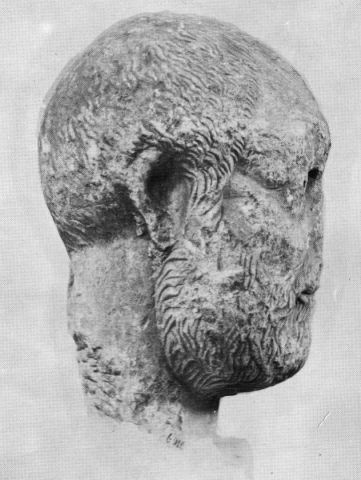
Over life-sized, H (overall) 31.4, (head) 27. 6, W 16.5, D 22.5 cm. The neck is broken at the throat. The right eyebrow, nose, and left earlobe are chipped off; at the back of the neck there is a deep hack. The surface is worn all over. The head was worked for insertion as is still visible from the beginning of the cone at the back.
The hair is indicated by wavy, parallel chisel lines; at the back it is only roughly finished. This is an indicator that the head in its present state was reworked from an earlier portrait. The beard is finished in the same technique as the hair but with shorter and irregular strokes.
Two parallel furs are carved into the brow with a chisel.
The iris is circumscribed by an incised line, the pupil is a round drilled hole in the centre of the iris.
The scarse modelings separate the large areas of the face (eye zone, cheeks, mouth) from each other; the proportions of the head are harmonized, the central vertical axis is stressed.
PROVENANCE/ LOCATION
The head was found in Sparti. It is today in the Sparti museum, inv. no. 6010.
DESCRIPTION (Subject)
The portrayed is an elderly man with an elongated face, short hair receding at the temples, and a trimmed beard. The brow is furrowed, his eyes wide open.
DATE
The head was dated to the tetrarchic period by Datsoule-Stavride.
The rendering of hair and beard, the hairstyle, and the rendering of the eyes indicate a late antique date to our head. The calm facial features with the harmonized proportions, in our view, speak in favour of a date in the later tetrarchy or the Constantinian period. This later approach, in the 4th century, is supported by the enlarged eyes.
While we favour a late tetrarchic or Constantinian date in the earlier 4th century, our outer dates account for Datsoule-Stavride's proposal.
Cite: Last Statues of Antiquity, LSA-418 (Ulrich Gehn).