
LSA-420
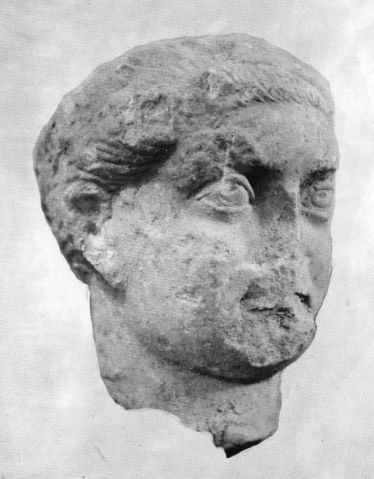
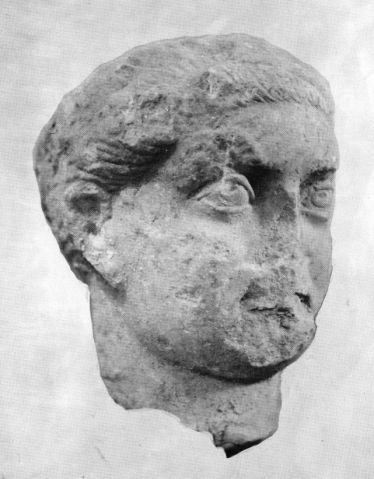
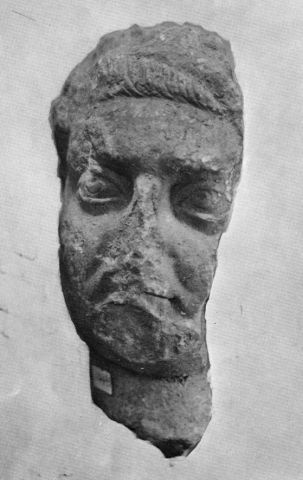
Portrait head of woman. Sparta. Early fourth century
Record details
Photographs
Bibliography
- Datsoule-Stavride, A., Romaika Portraita sto Mouseio tes Spartes, Athens 1987, p. 30 no. M 4473 figs. 76-7
Discussion
DESCRIPTION (Object)
H. 23. 5, W 10 cm. The neck is broken in an irregular line; the left part of the back head with athe left temple and a portion of the left cheek is broken off. The nose is flaked off, the right eyebrow and eye, lips, and chin are chipped. Minor chips are spread over the surface.
The hair is articulated by long parallel chiselled lines.
The iris is circumscribed by an incised line, the iris marked by a shallow round hole.
PROVENANCE/ LOCATION
There is no published record on the provenance of the head. It is today in the Sparti museum, inv. no. M 4473.
DESCRIPTION (Subject)
The portrayed is a woman with full cheeks and full round chin; naso-labial folds indicate an advanced age. Her hair is brushed to back, leaving the ears uncovered. The hairline in the back is high; the hair was probably combined there and looped unto the skull. Above the brow a diagonally encircling braid is laid over the lowest layer of hair. A hairstyle similar to the one once displayed by this badly damaged head is probably given by the head of an empress (Fausta?) in Paris (LSA-573) which accords with our head in the backward brushed hair, the diagonally encircling braid, the high hairline in the back, and the uncovered ears. There is no indication, however, that our head is the portrait of an empress.
DATE
The head was dated to the Constantinian era by Datsoule-Stavride.
Hairstyle and treatment of the eyes assign a late-antique date to our head. The conformance of the hairstyle with the portrait of Fausta in Paris ((LSA-573, see above, ‘Description (Subject)’) speak in favour of a date in the early 4th century.
Discussion references
- Schade, K., Frauen in der Spätantike--Status und Repräsentation, Mainz 2003, 90 (late third to early constaninian)
Cite: Last Statues of Antiquity, LSA-420 (Ulrich Gehn).