
LSA-422
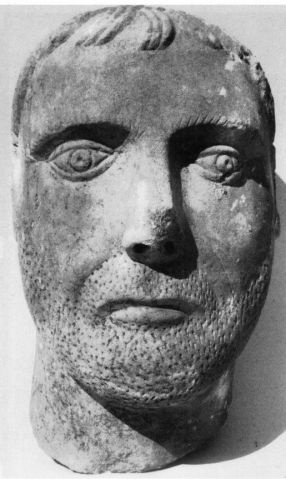
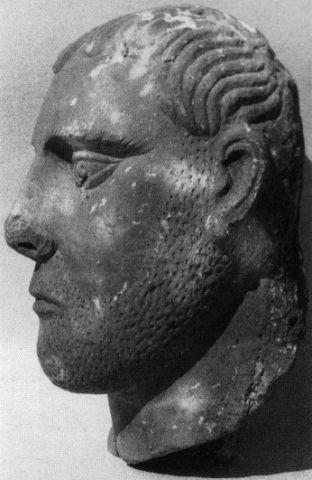
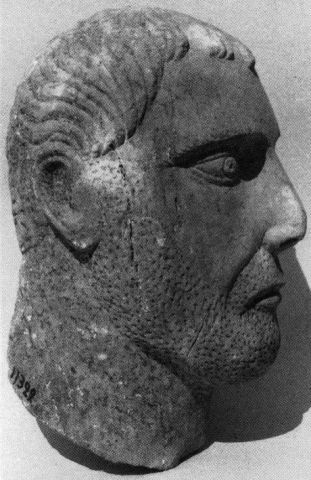
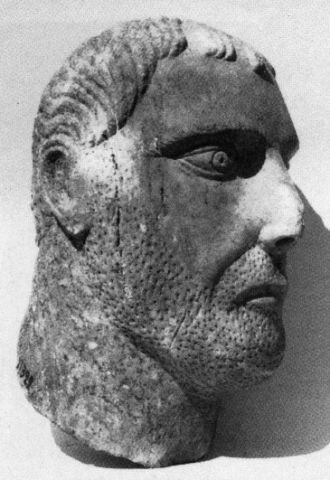
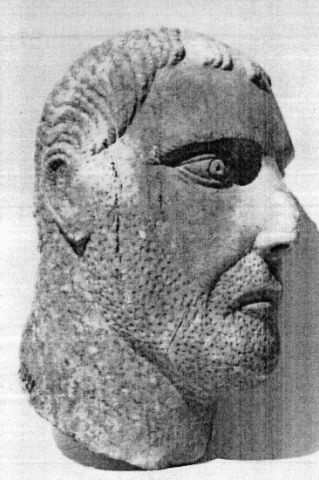
Portrait head of bearded man, reworked from earlier portrait. Sparta. Late third to fourth century
Record details
Photographs
Bibliography
- Waywell, G.B. & J. J. Wilkes, Excavations at the ancient theatre of Sparta 1992-94. Preliminary report, The Annual of the British School at Athens 90, pp. 435-460 , London 1995, pp. 458-9 no. 3 pl. 48c, 49 a-c
Discussion
DESCRIPTION (Object)
Fine to medium-grained white marble, local Laconian according to Wayward and Wilkes 1995. H (overall) 32, (chin to crown) 27.4, W 18.5, D 21.2 cm. The neck is broken close to its base. The tip of the nose and left nostril are chipped; a crack runs from the left nostril through the beard to the jaw, under the chin to the right jaw, then upwards to the right temple.
The hair around the face is accentuated into single strands by long parallel chisel lines. In the back and on top the surface is only roughly finished with a point. The beard is picked directly into the flesh with a point.
The eyebrows are marked by short vertical chisel strokes. The eyes are protruding, the iris is circumbscribed by a full circular incised line, the pupil is indicated as a small round drill hole in the centre of the iris.
The head in its present state results from reworking an older portrait. Indicators for this are the tight-fitting ears and the flattened proportions of the skull.
PROVENANCE/ LOCATION
The head was found 1993 in the orchestra drain in the theatre of Sparta. It is now in the Sparti museum, inv. no. 11322.
DESCRIPTION (Subject)
The portrayed is a mature man wearing a stubble beard; his forward-brushed hair is thinning above the brow. The wide open eyes lend an expression of alertness to the face.
The stubble beard characterizes the portrayed as of a ‘man on campaign’, as an imperial office holder; this is in good concordance with the alert eyes. In the Sparta theatre a further head of the type was found (LSA-7); the inscribed base for the governor (proconsul) of Achaea Anatolius who contributed to the cost of repairs in Sparta after the earthquake of 375 is still standing in situ in the eastern parodos of the theatre (LSA-357).
DATE
The head was dated to the last quarter of the 4th century by Waywell and Wilkes 1995.
The rendering of the eyes and the beard assign a late-antique date to our head. The picked beard is a feature of many heads of the tetrarchic period, but a date later in the 4th century can by no means be excluded.
Cite: Last Statues of Antiquity, LSA-422 (Ulrich Gehn).