
LSA-424
Base for statue of Erotius, priest of the Eleusinian goddesses, apparently lost. From Athens (Achaea). Third to fourth century.
Record details
Photographs
Inscription
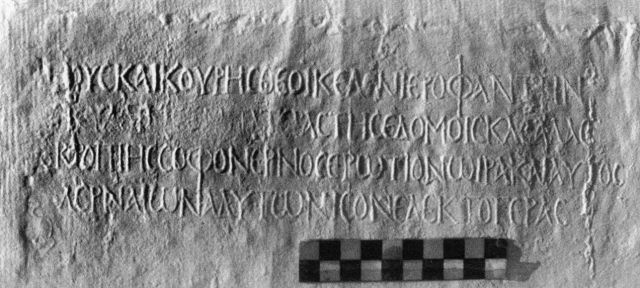
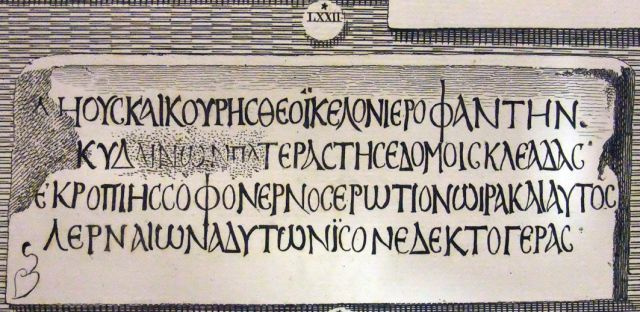
Δηοῦς καὶ Κούρης θεοΐκελον ϊἑροφάντην / κυδαίνων πατέρα στῆσε δόμοις Κλεάδας, / [Κ]εκροπίης σοφὸν ἔρνος Ἐρώτιον· ὧι ῥα καὶ αὐτὸς / Λερναίων ἀδύτων ἶσον ἔδεκτο γέρας.
Inscription translation
Cleadas set (this) up (to) his father in the temple of the goddesses, thus honouring the god-like priest (hierophant) of Demeter and Kore, Erotius, the wise offspring of (the city of) Cecrops (=Athens). Like him, he himself held the same honour (of being a priest) of the Lernaian sanctuary.
Bibliography
- Inscriptiones Graecae, II/III 3674
- Inscriptiones Graecae, II/III(2) 13278
Discussion
INSCRIPTION
Verse inscription of two elegiac distichs laid out in four lines:
Δηοῦς καὶ Κούρης θεοΐκελον ϊἑροφάντην, /
κυδαίνων πατέρα στῆσε δόμοις Κλεάδας, /
[Κ]εκροπίης σοφὸν ἔρνος Ἐρώτιον· ὧι ῥα καὶ αὐτὸς /
Λερναίων ἀδύτων ἶσον ἔδεκτο γέρας.
'Cleadas set (this) up (to) his father in the temple of the goddesses, thus honouring the god-like priest (hierophant) of Demeter and Kore, Erotius, the wise offspring of (the city of) Cecrops (=Athens). Like him, he himself held the same honour (of being a priest) of the Lernaian sanctuary'.
DESCRIPTION
Sironen published the inscription from a squeeze kept in Berlin (cf. below, 'Provenance and current Location'). The drawing in Chandler 1763 suggests that it was on a rectangular base.
PROVENANCE AND CURRENT LOCATION
The base was found in the area of the modern Metropolis Church and removed in the early 17th century to Oxford, where it formed part of the collection of antiquities of the Earl of Arundel. Sironen, who published it from a squeeze, reports that he was not able to find the base in Oxford.
HONORAND, AWARDER AND DATE
Poetic forms were used in a religious dedicatory context already long before the late Roman period, 'so that the form itself does not provide us with a clue as to its more exact date' (Sironen 1997, 75). Follet 1976, 273 was the first scholar to propose a late date 'between the middle of the 3rd and the end of the 4th century', on the basis of the irregular letter forms. The awarder Cleadas, son of the honorand, may be the same 'Cleadas' commemorated in the Palatine Anthology 9, 688 as the restorer of a city gate in Argos and as a priest in Lerna (Follet 1976, 273; Sironen 1994, 34; Sironen 1997, 75 n.118). This epigram in the Palatine Anthology contains a reference to Roman emperors in the plural (basileon), which, as Sironen has pointed out, best fits a late date. Sironen also points out that the combination of priesthoods (at Eleusis and Lerna) mentioned in our inscription feature on a taurobolic inscription in Athens that is almost certainly of 4th century date (IG II/III 4841; Sironen 1994, 34; Sironen 1997, 75; on the introduction of the taurobolium into Athens, Frantz 1988, 19).
We have chosen to leave the dating more open, while not excluding a date in the fourth century.
Discussion references
- Inscriptiones Graecae; , II/III 4841
- Chandler, R., Marmora Oxoniensia ex Arundelianis, Seldenianis aliisque conflata, Oxford 1763, 111 no. 72
- Follet, S., Athènes au IIe et au IIIe siècle. Études chronologiques et prosopographiques, Paris 1976, 273
- Sironen, E., The late Roman and early Byzantine inscriptions of Athens and Attica, Dissertation - University of Helsinki 1997, 74-5 no. 16
- Sironen, E. , 'Life and administration of late Roman Attica in the light of public inscriptions'
P. Castrén, Post-Herulian Athens : aspects of life and culture in Athens, A.D. 267-529 , Helsiniki 1994, 15-62, 33-4 no. 17 - Waltz, P. & G. Soury, Anthologie Greque. Première Partie. Anthologie Palatine. Tome VIII (Livre IX, Épigr. 359-827), Paris 1974, 139 no. 688
Cite: Last Statues of Antiquity, LSA-424 (Ulrich Gehn).