
LSA-427
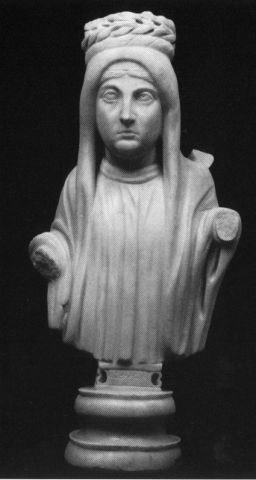
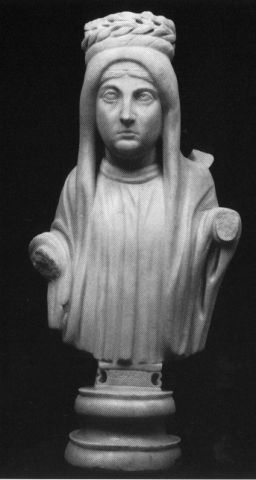
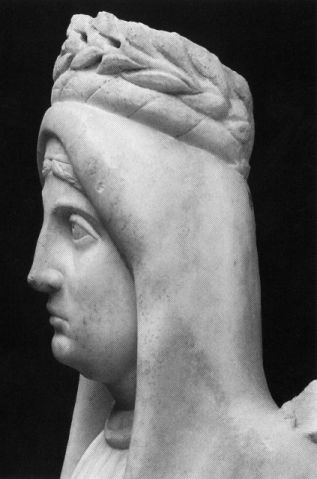
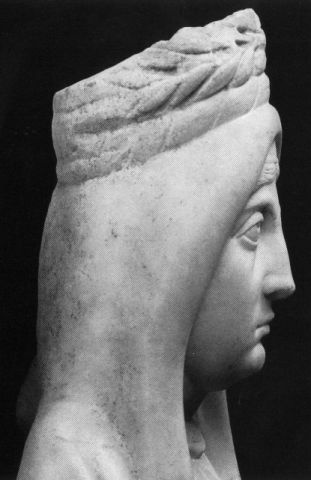
Portrait bust of woman with tabula inscribed Isbardia. From Asia Minor. Late fourth to fifth century.
Record details
Photographs
Bibliography
- Schade, K., Frauen in der Spätantike--Status und Repräsentation, Mainz 2003, 194-6 pl. 46, 1-4; 47,1(late fourth c.)
Discussion
DESCRIPTION (Object)
Life-size bust. H: 72, H (chin to headband): 16.5 cm. White marble.
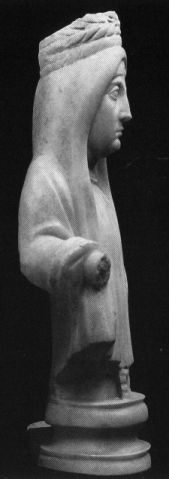
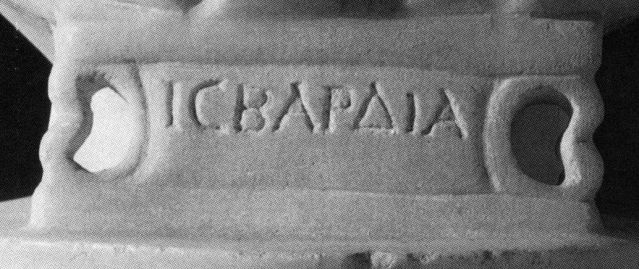
The bust is worked in one piece from its cylindrical foot to the wreath on the top of the head. It is missing both wrists and hands and the attribute held in the left arm for which there is a strut at the back of the left shoulder. The pupils are marked high on the eyeball by a low U-shaped drill channel. The curving lateral sides of the tabula are drilled out.
The tabula bears a one-line inscription.
PROVENANCE
Purchased in Izmir in 19th century. R. Känel believes that it probably produced in Side or Perge and that it comes from southern Pisidia where the older dialect might have continued and where the modern city Isparta is located.
INSCRIPTION
In one line on the tabula:
Ισβαρδια
Ispardia
This name relates to the Pamphylian name Sphardias. It probably denotes a city or an area.
DESCRIPTION (Subject)
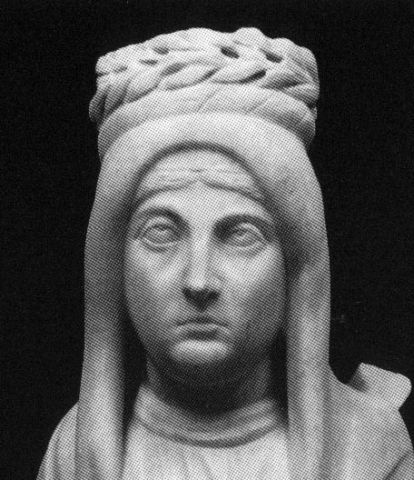
The portrait bust shows Isparta. She wears two garments. A heavy outer one is draped over the head, shoulders, and arms. Below this she wears an inner garment which has a high, double-edged, round neckline. Below the bordered neckline the folds hang straight down. On top of her head, on top of the heavy outer garment, is a crown composed of a twisted band and olive leaves above the band. She faces forward and once held an object in her left hand.
The hair is entirely concealed except for a small area at the centre of the brow. It is parted there and pulled back to the sides in long undulating strands. Directly above the parting a thin headband is visible. This is said to be the edge of a bonnet covering the hair but in the photographs it is difficult to assess.
The face is a long and full oval. The brow is low. The eyes are large. The nose is straight and long. The mouth is short from side to side. The rounded chin is well-defined but not projecting, and loose skin hangs below it.
The bust rests on a cylindrical foot which is nicely moulded above and below. Between the bust and the foot the spine is faced at the front by the inscribed tabula.
DATE
The technique suggests a date in the later fourth century or early fifth. The facial type is comparable to that of two female busts which certainly fall into that period (LSA-91 from Thessaloniki and LSA-446from Stratonicea).
IDENTIFICATION
The inscription gives a female name. It might represent a priestess (Schade) or more convincingly a city/region (Şahin) or a founding figure of a city. It lacks a contemporary name, wears a most unusual wreath, and holds attributes. Şahin has postulated that the bust may actually prove that the modern city Isparta (the city name is not Turkish) was possibly an ancient city named Isbardia.
Discussion references
- Känel, R. 'Eine Beschriftete römische Porträtbüste aus Pamphylien', Epigraphica Anatolica. Zeitschrift für Epigraphik und historische Geographie Anatoliens. 13, Bonn 1989, 123-4, pl. 4
- Şahin, S. 'Zur Identification einer Ortschaft und einer Büste ΙΣΒΑΡΔΙΑ = ISPARTA ?', Epigraphica Anatolica. Zeitschrift für Epigraphik und historische Geographie Anatoliens. 13, Bonn 1989, 125-6
Cite: Last Statues of Antiquity, LSA-427 (J. Lenaghan).