
LSA-429
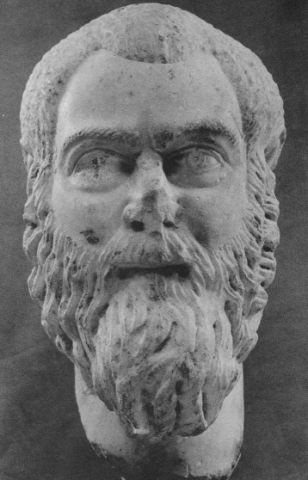
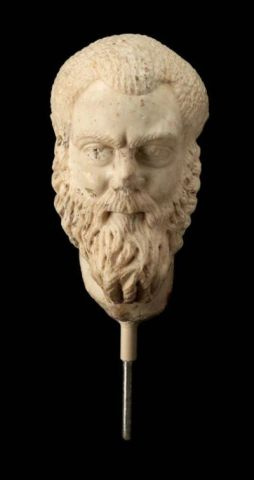
Portrait head of long-bearded man. From Athens or Corinth. Fourth to early fifth century.
Record details
Photographs
Bibliography
- Comstock, M.B. and C.C.C. Vermeule, Sculpture in Stone. The Greek, Roman, and Etruscan Collections of the Museum of Fine Arts Boston, Boston 1976, p. 243 no. 381
Discussion
DESCRIPTION (Object)
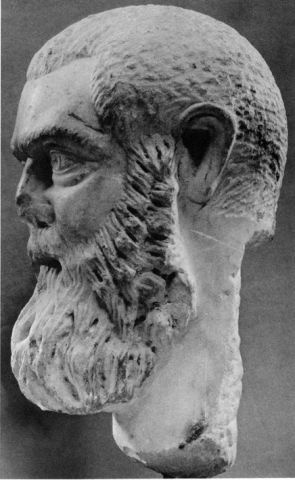
Pentelic marble, H 46.3 cm. Worked for insertion; the back of the neck is blocked out rectangular. The tip of the nose is broken off, the right eye is chipped.
The hair is a dense cap-like mass set off the flesh by an uninterrupted line. Single locks are indicated with a flat chisel; behind the ears the surface is worked only summarily. On the cheeks, single strands of the long beard are separated from each other by deep drill lines and subdivided by chiselled lines. At the chin the beard is mainly worked with a chisel with the drill only sporadically applied; the moustache is in chisel work.
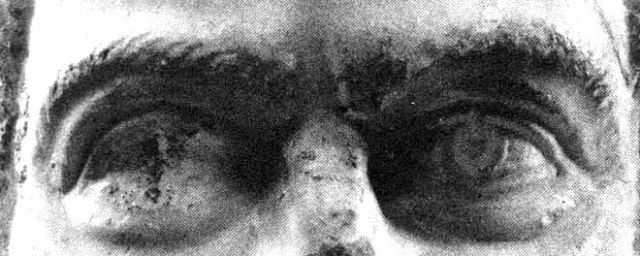
The eyebrows are marked by short chisel strokes. The iris is a shallow cavity framed by a thin bulgy line; the pupil is standing proud next to the upper lid.
The flesh is highly polished; the area of the eyes is set off the cheeks by a sharp ridge. The marked cavity of the eye zone might be an indicator that this portrait was re-worked from an earlier one; a further indicator for this are the tight fitting ears.
PROVENANCE AND CURRENT LOCATION
There are two conflicting informations about the provenience of the portrait. It is said to have been found in a well at Agia Paraskevi near Athens, in the area of an early Christian basilica (Comstock & Vermeule 1976); on a photocopy in the library of the Corinth excavations it is said to be from Corinth. The head is today in Boston, Museum of Fine Arts, J. H. and E. A. Payne Fund, inv. no. 62.465.
DESCRIPTION (Subject)
The portrayed has himself styled in this over life-sized portrait with a striking contrast between the short cropped hair and the long beard. The eyes are wide open, which might be associated with the spirituality of the ‘Holy man’ or with the alertness of the office-holder. A comparable syntax is offered by another Athenian head (LSA-131).
Vermeule’s proposal to identify the portrayed with Saint Paul (Comstock & Vermeule 1976, 243 no. 381) was dismissed by Breckenridge (in Weitzmann 1979 no. 270) and Herrmann (in Kondoleon 2000 no. 97); both argued in favour of a pagan philosopher. Vermeule alternatively proposed an identification of the portrayed with Iamblichus the younger (PLRE I, 451-2 Iamblichus 2) who was honoured with an inscribed portrait herm in Athens (LSA-135).
DATE
The head was dated to around 400 by Vermeule (Comstock & Vermeule 1976); it was associated with the ‘subtle style’ (art-historical category established by L’Orange 1961) of the first decades in the 5th century by Sydow 1969; a date around 400 was adopted by Bowersock (in Weitzmann 1979, no. 270). According to Herrmann (in Kondoleon 2000 no. 97) the hair indicates a date in the tetrarchic period (specified as ‘275-325’).
The rendering of the eyes assigns a late-antique date to our head. The emphatic glance of the eyes of this non-imperial portrait indicates, in our view, a date not earlier than the later 4th century.
Discussion references
- Kondoleon, C., Antioch: The Lost Ancient City, Princeton 2000, pp.210-11 no. 97 (J. Herrmann)
- L'Orange, H. P., 'Der subtile Stil. Eine Kunstströmung aus der Zeit um 400 n. Chr.', Antike Kunst , 4 (1961) 68-75
- Sydow, W. von, Zur Kunstgeschichte des spätantike Porträts im 4. Jahrhundert. n. Chr, Bonn 1969, pp.109-11
- Verduchi, P., "Equus: Constantinus", in E. M. Steinby (ed), Lexicon Topographicum Urbis Romae, vol. 2, Rome 1995
- Weitzmann, K. (ed.), Age of spirituality : late antique and early Christian art, third to seventh century : catalogue of the exhibition at the Metropolitan Museum of Art, November 19, 1977, through February 12, 1978, New York 1979, pp. 291-2 no. 270 (J. D. Bowersock)
Cite: Last Statues of Antiquity, LSA-429 (Amelia Brown/ Ulrich Gehn).