
LSA-43
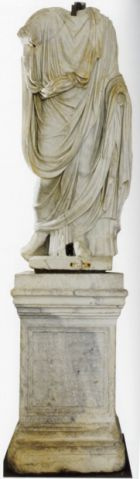
Base for toga statue of Quintus Flavius Maesius Lollianus, senatorial patron. From Puteoli. 334-342
Record details
Photographs
Inscription
Mavortii. / Q(uinto) Flavio Maesio Egnatio Lolliano, c(larissimo) v(iro), / q(uaestori) k(andidato), praetor(i) urbano, auguri publico po/puli Romani Quiritium, cons(ulari) albei Ti/beris et cloacarum, cons(ulari) operum publi/cum (sic, for ‘publicorum’), cons(ulari) aquarum, cons(ulari) Camp(aniae), /(7) comiti Flaviali, comiti Orientis, comitis (sic, for ‘comiti’) primi / ordinis et proconsuli provinciae Africae, / colligeus (sic) Decatressium patrono dignis/simo posuerunt.
Inscription translation
(Statue of) Mavortius. To Quintus Flavius Maesius Egnatius Lollianus, of clarissimus rank, quaestor (quaestor Kandidatus), urban praetor, public augur of the people of Rome and Quirites, officer in charge (consularis) of the banks of the Tiber and of the sewers, officer in charge (consularis) of public buildings, officer in charge (consularis) of the aqueducts, governor (consularis) of Campania, count in the imperial court of the Flavians (comes Flavialis), count of the East (comes orientis), count of the first order and governor (proconsul) of the province of Africa; the association of the decatrenses (collegium decatressium) set [this] up, to the most worthy patron.
Bibliography
- Corpus Inscriptionum Latinarum; , X, 1696
- Camodeca, G., 'Ricerche su Puteoli tardoromana (fine II-IV secolo)', Puteoli, IV (1981) 59-128, p. 101, n. 136
- Dessau, H., Inscriptiones latinae selectae, Berlin 3rd ed. 1962, 1224c
- Zevi, F. [et al.]., Museo Archeologico dei Campi Flegrei: Castello di Baia. II. Catalogo generale. Pozzuoli., Naples 2008, pp. 152-153 (R. Marchesini)
Discussion
INSCRIPTION
In ten lines. Letter height 7.3 (signum) and 2-4 cm.
Mavortii. / Q(uinto) Flavio Maesio Egnatio Lolliano, c(larissimo) v(iro), / q(uaestori) k(andidato), praetor(i) urbano, auguri publico po/puli Romani Quiritium, cons(ulari) albei Ti/beris et cloacarum, cons(ulari) operum publi/cum (sic, for ‘publicorum’), cons(ulari) aquarum, cons(ulari) Camp(aniae), /(7) comiti Flaviali, comiti Orientis, comitis (sic, for ‘comiti’) primi / ordinis et proconsuli provinciae Africae, / colligeus (sic) Decatressium patrono dignis/simo posuerunt.
'(Statue of) Mavortius. To Quintus Flavius Maesius Egnatius Lollianus, of clarissimus rank, quaestor (quaestor Kandidatus), urban praetor, public augur of the people of Rome and Quirites, officer in charge (consularis) of the banks of the Tiber and of the sewers, officer in charge (consularis) of public buildings, officer in charge (consularis) of the aqueducts, governor (consularis) of Campania, count in the imperial court of the Flavians (comes Flavialis), count of the East (comes orientis), count of the first order and governor (proconsul) of the province of Africa; the association of the decatrenses (collegium decatressium) set [this] up, to the most worthy patron.'
The signum was inscribed into the plinth.
DESCRIPTION
White marble base, 138 x 83 x 83 cm. The base has mouldings on top and bottom. The epigraphic field measures 51.5 x 53 cm. It is now weathered, and a damage on the lower left part affects the reading of the inscription. This must be recent, as it is not recorded in CIL. The epigraphic field was cut back, in order to erase an earlier inscription. the right side of the base has a patera, the left side has an urceus. The back bears an inscription datable to 1704, when the statue was found and re-erected. The statue (LSA-44) sits on the top.
PROVENANCE AND CURRENT LOCATION
Our base was found with the statue (LSA-44) in 1704 in the gardens of Pedro de Toledo, during the construction of the church of S. Giuseppe on modern-day Viale Capomazza. This was the area of the ancient Regio Decatriae, whose inhabitants were responsible for setting up our statue (Camodeca 1977, 68). They also dedicated LSA-335 to the son of our honorand, found in the same spot. It is now in Baia, Museo dei Campi Flegrei, Pozzuoli Sala 38 (inv. 320499).
HONORAND, AWARDER AND DATE
The inscription records a dedication to Quintus Flavius Maesius Egnatius Lollianus, a Roman aristocrat who occupied important positions in Rome, the provinces, and in the court (PLRE I, 512-514 Lollianus 5). The statue was set up before he reached the highest positions in his successful career: the prefecture of Rome, the consulship and the praetorian prefecture (not mentioned in the inscription). The latest office mentioned is the governorship of Proconsularis, datable to 334/337. The dedication must have taken place after that appointment and before his term as prefect of the City, in 342.
Lollianus was honoured with statues by different associations in Puteoli: LSA-47, LSA-332, and LSA-1909.
The statue was dedicated by the collegium Decatressium, probably an association of the inhabitants of the Regio Decatriae of Puteoli (Camodeca 1977, 66-70).
Discussion references
- Camodeca, G. "L'ordinamento in 'regiones' e 'vici' di Puteoli", Puteoli, 1, 1977, pp. 62-98
- Jones, A. H. M. et al., The Prosopography of the Later Roman Empire. Vol. I 260-395, Cambridge et al. 1971 (1975), pp. 512-514 (Lollianus 5)
Cite: Last Statues of Antiquity, LSA-43 (Carlos Machado and Ulrich Gehn).