
LSA-430
Small fragment of base for imperial statue, possibly Constantinian. Athens (Achaea). 310-337
Record details
Photographs
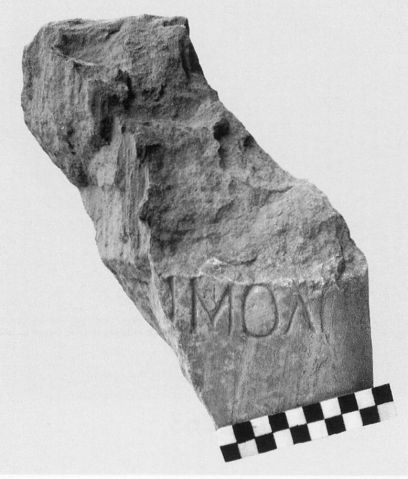
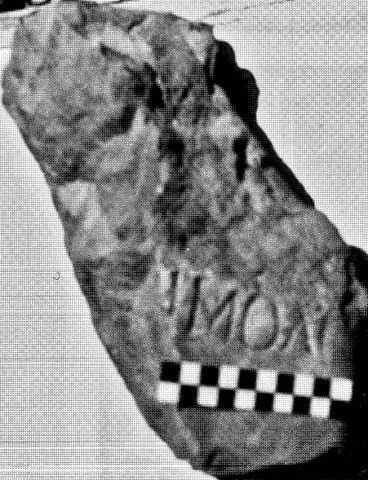
Inscription
---------imo A[ug(usto)]
Inscription translation
... to the most ... Augustus
Bibliography
- Inscriptiones Graecae, II/III(2) 13268
Discussion
INSCRIPTION
---------imo A[ug(usto)].
' ... to the most ... Augustus'.
Sironen for IG extended the inscription as follows:
[vacat? divina stirpe progenito ?] / [d(omino) n(ostro) Fl(avio)? Constantino?] / [victoriosissimo et? max]imo A[ugusto]. / vacat
'['To our Lord Fl(avius) Constantinus ?, of divine descent, the unvanquished and] most [powerful] A[ugustus]'.
DESCRIPTION
Fragment of a greyish marble block, broken on all sides with intact part at bottom. Epigraphic field smoothly finished.
PROVENANCE
From the Roman Agora in Athens. Now in the storerooms of A' Ephoria, inv. no. PA 1673.
HONORAND, AWARDER AND DATE
Sironen 2001, 262 no. 5 attributed this monument to a honorific monument for Constantine I, with a heavy restoration of the highly fragmentary inscription. Sironen himself stresses the hypothetical character of the restored inscription as well as of the attribution to Constantine I. Of any imperial name nothing is preserved. From the same findspot, Sironen could restore three further probable honorific monuments for members of the Constantinian dynasty (LSA-399, LSA-400, LSA-402; possibly even four, if IG II/III(2) 13270 and 13272 represent two different monuments; see LSA-399). G. Deligiannakis has recently suggested that this set of Constantinian inscriptions could be 'an indication that a shrine for the cult of Constantine's family was located in the Roman Agora'. This context might justify the attribution of this piece from the same findspot to Constantine I.
Constantine I was Augustus in the West from 306 onwards, but fully recognized in the East only by 310 (Kienast 1996).The inscription, though heavily damaged, gives no indication of a proconsul as awarder, as the other belonging monuments do (LSA-399, LSA-400, LSA-402, see Sironen 2001, 262).
Discussion references
- Deligiannakis, G., Late Antique Honorific Statuary from the province of Achaia, A.D. 300-600: A contribution to the topography and public culture of late antique Greece, Psaroudakes, K. & E. Sioumpara (eds.), Festschrift for Professor P.G. Themelis, Athens, 2010
- Kienast, D., Römische Kaisertabelle : Grundzüge einer römischen Kaiserchronologie, Darmstadt, 1996
- Sironen, E., 'Lateinische und griechische Inschriften der Spätzeit aus Attika', Zeitschrift für Papyrologie und Epigraphik 136, 257-266, Bonn 2001, 262 no. 5
Cite: Last Statues of Antiquity, LSA-430 (Ulrich Gehn).