
LSA-432
Base for statue of Rufus, 'consul'. Tegea (Achaea). Late fourth century (?)
Record details
Photographs
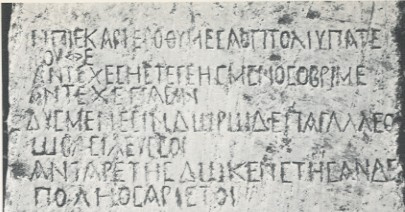
Inscription
Ἤπιε, καρτερόθυμε, σαόπτολι, ὕπατε / Ῥοῦφε, /
ἄντεχε, σῆς Τεγέης μένος, ὄβριμε, / ἄντεχε πᾶσιν /
(5) δυσμενέσιν, δώρῳ δ’ ἐπαγ(ά)λλεο / ᾧ βασιλεύς σοι / ἀντ’ ἀρετῆς δῶκεν, στῆσαν δὲ / πόλεος ἄριστοι.
Inscription translation
Gentle, strong-minded, protecting, consul Rufus, resist, you, the courage of your Tegea, resist, vigorous man, all enemies, and exult in the gift that the emperor bestowed on you for your virtue, and which the notables of the city set up.
Bibliography
- Inscriptiones Graecae, V, 2, 153
- Feissel, D. & Philippidis-Braat, A., Inventaires en vue d’un recueil des inscriptions historiques de Byzance, 3. Inscriptions du Péloponnèse, (à l’exception de Mistra)., Travaux et mémoires, 9, Paris 1985, 267-395, 292-3 no. 32
Discussion
INSCRIPTION
Verse inscription of two elegiac distichs, laid out in eight lines:
Ἤπιε, καρτερόθυμε, σαόπτολι, ὕπατε / Ῥοῦφε, /
ἄντεχε, σῆς Τεγέης μένος, ὄβριμε, / ἄντεχε πᾶσιν /
(5) δυσμενέσιν, δώρῳ δ’ ἐπαγ(ά)λλεο / ᾧ βασιλεύς σοι /
ἀντ’ ἀρετῆς δῶκεν, στῆσαν δὲ / πόλεος ἄριστοι.
'Gentle, strong-minded, protecting, consul Rufus, resist, you, the courage of your Tegea, resist, vigorous man, all enemies, and exult in the gift that the emperor bestowed on you for your virtue, and which the notables of the city set up'.
DESCRIPTION (from Premerstein 1912 and the published photo)
Besides the photo of the epigraphic field reproduced by Feissel 1985 pl. 5.1, there are no published images of this base. It is described as rectangular by Premerstein, ÖJH 1912, 215. The epigraphic field appears smoothly finished; it is not framed and the text is set out across the entire face of the base, extending to the very edge on the right. From the fact that the permission of the emperors is recorded, Feissel deduced that the base must have been for a bronze statue (Feissel 1985, 293; cf. Premerstein 1912, 216-7; Feissel 1984, 545-558).
PROVENANCE AND CURRENT LOCATION
The base was found 50 m northwest of the Episkopi church outside modern Tegea (Feissel 1985, 32; Arbanitopoulos 1906, 27), in the area of the ancient forum and theatre. There is no published record of its present location.
HONORAND, AWARDER AND DATE
Premerstein 1912 argued that the text must date later than the mid 4th century because of the imperial permission mentioned in it, and connected the allusions to military action and virtue with the invasion of the Visigoths under Alaric in 395. The single emperor referred to in the text would then be Arcadius. This view has been broadly accepted. Difficulties however arise from the honorand's title, ὕπατος, hupatos, consul, since no consul of that name is recorded at the end of the 4th century. Premerstein 1923, 77 tried to resolve this problem with the suggestion that Rufus held an honorary consulate offered to him by the emperor Arcadius, or was a consul suffect. Feissel 1985, 292, however, points out that the title of honorary consul is first recorded only under Zeno (474-91). We have followed Feissel, who accepts the date suggested by Premerstein, but with a degree of uncertainty.
The awarders, styled 'the best of the city', are the council (boule of Tegea. For the members of the council being styled ἄριστοι, cf. the inscription of Perpenna Romanus, Sicily (LSA-1515).
Discussion references
- Feissel, D. 'Notes d' Épigraphie chrétienne', Bulletin de Correspondance Hellénique 108, 545-579, Paris 1984, 545-58
- Premerstein, A. v., 'Griechisch-Römisches aus Arkadien', Jahreshefte des Österreichischen Archäologischen Instituts 15, 197 - 218, Wien 1912
- Premerstein, A. v., Zu den inschriften der Ostgermanen, Zeitschrift für deutsches Altertum und deutsche Litteratur 60, 1923, 71-80, 77-8
- Αρβανιτόπουλος, Α. Σ., Ανέκδοτοι Επιγραφαί και πλαστικά Μνημεία Τεγέας, Εφεμερίς Αρχαιολογική 25-66, 1906, 27-9
Cite: Last Statues of Antiquity, LSA-432 (Ulrich Gehn).