
LSA-436
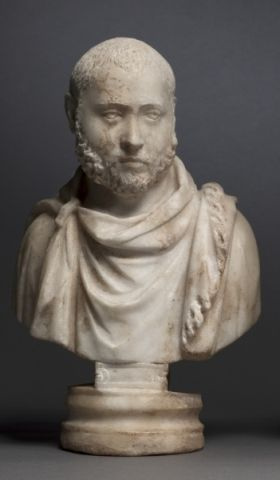
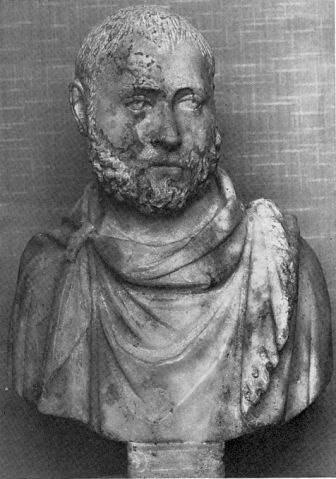
Small bust of man in fringed chlamys from group of six. From Asia Minor. Late third century.
Record details
Photographs
Bibliography
- Inan, J. & E. Alföldi-Rosenbaum, Römische und frühbyzantinische Porträ̈tplastik aus der Türkei : neue Funde, Mainz 1979, 323-4, no. 320, pls. 226.1, 229.1, 230.1-2
Discussion
DESCRIPTION (Object)
Miniature bust. H: 33.5, W: 21 cm. H (chin to crown): 12.5 cm. Fine-grained white marble.
The bust is completely preserved. The surface is polished. The back of the bust has been hollowed out and has a spine. The flat chisel has been used to engrave the hair on the head and eyebrows. The pupils are marked by drill points. The drill has also been used in the fringe of the cloak and in the beard.
PROVENANCE
Asia Minor. Said possibly to have come from western Phrygia. It was part of a coherent group of six small busts (see also LSA-433, LSA-434, LSA-435, LSA-437, LSA-438). These busts appeared on art market with figures from the story of Jonas and a statuette of the Good Shepherd.
DESCRIPTION (Subject)
The portrait bust shows the same man as LSA-437 and LSA-438. He wears an inner garment and a fringed cloak. The cloak is fastened on the right shoulder by a long rectangular fibula. It forms a tall border around the neck.
The head turns to its left. The man has short hair which comes forward and recedes sharply at the temples. He has a short moustache but a full beard; it is especially voluminous around the jowls. The face is broad with small eyes and a small mouth. The nose has a deep indentation at the root.
The bust rests on a thick cylindrical foot which has simple mouldings. Between the bust and the foot the spine is faced by a tabula. The curving lateral sides of the tabula are indicated by engraved lines but are not drilled out.
DATE
The hair and beard style compare well with coin portraits of Carinus, emperor 282-284. They were probably an option that existed both before and after the short-lived Carinus.
The hairstyle of the female portraits found with this (LSA-433, LSA-434, LSA-435) probably also belongs in the last quarter of the third century.
Inan and Rosenbaum place the Cleveland group of busts between 270-290.
FORM AND CONTEXT
Three pairs of miniature busts of the same couple are assuredly from a private, possibly funerary, context. Roman sarcophagi also show the same individual or individuals represented in different dress on the same monument.
Cite: Last Statues of Antiquity, LSA-436 (J. Lenaghan).