
LSA-44
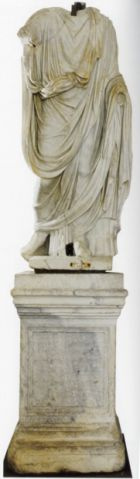
Toga statue of Quintus Flavius Maesius Lollianus signo Mavortius. From Puteoli (Campania). 334-342
Record details
Photographs
Bibliography
- Camodeca, G., 'Ricerche su Puteoli tardoromana (fine II-IV secolo)', Puteoli, IV (1981) 59-128, 100 ssq. nr. 1
- Gehn, U., Ehrenstatuen in der Spätantike. Chlamydati und Togati, Wiesbaden 2012, 514-18 cat. no. W 5
- Zevi, F. [et al.]., Museo Archeologico dei Campi Flegrei: Castello di Baia. II. Catalogo generale. Pozzuoli., Naples 2008, 152-3 (R. Marchesini)
Discussion
DESCRIPTION (Object)
Over life-size statue; the head was destroyed in the early 20th century. H: 200, W: 89, D: 58 cm. White marble.
The head was worked separately and inserted into a socket. It was destroyed in the early 20th century. Both arms were worked separately and are missing. The plinth is cracked and was repaired with clamps. The plinth is undercut on both sides.
PROVENANCE
The statue was found in 1704 with its base, LSA-43. They were found on the property of Pedro de Toledo which was located near the church of San Giuseppe.
DESCRIPTION (Subject)
The togate statue was identified by its base as Quintus Flavius Maesius Lollianus signo Mavortius. The right arm gestured away from the body; the left arm rests by the side. The weight is over the left leg, and a bundle of scrolls serves as the statue support on the outside of that leg.
The head was described by Fuhrmann in 1941 as stylistically different from that of C. Caelius Saturninus signo Dogmatius, LSA-903. Blanck in 1969 writes that he was told by Mustilli that it was in the Antiquario at Pozzuoli.
DATE AND HONORAND
Quintius Flavius Maesius Lollianus (PLRE I, 512-513, Lollianus 5) was honoured with statues in Rome LSA-1426, in Suessa Arunca LSA-1970, and at least four times (each time by a different region) in Puteoli as a patron (see LSA-43, LSA-47, LSA-332 and LSA-1909). This base, as all of the honours from Puteoli, cites his proconsulship of Africa in 336-7 but not his prefecture of the city of Rome in 342. Thus, it should date between 336-342.
The style of the dress and technique of the togate statue places its date of creation in the first century—according to Goette, in the last quarter of the century.
COMMENT
This monument is one of four. Of the four, another was found in the same state of preservation (see LSA-1124 andLSA-1909). Both of these monuments re-use a high-imperial togate statue which was apparently a highly satisfactory and traditional body type for senators in the fourth century; see, for example, LSA-46.
Discussion references
- Blanck, H., Wiederverwendung alter Statuen als Ehrendenkmäler bei Griechen und Römern, Rome 1969, 35-6, no. A 9, pl. 8a
- Dubois, C., Pouzzoles antique (histoire et topographie), Paris 1907, 421, no. 23
- Fuhrmann. 'Archäologische Funde. Italien, Libyen', Archäologischer Anzeiger, Berlin 1941, 614-615
- Goette, H.R., Studien zu römischen Togadarstellungen, Mainz 1990, 129, no. Ba 321 (Flavian)
Cite: Last Statues of Antiquity, LSA-44 (J. Lenaghan).