
LSA-440
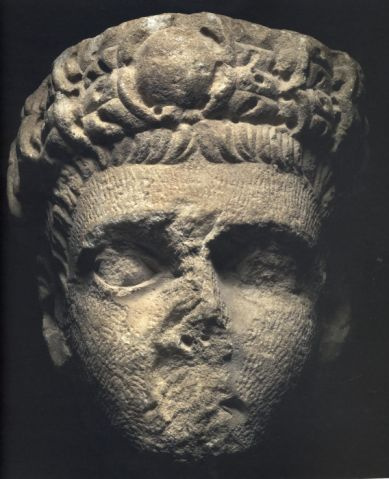
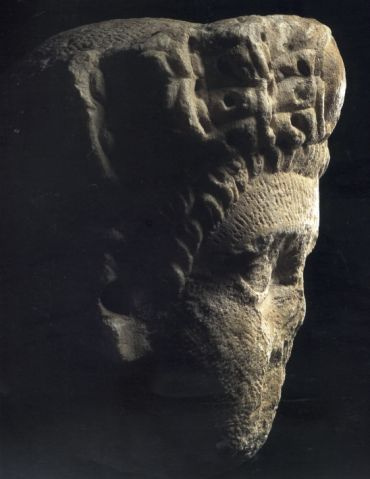
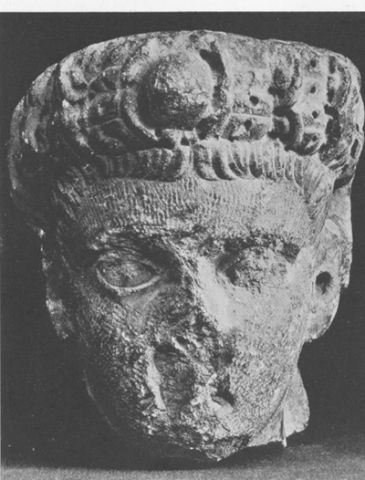
Re-cut portrait head of Emperor with corona civica. From Asia Minor. Mid-fourth century.
Record details
Photographs
Bibliography
- Delbrueck, R., Spätantike Kaiserporträts. Von Constantinus Magnus bis zum Ende des Westreichs , Leipzig 1933, 161-2, figs. 55-6
- Maischberger, M., Konstantin in Berlin, Milan 2006, 32-3, 43, no. 8 (A. Effenberger)
Discussion
DESCRIPTION (Object)
Over life-size head. H: 27 cm. Marble.
The head is preserved with a fragment of its neck. The nose and outer rim of the right ear are missing. The right eyebrow and the lips are badly damaged. The entire facial surface has been scored with a claw chisel. Only areas beneath the eyes and alongside the nose preserve the original finished skin surface.
The hair, above the wreath, is worked flatly with a claw chisel, and below the wreath, locks are rendered with a flat chisel. The wreath itself has some drill work. The eyes are large but preserve no markings.
The head has been re-worked from an earlier head. Both the wreath and the ears are too large for the present face.
PROVENANCE
Purchased in Istanbul in 1907 by Theodor Wiegand.
DESCRIPTION (Subject)
The head, which turns slightly to its left, depicts a clean-shaven young Emperor with short hair wearing a corona civica. The corona civica consists of a double row of laurel leaves, a central jewel, and ties at the back.
The young Emperor has short hair which is combed forward onto the brow. The locks part over the nose and are C-shaped, pointing downwards, around the temples. The face is triangular. The brow is broad and flat and the lower face small and tapering to the chin. The eyes are large and round with pointed inner canthi. The mouth was short and preserves downturned corners.
DATE
The traditional corona, lack of beard, and combed forward short hair place the portrait in the early fourth century. In 1933 L’Orange considered the original portrait to have been Julio-Claudian but re-used in the Tetrarchic or early Constantinian period. In his later work he considered it a son of Constantine. The hairstyle seems most closely related to another imperial portrait, now in the Louvre, LSA-563.
For this author there remains doubt as to whether the claw-chisel work over the face reflects an unfinished re-use or a deliberate defacement. All scholars to date have called it unfinished, and A. Effenberger has recently suggested that the portrait may have been intended to represent Crispus who was executed before it was finished. Whether unfinished or defaced, Licinius II (compare, for example, LSA-334) and Constans would seem equally possible candidates.
Discussion references
- Calza, R., Iconografia Romana Imperiale. Da Carausio a Giuliano (287-363 d. C.), Rome 1972, 277-8, no. 189, pl. 97,347
- Demandt, A. and J. Engemann, (eds.), Konstantin der Grosse, Mainz 2007
, no. I.9.44 (A. Effenberger:Crispus) - L'Orange, H. P., Das spätantike Herrscherbild von Diokletian bis zu den Konstantin-Söhnen, 284-361 n. Chr. Das Römische Herrscherbild. III. Abteilung ; Bd. 4 , Berlin 1984, 129, pl. 45b (Constantinian)
- L'Orange, H. P., Studien zur Geschichte des spätantiken Porträts, Oslo 1933, 57-58, 137, no. 84, fig. 160 (Tetrarchic to early Constantinian)
Cite: Last Statues of Antiquity, LSA-440 (J. Lenaghan).