
LSA-442
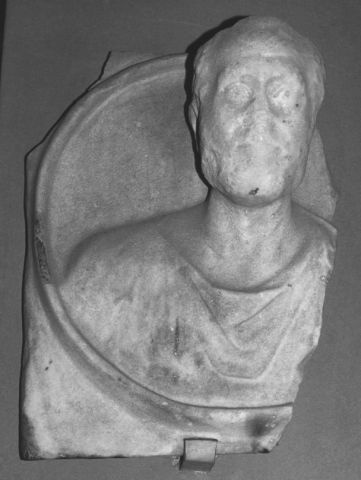
Shield portrait of bearded man. Constantinople. Fourth century?
Record details
Photographs
Bibliography
- Macridy, T. 'Erwerbungen des kaiserl. ottomanischen Museums in Konstantinopel im Jahre 1911' , Archäologischer Anzeiger, Berlin 1912, 585 no. 12 (second-third century)
- Mendel, G., Musées Impériaux Ottomans. Catalogue des sculptures grecques, romaines, et byzantines I-III, Constantinople 1912-1914, III, p. 519, no. 1309 (second-third century)
Discussion
DESCRIPTION (Object)
Shield portrait. H: 56, W: 42.5, D (of background): 4 cm. Large-grained white marble.
Missing are: the proper right upper corner of the shield, the proper left corner with the shield background, the proper bottom left corner with the left shoulder of the portrait, and the nose. The face is heavily worn.
No drill work is visible in hair. The pupils are virtually illegible but there are clear drill points at the inner canthi of the eyes.
PROVENANCE
Found in the Vefa quarter of Istanbul.
DESCRIPTION (Subject)
The shield portrait shows a man in a chiton and himation, the very edge of which is preserved on his left shoulder. The chiton is rendered flatly and in a series of simple repeating folds. He has untidy hair which recedes at the corners of the brow and a medium-length beard. The skeletal structure pushes through the skin; the eye area is hollow but the lower ridge of the brow, the cheekbones, and the square jaw line protrude. The forehead has a deep crease, and the naso-labial folds are indicated. The eyes have a high-arching upper lid, and a straight lower lid with pronounced canthi.
DATE
Here there is not enough of the face preserved (and or published) to make conclusive remarks on the date. However, shield portaits were particularly popular in late antiquity; see the group at Aphrodisias (LSA-206, LSA-207, LSA-210, LSA-211, LSA-212, LSA-213) and another from the Rome area (LSA-2109, LSA-2287, LSA-2440, LSA-2441, LSA-2511).
The simple schematic rendering of the chiton of this shield portrait plus the shape of the eyes and a general sensation that this represents a spare older man suggest a late date.
HONORAND
Frequently shield portraits erected in private houses showed great cultural men of the past (see the examples cited above). Here the hair-and beard-style are too classical and too standard to men of the Greek east to be easily defined as a portrait of a contemporary or a portrait of a past cultural figure.
Cite: Last Statues of Antiquity, LSA-442 (J. Lenaghan).