
LSA-443
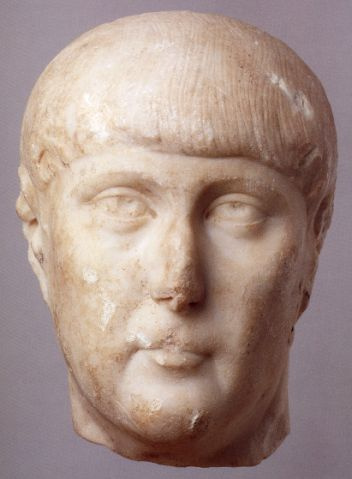
Portrait head of clean-shaven man. From Constantinople(?) Fourth to early fifth century.
Record details
Photographs
Bibliography
- Ortiz, G., In pursuit of the absolute : art of the ancient world : the George Ortiz collection , Bern 1996, no. 245
Discussion
DESCRIPTION (Object)
Over life-size head. H: 29 cm. Fine-grained marble.
The head is broken through the middle of the neck. The tip of the nose and the shells of the ears are chipped.
The hair is finely engraved with a flat chisel. The irises are also indicated by fine lines. The pupils are drilled out in a crescent-shape. The inner canthus of the right eye is defined by an engraved line, and the inner corner of that eye is marked by a drill point.
The head has been re-worked from an earlier head. Deep drill channels of the hair of the original portrait are visible at the corners of the brow; original locks are also visible at the back of the head according to Ortiz. The high placement of the ears also belongs to an earlier use.
PROVENANCE
According to the owner Ortiz, the head is allegedly from Constantinople.
DESCRIPTION (Subject)
The head, which turns slightly to its left, depicts a man with a full, clean-shaven face and hair that is brushed forward in long thin locks.
Most of the forehead is covered by the hair which reaches almost to the eyebrows. The fine eyebrows follow a low arch. The eyes are narrow and small. The nose also is fine and short. The mouth is small, and the lower lip pouts. The cheeks are large and flat. Beneath the eyes the skin indents and sags, and there are creases at the corners of the mouth.
DATE
The flat, combed forward hair, recalls imperial portraits of the Valentinian and Theodosian period; for example, LSA-578, LSA-589, LSA-337, and LSA-754. For these reasons, it should be placed between c. 370 and c. 410. LSA-1065 provides an example of a similar private portrait.
Cite: Last Statues of Antiquity, LSA-443 (J. Lenaghan).