
LSA-446
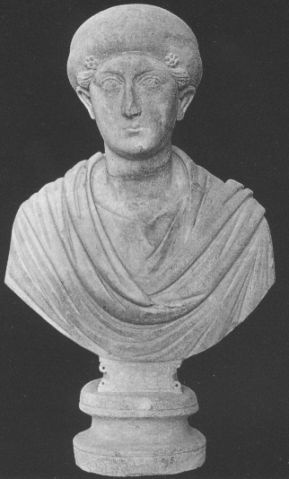
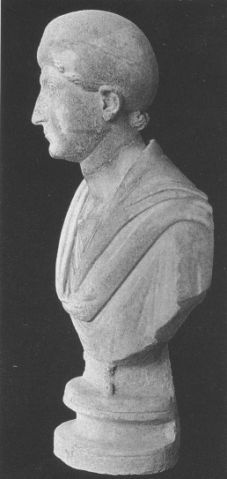
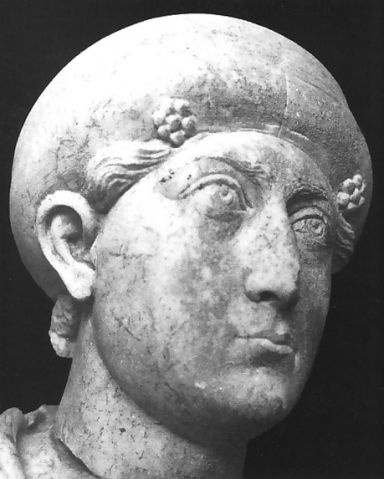
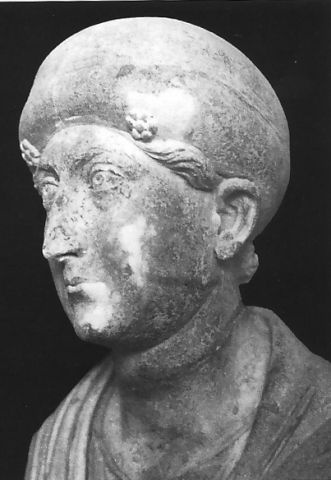
Portrait bust of woman wearing head covering. From Stratonicea. Fifth century.
Record details
Photographs
Bibliography
- Özgan, R., Die Skulpturen von Stratonikeia. Asia Minor Studien, vol. 32, Bonn 1999, 135-6, no. K 51, pl. 47a-d
- Özgan, R. and D. Stutzinger. 'Untersuchungen zur Porträtplastik des 5. Jhs.n.Chr. anhand zweier neugefundener Porträts aus Stratonikeia. ', Istanbuler Mitteilungen 35, 237-274, Istanbul 1985, 237-8, 240-41, pl. 51.1-3
Discussion
DESCRIPTION (Object)
Life-size bust worked together with tabula and foot. H: 67, W: 41 cm. H (chin to crown): 22.7, W (of head): 19.5 cm. H (of foot and tabula): 15 cm. Greyish, fine-grained hard marble.
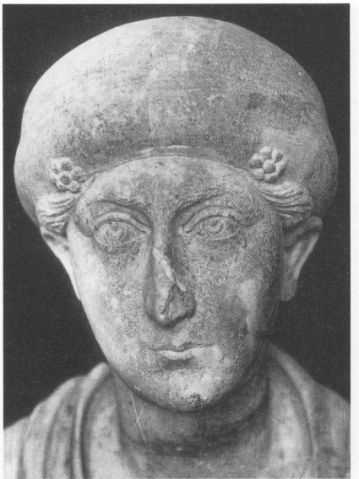
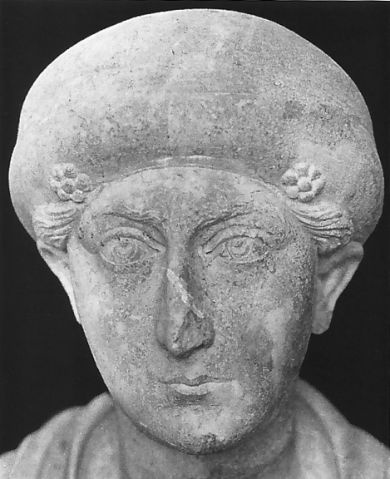
The head is broken from the bust but has been reattached. The tip of the nose is chipped. The surface is weathered.
The back of the bust has been hollowed and fully finished. It features a spine which does not flare. The back of the foot has worked down to a flat surface. The folds of the himation are flatly rendered and defined by channels made with a bull-nosed chisel. The U-shaped pupils seem to have been made with a narrower version of the same tool. The hair and eyebrows are rendered with a flat chisel as are the eyelids and semicircular irises. The scrolls on the sides of the tabula have been fretted with a drill.
PROVENANCE
The bust was found in 1978 with LSA-447 near a water basin at the city-gate in a rubble layer. The gate was constructed in the second century but was refurbished with a complicated water system later. Özgan and Stutzinger (p.238) suggest that this couple may have been involved in the financing of this remodelling of the Gate.
DESCRIPTION (Subject)
The life-size bust shows a woman, turned slightly to her right, who wears a tight bonnet, a cloak, and an inner garment. The bust extends from the shoulders to just below the breasts. It rests on a moulded foot, the front of which curves. A blank tabula makes the transition between draped bust and foot.
The face is oval in shape and lacks modelling. The facial features have a stylized quality. The face is long, and the nose is equally long and narrow. The eyebrows are arched and the eyes large with particularly pointed inner canthi. The mouth is bow-shaped with gently upturned corners and narrow lips. It is set in an immobile and undefined lower face.
The bonnet, made of a thick concealing cloth, sits low on the forehead and covers most of the hair. At the temples some long hair, which is pulled backwards, appears out from under the bonnet. Directly above where this hair emerges is a decorative flower on each side. It is probably intended to be jewellery or embroidery. At the nape of the neck five thick but short, corkscrew locks appear out from under the bonnet. The bonnet itself features two narrow bands. One runs above the ears. The other runs across the brow, to which are probably attached the decorative flowers.
DATE
On its own the portrait bust would be difficult to date. However, its find location with the bust LSA-447 and its technical similarity to that bust (especially, the eyes and eyebrows) strongly suggests that the two were pendants. The comparanda for the male head belongs in the fifth century, probably near the middle of the century.
The bonnet as an important fashion item appears in portraits that seem to belong to the second half of the fifth century or later (see, for example, LSA-8 and LSA-756)
Discussion references
- Schade, K., Frauen in der Spätantike--Status und Repräsentation, Mainz 2003, 212-213, no. I 52, pls. 58.3 and 59.1-3
Cite: Last Statues of Antiquity, LSA-446 (J. Lenaghan).