
LSA-447
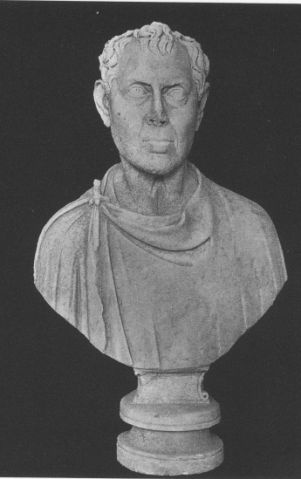
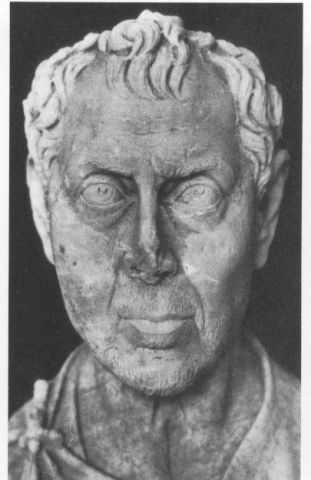
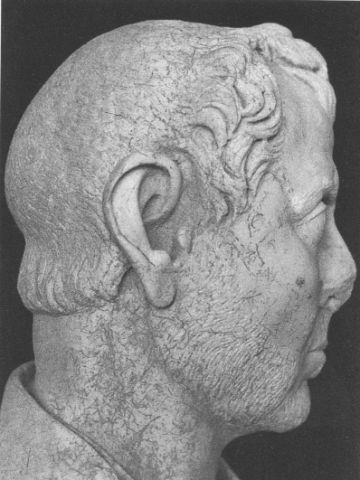
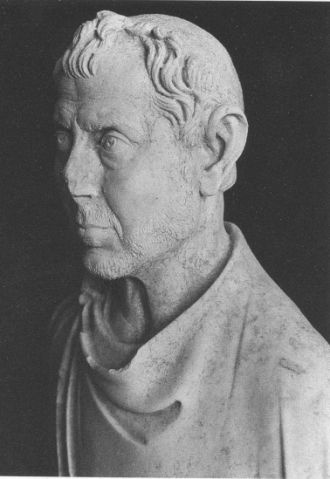
Portrait bust of man in chlamys, perhaps Apollinarius (see LSA-2081). From Stratonicea (Caria). Fifth century.
Record details
Photographs
Bibliography
- Özgan, R., Die Skulpturen von Stratonikeia. Asia Minor Studien, vol. 32, Bonn 1999, 134-5, no. K 50, pl. 46
- Özgan, R. and D. Stutzinger. 'Untersuchungen zur Porträtplastik des 5. Jhs.n.Chr. anhand zweier neugefundener Porträts aus Stratonikeia. ', Istanbuler Mitteilungen 35, 237-274, Istanbul 1985, 237-40, pl. 50
Discussion
DESCRIPTION (Object)
Life-size bust worked together with tabula and foot. H: 72, W: 44 cm. H (chin to crown): 24.7, W (of head): 19.7 cm. H (of foot and tabula): 16 cm. Greyish, fine-grained hard marble.
The object is broken between the lower edge of the draped bust and the upper edge of the tabula. The two parts have been reattached. The tip of the nose is chipped, and the scrolls on the proper right side of the tabula have broken off.
The bust was worked in one piece from the foot to the top of the head. The back of the bust is not shown in the published photographs, nor described, but presumably, like LSA-446, it was hollowed out, fully finished, and featured a spine. The back of the foot has been worked down to a flat, rather than rounded, surface. The back and top of the head have been rounded and smoothly finished but have been given no representational detail.
The folds of the himation are flatly rendered and defined by few and angular channels. The U-shaped pupils seem to have been made with a bull-nosed chisel. The hair at the nape of the neck and behind the ears is rendered with a flat chisel. The eyebrows and beard are rendered even more carefully with a fine flat chisel, as are the semicircular irises and a line below the lower lid. A drill channel separates the eyebrows from the upper eyelids. The locks of hair around the brow are also defined by the drill; bridges are visible over some channels. The scrolls on the sides of the tabula have also been drilled out.
PROVENANCE
The bust was found in 1978 with LSA-446 near a water basin at the city-gate in a rubble layer. The gate was constructed in the second century but was refurbished with a complicated water system later. Özgan and Stutzinger (p.238) suggest that this couple may have been involved in the financing of the later remodelling of the Gate.
DESCRIPTION (Subject)
The life-size bust shows a man with receding hair and a finely engraved beard. He is dressed in a cloak which is fastened at the right shoulder with a brooch. The bust sits immediately above a blank tabula which is mounted on a moulded foot, the front of which curves.
The neck is modelled but stiff. It features projecting tendons and the indentation between them at the neck, as well as flaps of skin hanging from the chin. The head itself seems to turn slightly to its left. The face is long with projecting large ears and prominent cheekbones. It is marked by signs of age; deep naso-labial folds, sagging skin below the eyes, creases across the brow, and hair receding at the temples. The eyebrows flare over large stylized eyes which have emphatically marked pupils. The lips are bow-shaped, and the lower lip particularly full. The hair over the brow, distinctively recedes at the corners and comes forward in four defined locks at the centre. The hair been combed forward from the top of the head and has curl and movement; both effects created by careful drillwork.
He wears a flat, heavy, virtually unmoving cloak or chlamys. It is held together at the right shoulder by a cross-shaped fibula. Underneath the fibula, the neckline of the undergarment, tunic or chiton, is visible at the right shoulder. This garment covers the entire right upper arm and has more folds than the cloak, indicating that it is of a finer material.
DATE
In terms of hair fashion (brushed forward and with an engraved beard) and technique (drillwork around the brow, rounded back of head, and flat folds) the bust recalls many other late-antique portrait images. Several portraits from Aphrodisias, also in Caria, are similar (for example, LSA-181, LSA-182, and especially LSA-169). These are generally dated to the fifth century. The cross-form of the fibula also supports a late date.
An architectural block, found in 2006, LSA-2081commemorates the dedicator of the new water system and may have carried an image. It should date between the middle of the fifth century and 498. Though possible, a secure connection between the portrait and the text cannot be made.
Discussion references
- Meischner, J., Bildnisse der Spätantike : 193-500 : Problemfelder : die Privatporträts , Berlin 2001, 117 fig. 339
Cite: Last Statues of Antiquity, LSA-447 (J. Lenaghan).