
LSA-448
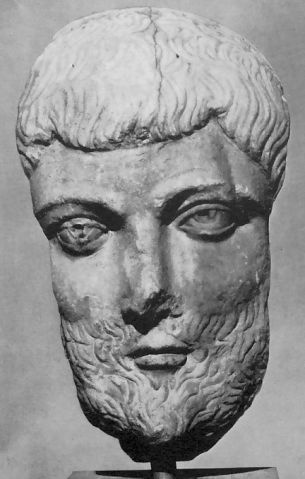
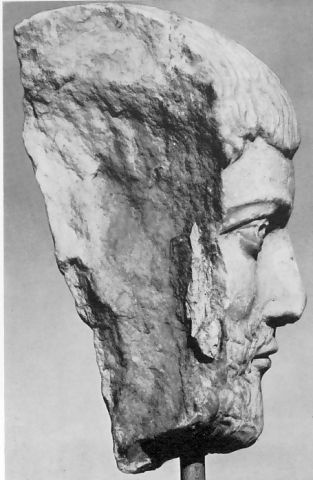
Portrait head of bearded man. Polybotus (Phrygia Salutaris). Later fourth to early fifth century.
Record details
Photographs
Bibliography
- Inan, J. and E. Rosenbaum, Roman and Early Byzantine Portrait Sculpture in Asia Minor, Oxford 1966, 189-190, no. 259, pl. 183.3-4 (third quarter of 5th c.)
Discussion
DESCRIPTION (Object)
Over life-size head. H: 31.5, W: 14.2 cm. Fine-grained white marble.
The head is broken through the neck and in two diagonal, convergent planes at the sides. Essentially only the face and hair over the brow are preserved. The tip of the nose is chipped.
The hair on the head and face is defined with fine, curving, flat chisel work. The pupils of the eyes are deeply drilled. The irises are incised and small; they do not touch the lower lid.
The portrait has been re-cut out of another head. The small mouth and the ornately inscribed beard and moustache indicate this.
PROVENANCE
From modern Bolvadin, ancient Polybotus.
DESCRIPTION (Subject)
The head shows a mature man with full hair that is combed forward and with a beard and moustache which lack volume but are medium-length. The hair recedes slightly above the temples.
The face is oval and has high-arching eyebrows and an emphatic line above each upper lid. The nose is straight, and the mouth is unusually small.
DATE
The fashion style of the beard and the length hair are similar to the portrait of Virius Audentius Aemilianus (LSA-46) which is dated by its base (LSA-41 ) to c. 364-379. A similar style can be found on the consular diptych of Fl. Constantius Felix, AD 428 [see W.F. Volbach, Elefenbeinarbeiten der Spätantike und des frühen Mittelalters, (Mainz 1976), 30, no. 2, pl. 2], and in the portrait of Oecumenius LSA-150 from Aphrodisias (and LSA-869 from Cyprus), Oecumenius, identified by his base at Aphrodisias (LSA-150), should be dated to the late fourth or early fifth century.
Cite: Last Statues of Antiquity, LSA-448 (J. Lenaghan).