
LSA-449
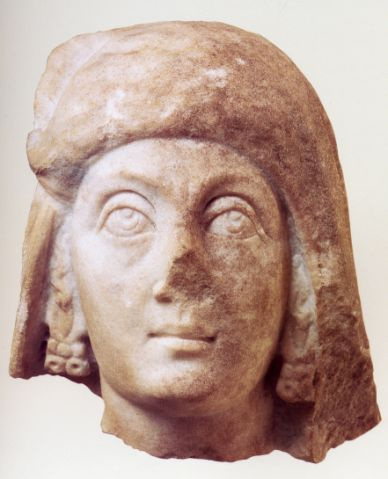
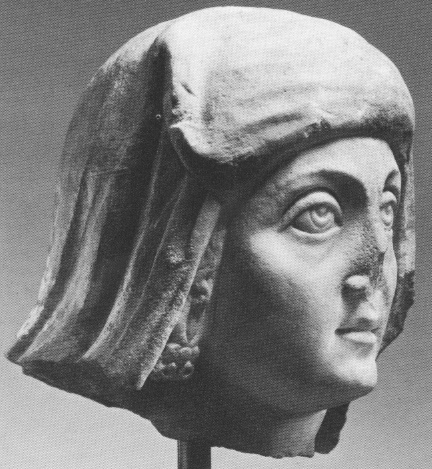
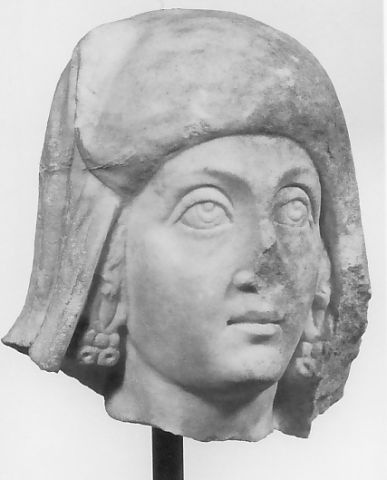
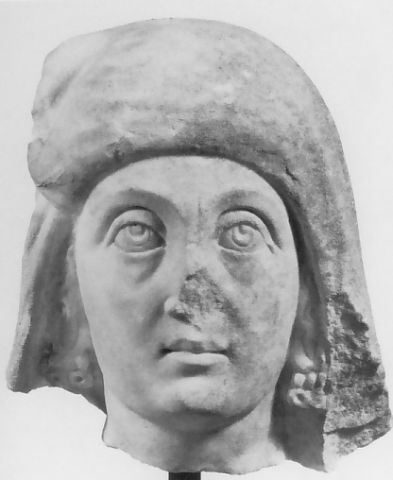
Portrait head of woman with veiled head. From Pamphylia. Fifth century to sixth century.
Record details
Photographs
Bibliography
- Ortiz, G., In pursuit of the absolute : art of the ancient world : the George Ortiz collection , Bern 1996, no. 251 (Virgin?)
- Schade, K., Frauen in der Spätantike--Status und Repräsentation, Mainz 2003, 226-7, no. I 66, pls. 66 and 67.1
Discussion
DESCRI PTION (Object)
Over life-size head, broken from statue. H: 27.1 cm. Large-grained white marble with bluish vein.
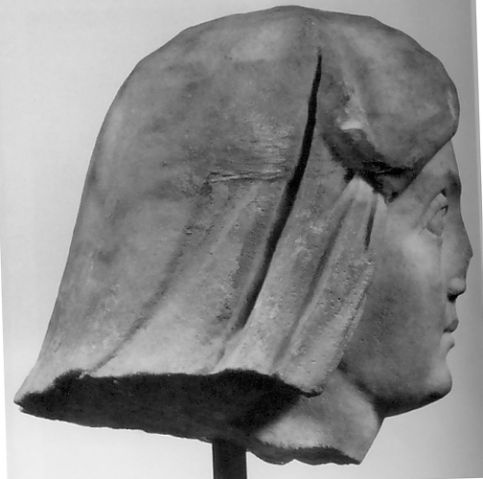
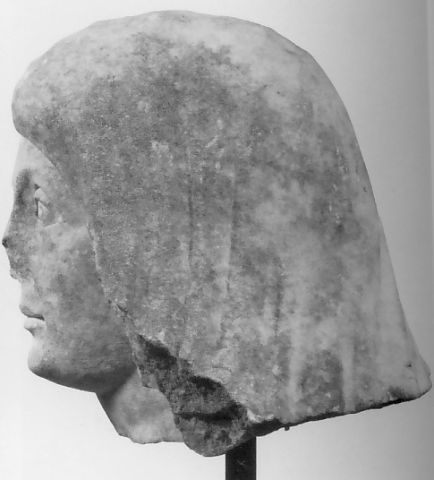
The head is broken through the base of the neck. The tip of the nose, an element on the right side of the veil, and the bottom of the fold on the left side of the neck are chipped.
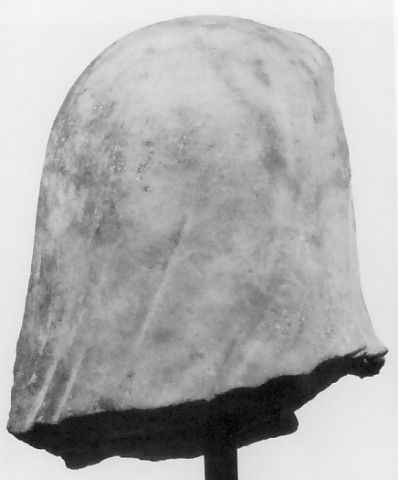
The irises and the lines defining the upper edge of the upper eyelids are engraved with a flat chisel. The irises are three-quarters of a circle and do not touch the bottom lids. The pupils have a semi-circular form and appear to be drilled out with a bull-nosed chisel. There are drill points at the corners of the mouth. The drapery at the back of the head is fully but flatly rendered.
This author believes that this head may have been re-worked from an earlier draped portrait. (1) The drapery arches over the brow in the manner of a hairstyle. This area is recessed in relationship to the rest of the veil and may once have been the element of hairstyle not covered by the drapery. (2) On draped heads often the folds at the sides, which distinguish front from back, are deeply cut. In this head, this is visible on the right profile. (3) On this head the right profile shows traces of a large fold, usually the edge of the himation which falls vertically, but here ends abruptly, yielding to smaller folds on a recessed plane below it. (4) On female heads with hairstyles that cover most of the ears or even toupee styles, the area of immediately in front of the ears is left visible. Here locks meld with earrings probably because the ends of locks have been transformed into earrings.
PROVENANCE
According to the owner Ortiz, the head is allegedly from Pamphylia.
DESCRIPTION (Subject)
The head portrays a woman whose himation is pulled upwards to cover the head. It probably came from a draped statue in which the right arm was free of the himation and which possibly turned to the left.
The himation was almost certainly wrapped first around the left shoulder. Its folds rise up from a forward position on the left shoulder and move distinctly to the right. On the right side they are set further back against the face and pull away from the head. This occurs, for example, often in Ceres type statues (see, the Sabina or Julia Domna statues in Ostia)
The hair is completely covered except around the ears where long curling strands hang in front of large earrings. The earrings consist of long tripartite strand that terminates in three spheres below which are two circular loops.
The face is long with a low brow, flat cheeks, and a projecting chin. The eyes are large with heavy upper lids that are framed by high-arching brows. The mouth is small with full lips. There are bags beneath the eyes and creases at the corners of the nose and mouth.
DATE
The re-cut head is devoid of specific physiognomy, wears ornate earrings (cut from the same block), and features eyes which are marked by concentric cuttings rather than by an arc of a circle and a crescent form. These four details place it in the late-antique rather than high imperial period. The technique of the eyes might even make a fifth-century or later date more probable than a fourth-century one.
Stutzinger and Schade compare it to a female portrait head now in Milan, LSA-760. That head is often identified as Theodora, wife of Julian and Empress from 527-548. The general similarity in physiognomy is not, however, enough to connect the two portraits securely. Moreover, the identification of the Milan portrait with Theodora is only probable.
Discussion references
- Jucker, H. and D. Willers (eds.) , Gesichter : griechische und römische Bildnisse aus Schweizer Besitz: Ausstellung im Bernischen Historischen Museum vom 6. November 1982 bis 6. Februar 1983, Bern 1983, 226-7, no. 96
- Stutzinger, D. (ed.), Spätantike und frühes Christentum. Ausstellung im Liebieghaus, Museum alter Plastik, Frankfurt am Main. 16. Dezember bis 11. März 1984, Frankfurt a.M. (1983), 474-5, no. 77
- Weitzmann, K. (ed.), Age of spirituality : late antique and early Christian art, third to seventh century : catalogue of the exhibition at the Metropolitan Museum of Art, November 19, 1977, through February 12, 1978, New York 1979, 295-6, no. 273
Cite: Last Statues of Antiquity, LSA-449 (J. Lenaghan).