
LSA-450
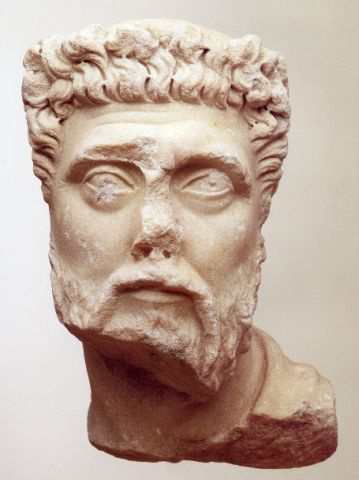
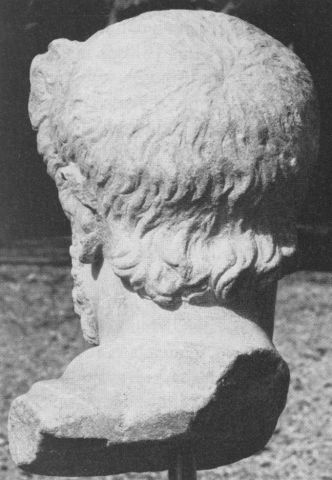
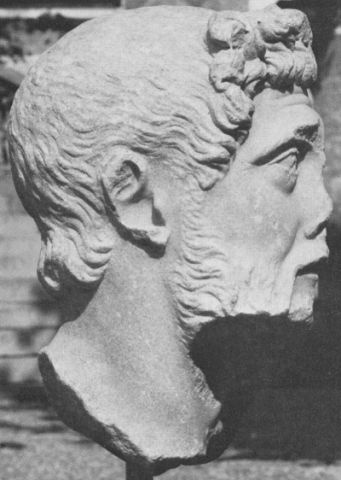
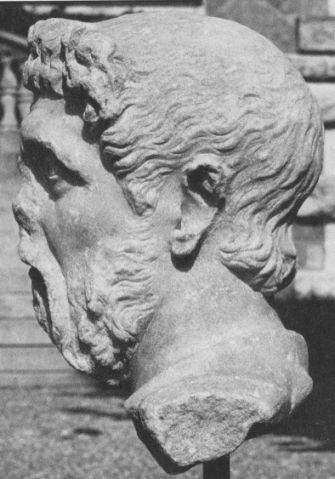
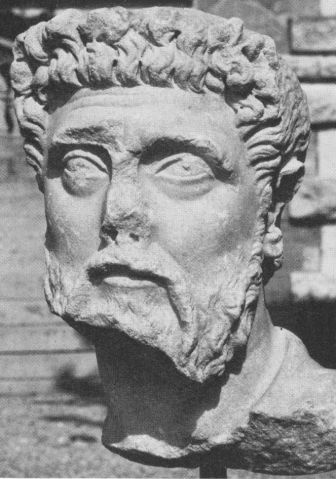
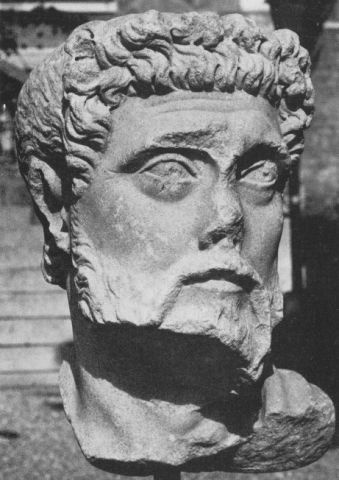
Portrait head of man from bust. From Asia Minor. Late fourth to fifth century.
Record details
Photographs
Bibliography
- Kranz, P, 'Ein Bildnis frühtheodosianischer Zeit in der Sammlung Georg Ortiz bei Genf', Archäologischer Anzeiger, Berlin 1979, 76-103, figs. 1, 10, 13, 16, 18
- Ortiz, G., In pursuit of the absolute : art of the ancient world : the George Ortiz collection , Bern 1996, no. 248
Discussion
DESCRIPTION (Object)
Head and left shoulder of over life-size bust. H: 34.8 cm. Large-grained marble from Asia Minor (according to Kranz, Ephesian).
The head is broken around the base of the neck on its right and front sides and at the middle of the shoulder on its left side. The right eyebrow and nose are chipped. The beard and chin have broken obliquely. The rim of the bust is preserved at the proper back left. The back of the bust was fully hollowed out and finely finished.
The hair around the face is carefully drilled, and bridges have been left over many of the channels. The hair at the back of the head is rendered naturalistically with flat chisels. In the right eye the engraved iris is still visible. The pupils of both eyes are crescent-shaped nicks.
PROVENANCE
Ortiz, the owner, believes the provenance to be Asia Minor. He acquired the head from a Sothebys auction in London (4 December 1972) of the Lansdowne collection. The bust wears a himation and has strong technical and fashion similarities to a series of portraits found in Asia Minor (see below). It therefore probably does not come from main Lansdowne collection which was acquired between 1771 and 1805 in the west. It was not described by A. Michaelis in his inventory of the Lansdowne collection.
DESCRIPTION (Subject)
The head, which turns slightly to its left, portrays a vigorous man of mature age. He wears probably a traditional Greek himation which fits loosely around his neck where it gathers in broad folds.
The broad brow is marked by two creases between and below which the skin bulges. The eyebrows hang over the eyes which are wide-set but not large. The skin follows the shape of eye socket, and there are crow’s feet wrinkles at the corners of the eyes. The moustache and beard are heavy and long. The sterno-cleido mastoids are defined in the neck.
The hair follows the shape of the cranium and indents at the juncture of head and nape. It is brushed forward in long wavy locks from the crown. The locks are cut straight across the brow, and directly over the brow, but not at the temples, the locks pile on top of each other into two tiers of curling ends.
DATE
The fashion style of beard and hair and the drilling of the brow hair are similar to that of the portrait of Oecumenius LSA-150 from Aphrodisias and LSA-869 from Cyprus. Oecumenius, identified by his base at Aphrodisias, should be dated to the late fourth or early fifth century. Such a date seems well-confirmed by the Obelisk of Theodosius in Istanbul on which this fashion style is attested.
Examples of similarly styled portraits are LSA-445, LSA-2282 and LSA-705, all from Asia Minor.
CLOTHING
The drapery around the neck is articulated in broad but differentiated folds. These can only belong to a himation; a chlamys has far fewer folds (pace Kranz who suggests that the bust wore a chlamys like LSA-2282). The himation was the traditional garment of men in the Greek East and continued to be used in late-antiquity; see LSA-218 for discussion. Moreover, if this is truly a bust portrait, it probably belonged to the private sphere.
Discussion references
- Jucker, H. and D. Willers (eds.) , Gesichter : griechische und römische Bildnisse aus Schweizer Besitz: Ausstellung im Bernischen Historischen Museum vom 6. November 1982 bis 6. Februar 1983, Bern 1983, 222-3, no. 95
- Meischner, J., 'Das Porträt der theodosianischen Epoche I (380 bis 405 n. Chr.),' , Jahrbuch des Deutschen Archäologischen Instituts 105, Berlin 1990, 321, fig. 17
Cite: Last Statues of Antiquity, LSA-450 (J. Lenaghan).